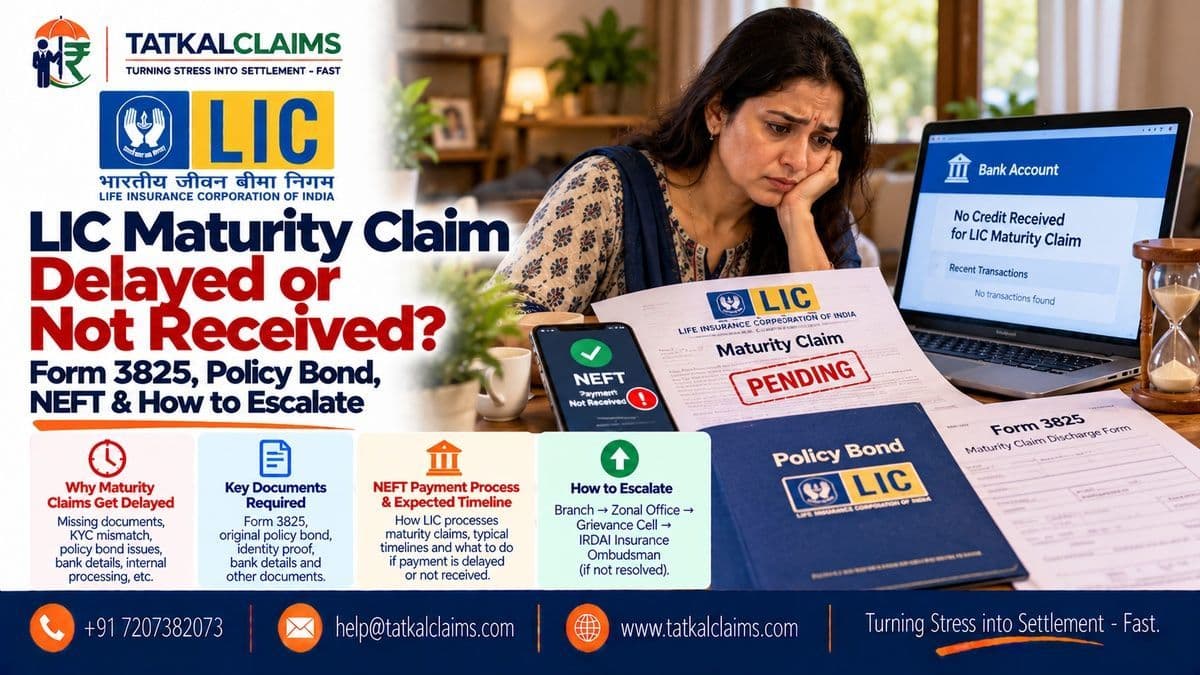
A maturity claim should normally be the simplest LIC claim: the policy reaches its maturity date, the final requirements are already with the servicing branch, and the amount is credited to the policyholder's bank account on the due date. When that does not happen, the delay is often caused by a specific missing link rather than a dispute over whether a death claim is payable.
The useful question is therefore not merely 'why has LIC not paid?' but 'which stage has stopped the maturity claim—maturity intimation, Form 3825, original policy bond, final premium, assignment, KYC, NEFT validation, loan adjustment or the bank credit itself?'
Written by: Tatkal Claims, Claims Review Team
Reviewed by: Ankit L Kanoi, Founder
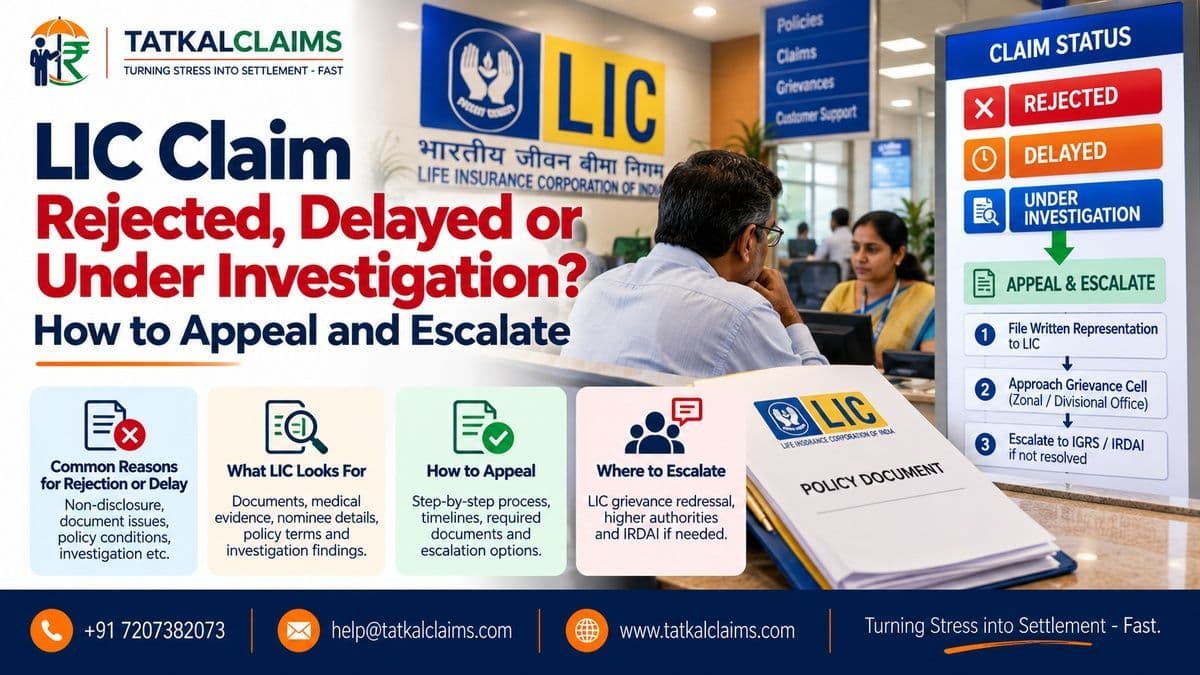
If the problem is broader than a maturity payout—for example an LIC claim is rejected, under investigation or stuck in escalation—see our LIC claim rejection, delay and escalation guide.
Form 3825 Is Still LIC's Current Maturity Discharge Form
LIC's current Download Forms page, updated in April 2026, continues to list Form No. 3825 under 'Maturity Claims'. It says LIC usually sends maturity intimation about two months in advance and asks the policyholder to submit the discharged receipt with the original policy document at least one month before the due date.
I also checked the current four-page Form 3825 PDF linked from LIC's website. It is a maturity discharge receipt that records the matured policy, gross claim components, deductions and the net claim amount, and is signed by the life assured/assignee as applicable.
| Part of form | Why it matters |
| Policy and maturity details | Identifies the matured contract and due date |
| Gross claim amount | Shows sum assured/paid-up value and bonus components |
| Deductions | Can include unpaid premium, late fee, loan, loan interest and other recoverable amounts |
| Net claim amount | What remains payable after adjustments |
| Policyholder / assignee discharge | Acknowledges settlement of the matured policy |
| Witness / authority sections | Used where signatures, thumb impression or multiple claimants require attestation |
What LIC Currently Asks For Before Maturity Payment
| Requirement | Current LIC position |
| Form 3825 | Current maturity discharge receipt |
| Original policy document / bond | Normally requested for regular maturity settlement |
| NEFT mandate | Bank account particulars for direct credit |
| Bank proof | Cancelled cheque or passbook/cheque-book page showing account details |
| KYC | LIC's current claims guidance says KYC requirements may be called for |
| Proof of age | May be required if age was not admitted earlier |
| Assignment documentation | Relevant if policy is validly assigned and payment is due to assignee |
| Final premium position | Must be reconciled if LIC's records show the last premium unpaid |
The Maturity Intimation Timeline Is Not the Same as the Payment Due Date
LIC's Download Forms page says the servicing branch usually sends maturity claim intimation two months in advance. LIC's 2024 Citizens' Charter separately sets a benchmark of policy-payment information one month before the due date.
The same Citizens' Charter gives 'On due date' as the benchmark for settlement of maturity claims once the required documents are in place. The practical goal is to get the file complete before the maturity date, not to start chasing documents after it.
| When | What should happen |
| About 2 months before due date | LIC's Download Forms page says maturity intimation is usually sent |
| At least 1 month before due date | Submit Form 3825 + original policy document; also complete NEFT/KYC requirements |
| Before due date | Branch validates documents, premium status, assignment, loan and bank details |
| Maturity due date | LIC's published benchmark is payment on due date |
| If not credited shortly after due date | Check branch claim status and NEFT/bank-credit issue immediately |
If You Never Received the Maturity Intimation
Do not wait for the maturity date to pass. LIC's current forms page expressly tells policyholders to contact the servicing branch if no intimation has been received for a claim due within the next two months.
| Detail | Why |
| Policy number | Locates the servicing record |
| Policyholder name and DOB | Identity verification |
| Current mobile/email/address | Old contact data is a common reason notices are missed |
| Maturity date shown on bond/portal | Confirms timing |
| Premium status | Shows whether final instalments were received |
| Bank account details | Allows NEFT validation before due date |
| Assignment status | Avoids payment going to the wrong entitled party |
NEFT Problems Can Look Like an LIC Claim Delay
LIC's current claims guidance says maturity payment is made directly to the policyholder/assignee bank account through NEFT. The NEFT mandate currently linked from LIC's Download Forms page asks for the bank name, account type, account number, IFSC, mobile/email and supporting bank proof.
The same mandate tells the policyholder/claimant to keep the receiving account operational and to make sure the name under the policy matches the bank-account name; it warns that a mismatch can cause rejection of the bank details.
| Problem | What to check |
| Wrong account number | Compare mandate with cancelled cheque/passbook |
| Wrong IFSC | Use current branch IFSC, especially after bank mergers |
| Closed/dormant/frozen account | Submit a fresh operational account mandate |
| Name mismatch | Correct bank or LIC records as appropriate |
| Old bank details still registered | Submit fresh NEFT mandate before payment |
| Credit sent but not visible | Ask LIC for payment/transaction reference, then check with bank |
What If the Original Policy Bond Is Missing?
LIC's current guidance normally asks for the original policy document for maturity claims, and its policy guidelines describe the bond as an important document required at claim settlement.
A lost bond should be reported to the servicing branch as soon as possible. LIC's current Download Forms page separately lists a questionnaire and Form No. 3756 for duplicate-policy issuance. The exact requirement can depend on the policy and timing, so do not wait until the maturity date to raise the loss.
Why the Maturity Amount Can Be Lower Than Expected
Form 3825 itself shows that a maturity settlement can contain deductions before arriving at the net claim amount.
| Adjustment | Possible effect |
| Unpaid instalment of premium | Deducted from claim if due under policy conditions |
| Late fee | May be recovered where applicable |
| Policy loan | Outstanding loan can reduce maturity proceeds |
| Loan interest | Interest due can also be deducted |
| Age-related recovery | Form includes a field for amount recoverable for understatement of age |
| Other policy-specific adjustments | Depend on contract and servicing record |
If the maturity credit is lower than expected, ask for the maturity calculation sheet rather than assuming the missing amount is a 'short-settled claim'. The branch should be able to show gross benefits, deductions and net amount.
The Final Premium Can Cause a Last-Minute Hold
The current Form 3825 contains a note for cases where LIC's records do not show that the final premium has been paid. LIC may calculate the claim on the assumption that it remains unpaid, but the form also provides for refund/adjustment if the policyholder later proves that the premium was actually paid.
| Evidence | Use |
| LIC premium receipt | Direct proof of payment |
| Bank/UPI/card debit record | Shows money left your account |
| Employer certificate for Salary Savings Scheme | Useful where employer deducted premium |
| Portal premium history | Cross-check LIC system entry |
| Deposit receipt / collection office details | Helps trace an offline payment |
Assignment Can Change Who Is Entitled to the Maturity Money
LIC's maturity guidance refers to payment to the policyholder or assignee. If the policy was assigned—for example to a lender—the branch must first confirm whether the assignment is still effective or has been reassigned/released.
If LIC's records still show an assignment that should have ended, do not merely submit fresh bank details. First get the assignment/reassignment record corrected because entitlement to the maturity proceeds comes before NEFT destination.
Paid-Up Policies Can Still Mature, but the Amount May Differ
A traditional policy that became paid-up can still have a maturity value under its contract even though full premiums were not paid. The amount is not necessarily the original full sum assured plus full projected benefits.
If the maturity figure looks unexpectedly low, first establish whether LIC is treating the policy as in-force, paid-up, revived or otherwise altered. That status often explains more than the payment date itself.
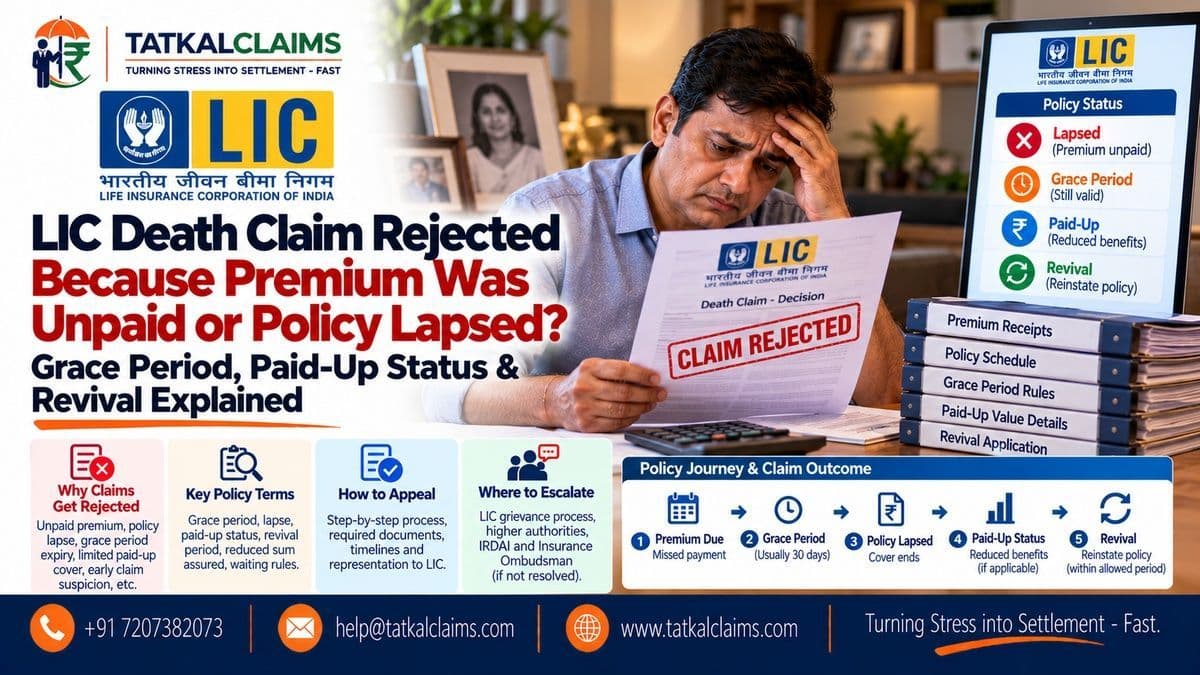
If there is a dispute about unpaid premium, lapse, paid-up status or revival, see our LIC lapse, grace-period and revival guide.
Maturity Amount Due but Not Claimed for a Long Time
If the due date passed months or years ago and the policyholder never completed the maturity requirements, the issue may have moved from an ordinary current maturity claim into an outstanding or unclaimed-amount problem.
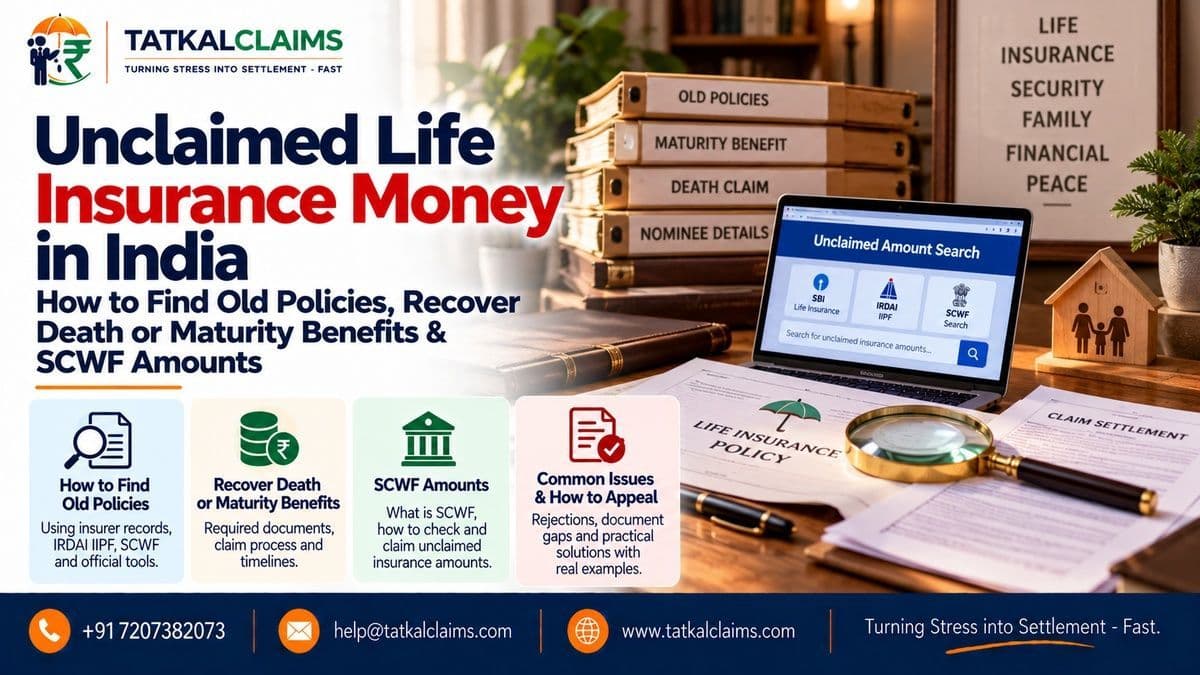
For older unpaid maturity proceeds and tracing unclaimed policy money, use our Unclaimed Life Insurance Money in India guide.
How to Escalate an LIC Maturity Claim Delay
1. Servicing Branch
Ask for a written status showing whether Form 3825, original bond, KYC, NEFT, final premium, assignment and loan adjustments are complete. If anything is deficient, ask for the requirement in writing rather than repeatedly resubmitting the whole file.
2. Branch / Divisional Grievance Redressal
LIC's grievance page identifies the Senior/Branch Manager at branch level and Manager CRM at divisional level as grievance redressal officers. Submit the policy number, maturity date, date all requirements were completed, acknowledgement and bank details.
3. LIC Customer Portal / Central Complaint
LIC allows registered users to lodge and track policy grievances through the Customer Portal and currently publishes co_complaints@licindia.com. Its Customers Corner also lists call centre 022 6827 6827.
4. Bima Bharosa
If the insurer grievance remains unresolved or unsatisfactory, register it through Bima Bharosa so the complaint has an IRDAI-visible trail.
5. Insurance Ombudsman
The Council for Insurance Ombudsmen currently requires a complaint to the insurer first. If you are dissatisfied with the insurer's response or receive no response within 30 days, an eligible complaint can be filed with the Ombudsman, subject to the current ₹50 lakh monetary limit, general one-year filing period and no-parallel-forum condition.
What LIC's Current Complaint Benchmark Says
LIC's 2024 Citizens' Charter says complaints should be acknowledged the same day and action/decision should be communicated within 14 days. If unresolved, the policyholder should also be told about options such as the Insurance Ombudsman or consumer court within that same 14-day framework.
Trace the Payment or the Missing Requirement
Ask the servicing branch for a written status: whether it received Form 3825 and the original bond, accepted KYC and NEFT details, and found any final premium, assignment or loan balance outstanding. Request the gross amount, each deduction and the net amount. If the bond is missing, follow LIC's branch-prescribed duplicate or indemnity requirements rather than repeatedly submitting the same incomplete file.
If LIC says it has paid, obtain the NEFT transaction reference and ask the receiving bank to trace the credit. If the file is complete, the due date has passed and LIC has not transmitted payment or given a clear deficiency, escalate the documented delay through LIC's grievance channels. Preserve the branch acknowledgement and each written response for any later Ombudsman complaint.
Can TatkalClaims Help With an LIC Maturity Claim Delay?
We first locate the break between maturity processing and bank credit. Form 3825, bond receipt, final premium, assignment, loan deduction, NEFT validation and transmission status each point to a different remedy. A written maturity calculation and branch acknowledgement are more useful than a general complaint that payment is late.
Send the policy schedule or bond copy, maturity intimation, Form 3825 acknowledgement, NEFT mandate and LIC's written status to help@tatkalclaims.com, or call +91 7207382073. If LIC has transmitted the correct amount, we will separate a receiving-bank trace from an insurer-delay grievance.
Frequently asked questions
Is Form 3825 still required for LIC maturity claims?
Yes. LIC's current Download Forms page, updated in April 2026, still lists Form No. 3825 as the maturity discharge receipt and asks policyholders to submit it with the original policy document at least one month before the maturity due date.
When should LIC pay a maturity claim?
LIC's current Citizens' Charter gives 'On due date' as the benchmark for maturity-claim settlement, assuming the required documents and servicing conditions are complete.
What if LIC has not credited the maturity amount even though all documents were submitted?
First ask whether the claim is still pending, already admitted, or already transmitted through NEFT. If it remains pending without a valid deficiency, lodge a formal grievance with proof of when the complete requirements were submitted.
Can LIC deduct an outstanding policy loan from the maturity amount?
Form 3825 expressly includes fields for loan and interest deductions before arriving at the net claim amount. Ask for the maturity calculation if the credited amount is lower than expected.
What if I lost the original LIC policy bond before maturity?
Inform the servicing branch immediately. LIC currently lists duplicate-policy forms, including a questionnaire and Form 3756. The branch may require the applicable duplicate/indemnity process before settlement, so start it before the maturity date.
Do I need to go to the Claims Dispute Redressal Committee for a delayed maturity claim?
No. LIC describes CDRC for repudiated death claims. A maturity-payment delay is ordinarily handled through the servicing branch, LIC grievance channels, Bima Bharosa and the Insurance Ombudsman if eligible.
Sources & Methodology
Primary-source review completed 5 October 2026. Form 3825 was re-verified against LIC's current Download Forms page and the actual four-page PDF linked there. Maturity requirements and due-date processing were cross-checked against LIC's Claims Settlement Requirements, Help Us to Serve You Better page, current NEFT mandate, Policy Guidelines, 2024 Citizens' Charter and current grievance pages. The Ombudsman route was checked directly with the Council for Insurance Ombudsmen.
Disclaimer: This guide explains LIC maturity-claim servicing and escalation in general terms. The amount and requirements depend on the exact policy, maturity date, premium status, paid-up/revival history, assignment, policy loan, age admission, KYC, bank validation and other contract-specific records. It is not legal advice and does not guarantee a particular maturity amount or payment date.