
A family finds an old life-insurance policy bond while sorting papers after a death. The premium receipts are there, the policy number is readable, but nobody knows whether a death benefit was ever claimed. In another case, the policyholder is alive and discovers that a maturity amount became due years ago, but the bank account on record was closed and the cheque never reached the new address.
These are not the same problem as a fresh claim rejection. The first job is to identify what money actually became due, when it became due, whether anybody already initiated a claim, and whether the amount is still recorded with the insurer or has moved into the Senior Citizens’ Welfare Fund framework.
Do not start by sending a large bundle of documents to every insurer. Start by classifying the case. An old policy document proves that a policy existed; it does not by itself prove that a benefit is presently payable. Policy status, maturity date, death date, assignment, surrender, lapse, nomination and prior payment history can completely change the answer.
What Does “Unclaimed Life-Insurance Money” Mean Today?
IRDAI’s February 2024 modification to the unclaimed-amount framework uses a specific regulatory definition. Broadly, an amount held by an insurer and payable to a consumer, including income accrued on it, falls into the unclaimed framework when the consumer cannot be contacted and the amount remains unpaid for more than 12 months from its due date.
The same circular separately requires pending amounts caused by litigation, rival claims or open title, or a government freeze/block to be tracked under “Litigation and others” within the unclaimed framework. That distinction matters because the insurer may know exactly who the family is but still be unable to release the money until the legal obstacle is resolved.
This is why a portal label should not drive the legal analysis. If your family filed a death claim two years ago and the insurer has still not paid, treat it as a claim-handling or payment problem. If nobody ever knew a matured policy existed and the insurer could not contact the policyholder, the unclaimed-money route is much closer to the real issue.
How Much Unclaimed Insurance Money Is There?
The issue is not marginal. The Ministry of Finance told Parliament that unclaimed insurance amounts outstanding with insurers were ₹8,973.89 crore as of 28 February 2026. The useful point for an individual claimant is not the national total; it is that regulators now expect insurers to actively trace recipients and provide digital ways to identify money that has not reached the person entitled to it.
First Classify Your Situation Before You Claim
| Situation | What to establish first |
| Old policy found after the insured’s death | Was the policy in force on death, was any death claim ever filed, and who is entitled to claim? |
| Maturity or survival benefit never received | Maturity/survival due date, policy status on that date, bank/contact details used, and whether the insurer records an unpaid amount. |
| Cheque became stale or NEFT failed | Whether payment was actually authorised, transaction/cheque details, return reason and current bank/KYC details. |
| Nominee is dead, missing or disputed by heirs | Whether the insurance benefit itself is admissible and what title/nomination documents establish the receiving claimant. |
| Claim was already filed and insurer says approved/settled | Treat this primarily as an approved-but-unpaid or claim-delay problem, not as a fresh unclaimed-money search. |
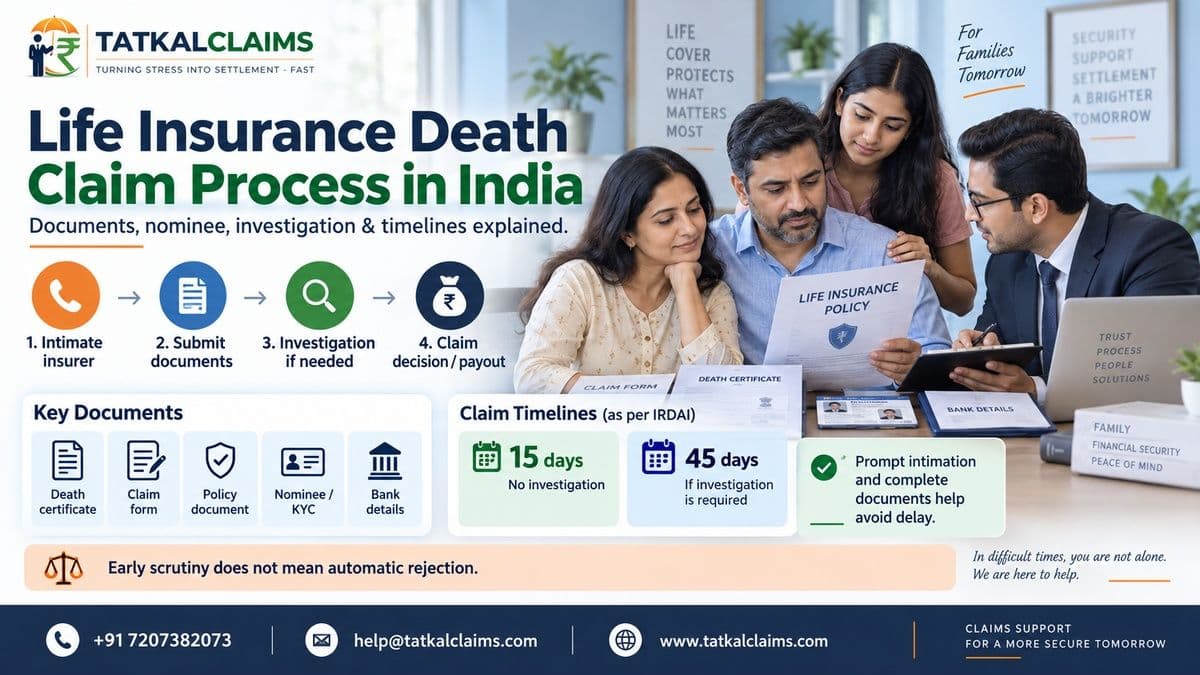
If no death claim was ever filed, use our life-insurance death claim process guide for the filing documents, nominee position and investigation timeline.
If the insurer has already admitted the claim or given a settlement amount but the money has not reached the bank, use our approved-but-payment-not-received guide instead of treating the case as an unidentified unclaimed policy.
Step 1: Reconstruct the Policy Before Searching for Money
The easiest cases have a policy number and insurer name. Harder cases begin with only an old premium receipt, debit entry, employer record, loan document, email, SMS or policy bond. Build a one-page policy inventory before approaching the insurer.
| Record | What it can reveal |
| Old policy bond / premium receipt | Insurer, policy number, plan name, commencement date and possible maturity date. |
| Bank statements / ECS / NACH history | Recurring premiums and the insurer or intermediary that collected them. |
| Email and SMS archives | Renewal notices, maturity alerts, policy-service messages and claim correspondence. |
| Income-tax / financial records | Premium-payment references that help identify the insurer or policy period. |
| Employer benefit records | Group-life or employer-arranged cover that the family may not know existed. |
| Loan documents | Assignment or credit-life linkage that can affect who receives policy proceeds. |
| DigiLocker / e-insurance records, if used | Electronic policy records and identifiers. |
Do not infer a payable maturity amount just because premiums were once debited. A policy may have lapsed, been surrendered, become paid-up, been assigned to a lender or already been paid. Ask for the current or historical policy status and benefit event rather than only asking, “Is there unclaimed money?”
Step 2: Use Bima Bharosa and the Insurer’s Unclaimed-Amount Search
IRDAI’s Bima Bharosa portal maintains a current list of insurer unclaimed-amount pages and also provides an unclaimed-amount query form. The form currently asks for the policyholder’s name, mobile number and date of birth, permits PAN as an additional identifier, and asks the user to select insurers and enter policy number(s). It allows a maximum of five insurers in one query.
If you know the insurer and policy number, start with the insurer’s own unclaimed-amount page through Bima Bharosa. Save the search result, screenshot or acknowledgement. If the result shows an amount, record the policy number, amount, date/status shown and any claim instructions before submitting documents.
If you do not know the policy number, the Bima Bharosa query form itself may not solve the identification problem because policy number is currently a mandatory field. In that situation, first reconstruct the insurer/policy from family records and then ask the insurer’s servicing team to search using the strongest identifiers available. Do not pay an agent or unknown website merely to “release” unclaimed money.
If the Unclaimed Amount Is a Death Benefit
A family may discover the policy years after the insured died. Before assuming the insurer owes the sum assured, verify whether the policy was in force on the date of death, whether premiums were up to date or the policy had paid-up value, whether any earlier claimant notified the insurer, and whether the death benefit was already discharged.
If no claim was ever initiated, the family may need to file the underlying death claim first. That usually means death certificate, claimant identity/KYC, policy details and bank proof, with additional records depending on the cause of death, policy status and insurer requirements. A very old claim can also create evidence gaps, so preserve any original policy bond, premium history, hospital/police records and insurer correspondence that still exists.
Where the benefit exists but the insurer is unsure who should receive it, use our nominee vs legal-heir guide. Do not confuse claimant-title problems with a rejection of the insurance benefit itself.
If the Policy Matured but the Money Never Reached the Policyholder
Maturity and survival-benefit cases often turn on stale contact and banking records rather than claim admissibility. The policyholder may have moved, changed phone number, closed the old bank account or missed a cheque. Ask the insurer for the maturity/survival due date, gross amount, deductions if any, payment mode attempted and the reason the amount remains unpaid.
IRDAI’s 2024 unclaimed-amount modification directs insurers to send advance notifications for maturity claims and survival benefits at least six months in advance through possible modes, ask for KYC/bank details, and follow up periodically with customers who do not respond. If the insurer had current contact details but no meaningful effort was made, preserve that fact in the servicing complaint.
The fact that a maturity amount appears in an unclaimed search is strong evidence that the insurer has identified an unpaid amount. It does not automatically settle every issue about identity, assignment, lien, tax, prior payment or claimant title. Ask for a written amount statement and the exact release requirements.
Stale Cheque, Failed NEFT or Closed Bank Account
Do not treat a payment failure as a mysterious insurance dispute. Ask for the original payment instruction, cheque number or UTR/reference, date, beneficiary details, bank-return reason and whether the insurer has reversed the failed payment back into its books.
Then submit updated bank proof through the insurer’s documented servicing channel. Use a cancelled cheque, bank statement/passbook or other accepted proof that clearly shows the claimant’s name, account number and IFSC. Keep the acknowledgement because a second failure often happens when the insurer updates one field but leaves an old beneficiary or KYC record unchanged.
Nominee, Legal Heir and “Open Title” Problems
Some old proceeds remain unpaid because there is no surviving nominee, the registered nominee has died, heirs disagree, a will is produced, the policy was assigned, or the insurer sees competing claims. IRDAI’s 2024 framework specifically recognises rival claims or open title as a separate pending category.
That does not mean the insurer can indefinitely say “family dispute” without identifying what it needs. Ask whether the insurance benefit itself is admitted and, separately, what document is required to establish the person entitled to receive it. Depending on the facts, the answer may involve nomination records, legal-heir proof, succession/probate documents, assignment records or a court direction.
If the dispute is genuinely about inheritance or competing ownership rights, an insurance grievance forum may not be able to decide the entire succession dispute. The claim strategy should not promise that Bima Bharosa or an Ombudsman complaint will substitute for a necessary civil or succession proceeding.
What Happens After 10 Years? The Senior Citizens’ Welfare Fund
Current Government guidance says insurance proceeds that remain unclaimed for more than 10 years are transferred to the Senior Citizens’ Welfare Fund (SCWF). The transfer does not by itself extinguish the rightful owner’s entitlement.
The same guidance states that policyholders, nominees or legal heirs may continue to approach the concerned insurer to claim the amount for up to 25 years from the date of transfer. The practical point is important: even after transfer, start with the insurer that issued the policy rather than assuming you must claim directly from the Government fund.
Ask the insurer to confirm whether the amount was transferred to SCWF, the transfer date, the amount transferred, the present amount it says is claimable, and the documents required for restoration/payment. Keep this written response because the 25-year period is linked to the transfer date.
Build a Recovery File Before You Escalate
| Document / evidence | Why it matters |
| Policy bond, policy number or insurer record | Identifies the contract and benefit event. |
| Policy-status / benefit statement | Shows whether maturity, paid-up, death or another benefit was actually due. |
| PAN/Aadhaar or accepted KYC | Supports identity matching with old insurer records. |
| Current bank proof / cancelled cheque | Allows re-payment to the correct account. |
| Death certificate, if claiming after death | Establishes the insured/policyholder’s death. |
| Nomination / relationship / legal-title documents | Shows who can receive the money where the original policyholder is deceased. |
| Old cheque, payment advice, UTR or return message | Explains why an attempted payment did not reach the claimant. |
| Old address, phone and email evidence | Helps match historical insurer records where details changed. |
| SCWF transfer confirmation, if applicable | Fixes the transfer date and the route for reclaiming the amount. |
| Chronology of requests and acknowledgements | Shows what the insurer was asked to do and when. |
What Makes an Unclaimed-Money Case Strong—or Difficult?
A strong recovery file usually has a clear policy number, a benefit event that unquestionably occurred, a matching insurer record showing an unpaid amount, and a claimant who can prove identity or title. A failed transfer with a documented return reason is usually easier to diagnose than a case where nobody can establish whether a policy was still in force.
A difficult case may involve a lapsed policy with no payable benefit, a surrendered policy, an assignment to a lender, prior payment to a registered recipient, rival heirs, a missing policy number, or a claim that was already repudiated on substantive policy grounds. Calling all of these “unclaimed money” can waste months because the real dispute is elsewhere.
If the insurer says no amount is due, ask it to show the policy status, benefit calculation and payment/closure history. If the insurer says an amount is due but will not release it, ask for the precise release condition. Those two answers lead to very different appeals.
What to Ask the Insurer in One Written Request
A useful request is specific enough that the insurer cannot answer with a generic “please submit KYC” message. Ask for the policy status, benefit type, due date, amount originally due, current unpaid amount, whether income has accrued under the unclaimed framework, payment attempts made, reason for failure, current regulatory classification, whether/when the amount was transferred to SCWF, and the exact documents still required.
For a deceased policyholder, also ask the insurer to state the nomination/assignment position in its records and whether the issue is claim admissibility or claimant title. If a death claim was never lodged, ask for the current claim form and document list. If it was lodged, ask for the claim number and decision/status history.
When to Escalate Instead of Repeating Customer-Care Calls
Escalate when the insurer will not confirm whether money is due, repeatedly asks for documents already acknowledged, gives inconsistent policy/payment history, cannot explain an SCWF transfer, or leaves a complete servicing request unresolved without a reasoned response.
Start with the insurer’s grievance channel and keep the complaint narrow: identify the policy, the amount/event you are trying to trace, the documents already supplied and the specific answer or payment step still missing. If that does not resolve the servicing problem, Bima Bharosa can be used to register and track the grievance.
Before choosing the next forum, compare the scope and prerequisites in our Bima Bharosa vs Insurance Ombudsman guide; Ombudsman eligibility depends on the nature and value of the dispute and the applicable rules.
If the insurer has actually rejected the underlying life claim on a policy ground—such as lapse, non-disclosure, exclusion or lack of entitlement—stop framing it as only an unclaimed-money issue. The repudiation must be reviewed on its own terms and evidence.
For a formal repudiation rather than a tracing/payment problem, use our insurance claim rejection guide as the broader appeal framework.
Common Mistakes That Delay Recovery
Sending only an old policy bond without checking policy status or benefit due date.
Assuming “10 years” means the insurer or Government permanently owns the money.
Treating a nominee/legal-heir dispute as if it were only a missing-bank-details problem.
Using an unclaimed-money search when a claim was already filed and is actually delayed or approved-but-unpaid.
Paying a caller, agent or website that promises to unlock Bima Bharosa or SCWF money.
Submitting fresh KYC repeatedly without demanding the insurer’s written policy/payment history and exact outstanding requirement.
A Practical Recovery Checklist
| Order | Action |
| 1 | Identify insurer and policy number from original or secondary records. |
| 2 | Confirm policy status and the benefit event that allegedly became due. |
| 3 | Search the insurer/Bima Bharosa unclaimed facility and save the result. |
| 4 | Confirm whether any claim had already been initiated. |
| 5 | Establish the correct claimant: policyholder, nominee, beneficiary or legal heir. |
| 6 | Collect KYC, current bank proof and event-specific documents. |
| 7 | Ask for payment history, failed-transfer details and SCWF status in writing. |
| 8 | Submit one indexed servicing/claim package and keep acknowledgement. |
| 9 | Escalate through the insurer grievance channel if the answer remains unclear or payment is not processed. |
| 10 | Use Bima Bharosa/Ombudsman or other legal remedies only after identifying the actual dispute. |
How Tatkal Claims Can Help
Tatkal Claims can review the old policy record, policy status, maturity/death event, nomination or assignment, insurer unclaimed-search result, bank/payment trail and SCWF status to identify what the case actually is: a forgotten benefit, an unfiled death claim, a failed payment, a claimant-title problem or a substantive rejection.
Where the amount appears payable but the insurer’s records or requirements are unclear, assistance can include building a document-indexed chronology, asking for the policy/payment history, preparing the insurer grievance and escalating through Bima Bharosa or the Insurance Ombudsman where eligible. Recovery cannot be promised, and a genuine succession, assignment or policy-validity dispute may require a different legal route.
Frequently Asked Questions
Frequently asked questions
How can I check whether a life insurer has unclaimed money in my name?
Use the insurer’s unclaimed-amount search page, which can be reached through IRDAI’s Bima Bharosa unclaimed-amount directory. Bima Bharosa also provides a query form. Keep the policy number, policyholder name, date of birth and available PAN/contact details ready.
What if I do not know the policy number?
Start by tracing the insurer and policy from old bonds, premium receipts, bank debits, emails/SMS, employer records, loan papers or electronic insurance records. The current Bima Bharosa query form requires a policy number, so an insurer-level search using other identifiers may be necessary first.
Does unclaimed life-insurance money disappear after 10 years?
No. Current Government guidance says amounts unclaimed for more than 10 years may be transferred to the Senior Citizens’ Welfare Fund, but the rightful claimant can continue to claim through the insurer for up to 25 years from the transfer date.
Do I have to pay a fee to claim unclaimed insurance money?
Government guidance says there is no fee for claiming unclaimed insurance proceeds. IRDAI’s Bima Bharosa portal also warns users not to make payments or scan QR codes in exchange for complaint resolution or disbursement.
Can a nominee or legal heir recover an old unclaimed death benefit?
Potentially yes, if a death benefit is payable and the claimant can establish the required entitlement. The documents depend on the nomination, assignment, family/title position and insurer requirements. A succession dispute should be separated from the question of whether the policy benefit itself is admissible.
My maturity cheque expired years ago. Is the money lost?
An expired cheque does not by itself prove that the underlying benefit was forfeited. Ask the insurer for the original payment record, whether the cheque was encashed or reversed, the current unpaid amount, and the procedure to update bank/KYC details and obtain payment.
My death claim was already filed but is still unpaid. Is that an unclaimed amount?
Not necessarily. IRDAI’s February 2024 modification says claims initiated by the consumer should not be classified as unclaimed amounts for that regulatory framework. The case may instead be a claim delay, investigation, repudiation or approved-but-unpaid payment problem.
Does finding an old life-insurance policy mean a payout is definitely due?
No. The policy may have lapsed, been surrendered, become paid-up, been assigned, already matured and paid, or otherwise have a different status. Confirm the policy history and benefit event before assuming a recoverable amount exists.
Is income or interest added to unclaimed insurance money?
IRDAI’s unclaimed-amount definition includes income accrued on amounts held in the unclaimed framework. The exact current amount should be obtained from the insurer because the calculation and classification depend on the applicable regulatory treatment and the policy/payment history.
Should I contact the Senior Citizens’ Welfare Fund directly after 10 years?
Current Government guidance tells policyholders, nominees and legal heirs to approach the concerned insurer even after an amount has been transferred to the SCWF. Ask the insurer to confirm the transfer date and its recovery procedure.
Sources and Methodology
Disclaimer: This guide explains the current IRDAI unclaimed-amount framework and Government guidance in general terms. Whether any amount is actually payable depends on the specific policy status, benefit event, premiums, assignment, nomination, prior claim/payment history, KYC and claimant-title facts. A search result showing an unclaimed amount is not a guarantee of immediate payment, and a missing search result does not by itself prove that no policy or benefit exists. This is not legal or financial advice for a specific case.