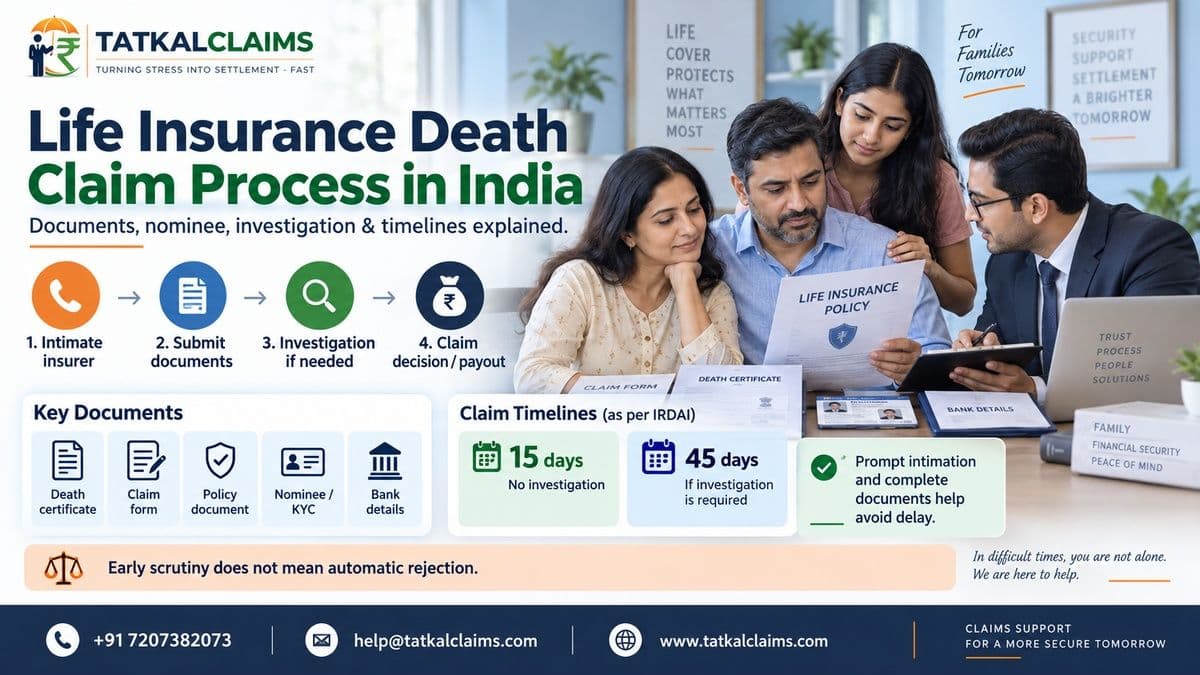
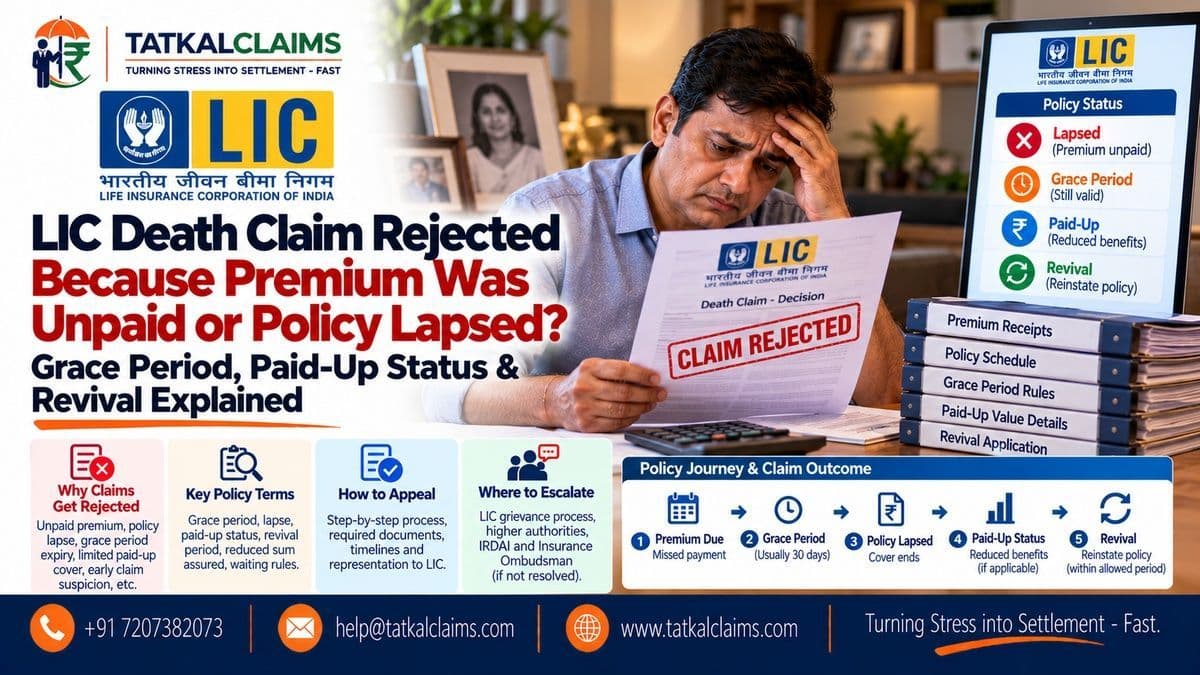
A death claim can become a policy-status dispute before anyone even looks at the cause of death. The nominee submits the claim, LIC checks the premium ledger, and the response comes back: the premium was unpaid and the policy had lapsed.
That answer is not enough on its own. I would immediately ask four questions: When was the premium actually due? Was the death still inside the grace period? Had the policy already acquired paid-up value? And does the exact plan contain any concession for death soon after the first unpaid premium?
Written by: Tatkal Claims, Claims Review Team
Reviewed by: Ankit L Kanoi, Founder
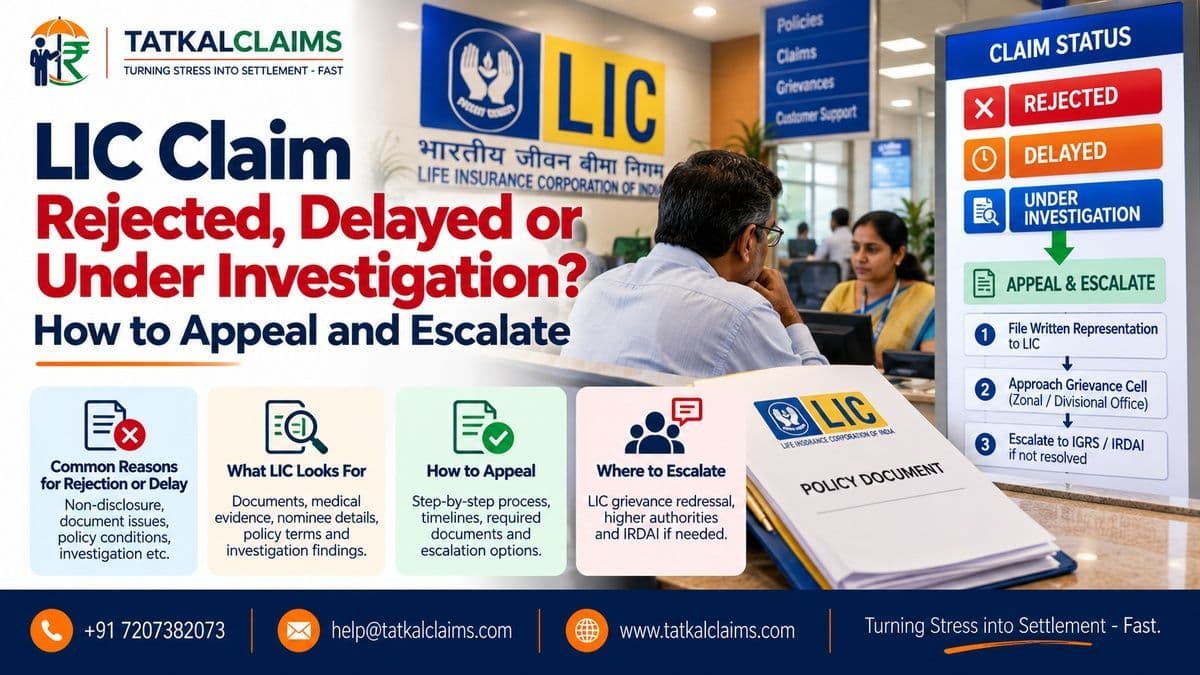
If your LIC dispute is broader than non-payment or lapse, use our LIC claim rejection, delay and investigation guide.
First, Put the Policy Into the Correct Bucket
| Situation | Likely policy position | What the nominee should check |
| Premium due; death occurs within grace period | Cover ordinarily remains in force under LIC's general guidance | Due date, mode of premium, exact grace period and amount LIC may deduct |
| Grace period expired; policy has not acquired paid-up value | Policy may have lapsed with no death benefit under the plan | Minimum premiums required under the issued policy and date of first unpaid premium |
| Grace period expired; policy has acquired paid-up value | Reduced paid-up death benefit may remain payable | Paid-up formula, bonuses already vested and rider treatment |
| Policy is lapsed but death occurs soon after first unpaid premium | Some plans/general LIC concessions may preserve a fuller claim for a limited period | Whether the concession actually forms part of this policy/plan |
| Arrears were paid before death but revival approval was pending | Do not assume revival was complete | Revival application, health requirements, approval/receipt and effective date |
| Policy was formally revived before death | Benefits may be restored, but recent revival can trigger extra claim review | Revival approval date, declaration/medical records and early-claim requirements |
| Premium was paid but LIC ledger shows it unpaid | This may be a payment-posting/service dispute, not a true lapse | Bank/UPI receipt, LIC receipt, transaction date, policy number and reversal history |
Grace Period: The Difference Between 'Premium Unpaid' and 'Policy Lapsed'
LIC's current general guidance states that yearly, half-yearly and quarterly premiums receive a grace period of one month but not less than 30 days, while monthly premiums receive 15 days. LIC also says that if death occurs within that period, the life assured remains covered for the full sum assured, with the due premium dealt with under the policy conditions.
That means the date of death can be decisive. A quarterly premium being unpaid on the due date does not automatically mean the policy lapsed that same day.
| Event | Illustrative date |
| Quarterly premium due | 1 June 2026 |
| Grace period | At least 30 days under LIC's general guidance |
| Death on 20 June 2026 | Still within grace period; do not treat as an automatic lapse |
| Death after grace expires | Move to the paid-up/lapse/concession analysis |
If the Grace Period Expired, Ask Whether the Policy Had Acquired Paid-Up Value
A paid-up policy is not the same as an in-force policy, and it is not the same as a policy with no value. In many savings-oriented life products, once a minimum premium history is completed, stopping future premiums reduces the benefit instead of wiping it out completely.
This is where generic internet advice becomes dangerous. LIC's general Policy Conditions page describes a non-forfeiture rule after at least three full years. But current LIC products can use different thresholds. For example, current Jeevan Umang wording provides that after at least one full year's premiums have been paid and the first policy year is completed, subsequent non-payment can leave the policy continuing on a paid-up basis.
| Item | What to verify in the issued policy |
| Death benefit | The reduced 'Death Paid-up Sum Assured' formula |
| Maturity benefit | Whether a reduced maturity paid-up amount remains |
| Bonuses | Whether already vested bonuses remain attached and whether future participation stops |
| Survival benefits | Whether they reduce, stop or continue under a special formula |
| Riders | Many riders do not acquire paid-up value and can cease on lapse/paid-up status |
| Minimum premium history | One year, three years or another threshold depending on the product/version |
| Revival right | Whether the paid-up policy may later be revived within the plan's revival period |
So if LIC says 'policy lapsed', ask for the actual benefit calculation. A policy can be lapsed for full-risk purposes yet still carry a paid-up value. The nominee needs the exact plan condition, not just the status label shown on a screen.
LIC Also Publishes Lapse-Claim Concessions — But Do Not Assume They Apply to Every Plan
LIC's current general Policy Conditions page describes two concessions for certain claims after premiums stop:
| Premium history before default | Death timing stated by LIC's general page | General consequence stated by LIC |
| At least 3 full years' premiums paid | Death within 6 months from the due date of first unpaid premium | Policy money paid in full after deduction of unpaid premiums with interest up to death |
| At least 5 full years' premiums paid | Death within 12 months from the due date of first unpaid premium | Policy money paid in full after deduction of unpaid premiums with interest up to death |
These concessions are important enough to check, but I would never promise them merely because the claimant meets the dates. LIC's own policyholder guidance says there are exceptions for some plans, and individual product wordings may contain their own version of the concession—or none at all.
The right way to use this provision is to ask LIC to identify the policy clause governing the lapsed claim and to explain whether the plan's concession applies. If LIC refuses the concession, the appeal should quote the issued wording and the exact premium/death chronology.
A Recent Kerala High Court Case Shows Why the Grace Date Matters
In Life Insurance Corporation of India v. Smt. Surumi, decided by the Kerala High Court on 31 January 2026, the life policy had commenced in June 2011. The December 2012 premium remained unpaid, the 30-day grace period expired, and the life assured died on 29 January 2013.
The Division Bench accepted that the policy had lapsed because the premium was not paid within the grace period and said a lapsed policy could not simply be revived by condoning the delayed premium after death. On the unusual facts, it nevertheless upheld an old Insurance Ombudsman ex-gratia direction made under the former 1998 grievance rules.
What If the Premium Was Actually Paid?
Before accepting a lapse rejection, make sure the payment really failed. I have seen policy disputes where the family had a bank debit, UPI reference or receipt, while the insurer's ledger showed the premium as unpaid or later reversed.
| Evidence | What it proves |
| LIC premium receipt | Direct evidence that LIC accepted the premium against the policy |
| Bank statement | Date and amount of debit |
| UPI / card / net-banking reference | Transaction trail for online payment |
| Failed/reversed transaction message | Whether the payment actually reached LIC |
| Auto-debit mandate / NACH record | Whether a debit instruction existed |
| Employer salary deduction record | Relevant for Salary Saving Scheme disputes |
| LIC premium ledger | How LIC posted the payment and the first unpaid premium date |
A bank debit by itself does not always prove the insurer finally received and allocated the premium. Equally, an internal LIC 'lapsed' status should not defeat a documented payment without reconciliation. Ask for both sides of the transaction.
What If the Policy Had Become Paid-Up?
If paid-up status applies, the nominee should not argue for the full original sum assured unless the plan provides a claim concession that preserves it. The first task is to calculate what the paid-up death benefit should be.
Current Jeevan Umang wording illustrates the mechanism: the Death Paid-up Sum Assured is based on the original Sum Assured on Death multiplied by the ratio of the period for which premiums were paid to the maximum premium-paying period. Its wording also preserves vested bonuses, subject to the product terms.
That formula is an example, not a universal LIC formula. Older plans and different product categories may use different paid-up thresholds and calculations. Use the policy schedule, UIN and wording applicable to the deceased's plan.
What If the Policy Was Revived Before Death?
A lapsed or paid-up policy may be eligible for revival during the life assured's lifetime, subject to the plan conditions, arrears, interest and continued-insurability requirements. LIC may accept revival on original terms, accept it on modified terms or decline it. LIC's general policy conditions state that revival takes effect only after the Corporation approves it.
That makes 'we paid all the arrears' different from 'the policy was revived'. If death occurs after arrears were paid but before revival approval, obtain the full revival file before assuming the cover was restored.
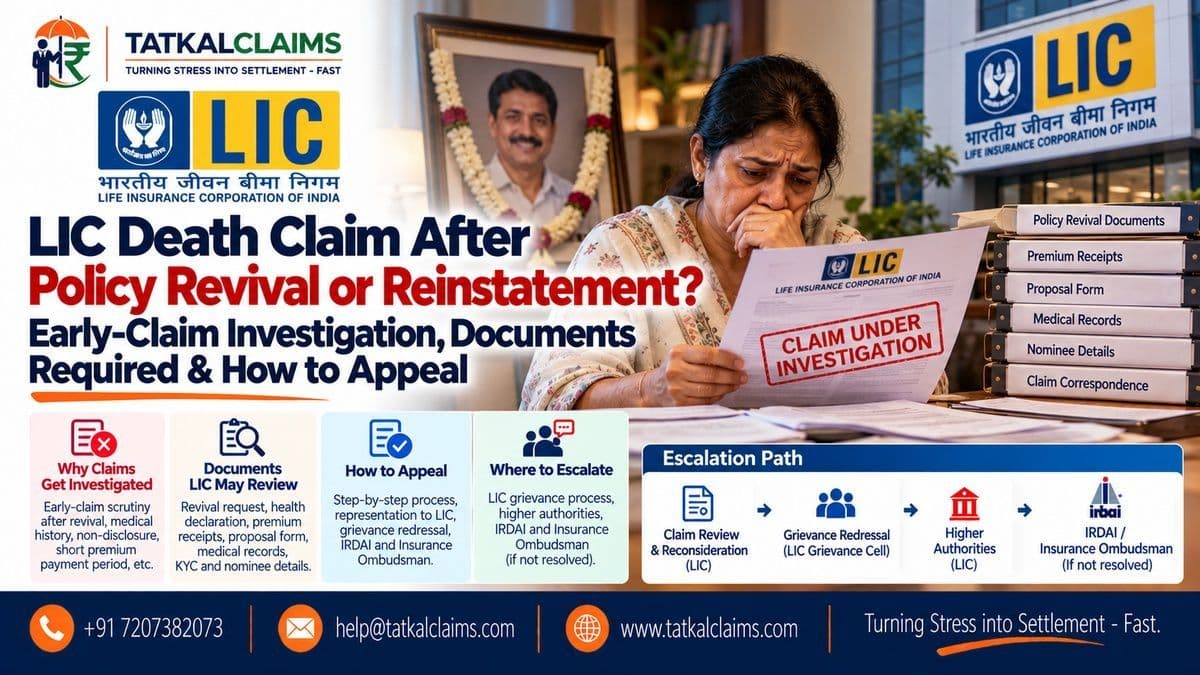
If the policy was actually revived and death occurred soon afterwards, use our dedicated LIC death claim after revival or reinstatement guide.
Documents to Collect Before Challenging a Lapse Rejection
| Document | Why it matters |
| Policy bond / Customer Information Sheet | Grace, lapse, paid-up and revival clauses |
| Policy schedule and UIN | Identifies the exact product/version |
| Complete premium ledger | Due dates, paid dates and first unpaid premium |
| Last 2-3 premium receipts | Checks whether ledger and receipts agree |
| Bank/UPI/card statements | Payment or failed-payment evidence |
| Auto-debit/NACH mandate, if relevant | Shows collection instructions |
| Employer salary deduction records, if relevant | Useful in Salary Saving Scheme disputes |
| Death certificate | Fixes the death date against grace/lapse dates |
| LIC status or repudiation letter | Exact reason LIC says the claim is not payable |
| Paid-up benefit calculation | Shows whether LIC considered non-forfeiture |
| Revival application/receipt/approval, if any | Separates arrears payment from completed revival |
| Claim forms and acknowledgements | Claim chronology |
| Grievance correspondence | Required for later escalation |
The Questions I Would Put to LIC in Writing
| Question | Why it matters |
| What was the exact premium due date? | Establishes the starting point |
| What premium mode applied? | Determines the applicable grace period |
| On what date did the grace period expire? | Tests whether death was actually after lapse |
| What is the first unpaid premium date in LIC's ledger? | Controls lapse and concession calculations |
| Did the policy acquire paid-up value? | Separates no-value lapse from reduced benefit |
| What exact paid-up formula was applied? | Allows calculation audit |
| Does this plan contain a 6-month/12-month lapse-claim concession? | Tests whether fuller benefit survives temporarily |
| Were any rider benefits extinguished separately? | Rider status can differ from base policy |
| Was a revival application/payment pending before death? | Tests whether LIC had approved restoration |
| Which policy clause supports the final decision? | Prevents reliance on a generic status label |
Challenge LIC's Lapse Calculation in Writing
Begin with the servicing branch, not a generic appeal. Ask it to reconcile the premium ledger with bank or UPI proof and to show the premium due date, grace expiry, paid-up calculation and issued-policy clause it applied. A payment posting error calls for correction of the ledger; an accurate ledger may still leave a dispute about the amount payable.
Put a clause-and-date representation through LIC's written grievance channel, including co_complaints@licindia.com, if the calculation remains wrong. For a formally repudiated death claim, request the Zonal CDRC address and show the actual policy wording, premium history and benefit calculation. An appeal based only on the family's need will not establish cover after lapse.
Bima Bharosa can create an IRDAI-visible record of an unresolved grievance. The Insurance Ombudsman generally requires an insurer complaint first, then an unsatisfactory response or 30 days without one; the current limit is ₹50 lakh and filing is generally within one year of the relevant response or expiry of that period. Consider a consumer proceeding where appropriate, after checking jurisdiction, limitation and parallel-forum restrictions.
Can TatkalClaims Help With an LIC Lapse or Unpaid-Premium Claim?
Yes, but the first job is usually not writing a long appeal. It is reconstructing the premium history accurately enough to know whether LIC's 'lapsed' label is actually fatal to the claim.
TatkalClaims can review the policy wording, premium ledger, payment trail, paid-up entitlement, lapse-concession clause, revival documents and claim decision. Where the records support a challenge, we can prepare a focused representation showing the dates, calculation and exact clause LIC should apply.
We will also tell you when the records point the other way. If the grace period clearly expired, the policy had not acquired paid-up value, no applicable concession exists and no valid revival was completed before death, an appeal cannot be made stronger by simply repeating that the family needs the money.
For an initial review, call +91 7207382073 or email help@tatkalclaims.com. Send the policy bond, last premium receipt, premium ledger/status, death certificate and LIC's rejection/status letter first.
Frequently asked questions
If the insured dies on the premium due date without paying, is the LIC claim automatically rejected?
No. For modes covered by LIC's general grace-period rule, the policy does not lapse on the due date itself. The applicable grace period must first be checked against the death date and the issued policy.
Can LIC deduct the unpaid premium if death occurs during the grace period?
LIC's general policy conditions state that full cover continues during grace. The policy wording can permit deduction of the premium then due and, for some modes, other premiums falling due before the next policy anniversary. Check the issued plan for the exact deduction.
Does every LIC policy become paid-up after three years?
No. LIC's general webpage describes a three-year non-forfeiture rule, but current products can use different thresholds; current Jeevan Umang, for example, provides paid-up treatment after at least one full year's premiums and completion of the first policy year. The policy bond and product wording control.
Can a nominee pay the overdue premium after the insured has died and revive the policy?
Generally no. Revival is a process available during the life assured's lifetime and takes effect only after LIC approves it. A post-death payment cannot simply convert a lapsed policy into an in-force policy.
If LIC calls the policy 'lapsed', should I still ask for the paid-up value?
Yes, where the plan may have acquired non-forfeiture benefits. Ask LIC to state whether paid-up value exists and provide the death-benefit calculation. 'Lapsed for full cover' and 'nothing payable' are not always the same conclusion.
Do LIC's six-month and twelve-month lapse concessions apply automatically?
No. LIC's general Policy Conditions page publishes those concessions, but LIC also says exceptions exist for some plans. Confirm that the issued plan contains or is governed by the concession before relying on it in an appeal.
Sources & Methodology
Primary-source review completed 4 October 2026. LIC's current general policy guidance was cross-checked against a newer product wording because paid-up thresholds and revival rules are plan-specific. Current grievance contacts were re-confirmed directly from LIC for this article. Ombudsman eligibility was checked against the Council for Insurance Ombudsmen rather than LIC's older summary wording.
Disclaimer: This guide explains LIC death-claim disputes involving unpaid premiums, grace periods, lapse, paid-up status and revival in general terms. The result depends on the exact policy bond, UIN, premium mode, product version, non-forfeiture provisions, rider terms, payment history and dates. It is not legal advice and does not guarantee payment or reversal of a rejected claim.