A family files an LIC death claim and expects a straightforward payout. Instead, the servicing branch asks for old hospital records, employer details or additional certificates. Weeks pass and the status remains “under investigation.” In other cases, the claimant receives a repudiation letter alleging non-disclosure, policy lapse or another policy condition.
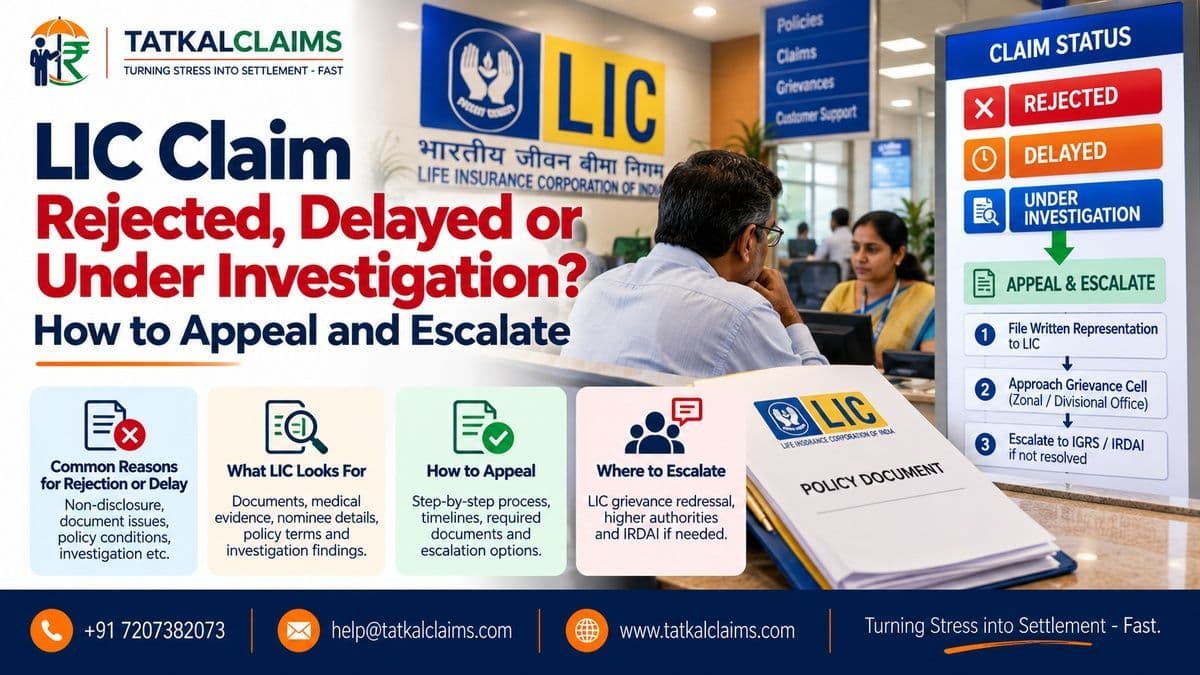
An LIC claim dispute should be handled in stages. First identify whether the claim is merely pending, formally under investigation, delayed beyond the current turnaround time, or actually repudiated. Each stage has a different response and a different escalation route.
This guide focuses mainly on LIC death claims because that is where investigation, Section 45 and LIC’s internal Claims Dispute Redressal Committees are most relevant. Maturity, survival benefit and other payment delays are also addressed where the escalation path overlaps.
Written by: Tatkal Claims, Claims Review Team
Reviewed by: Ankit L Kanoi, Founder
What This LIC Guide Covers — and What It Does Not
This page is LIC-specific. It explains LIC’s claim forms, early-death claim handling, current 15/45-day benchmarks, branch and grievance channels, and LIC’s own Zonal and Central Claims Dispute Redressal Committees.
It does not replace the broader legal analysis of every life insurer’s investigation powers or Section 45. For that, use the dedicated Tatkal Claims early-death investigation guide.
See: Life Insurance Claim Under Investigation After an Early Death? 45-Day Timeline & Section 45.
First Identify the Status: Pending, Under Investigation, Delayed or Rejected
| Status | What it usually means | Immediate action |
| Pending / requirements awaited | LIC says some claim requirement is outstanding | Ask for one consolidated written list and submit with proof |
| Under investigation | Additional verification is being carried out before decision | Ask what issue is being investigated and track the 45-day benchmark |
| Delayed | Applicable claim turnaround time has passed without decision/payment | File a dated grievance with the chronology |
| Repudiated / rejected | LIC has issued a formal adverse decision | Audit the grounds, evidence and policy/Section 45 basis; use LIC’s appeal machinery |
| Partly admitted / rider denied | Base claim or one benefit is admitted but another component is disputed | Separate the admitted amount from the disputed rider/benefit |
LIC Death Claim: Basic Documents and the Servicing Branch
LIC’s current claim guidance says the person legally entitled to the policy money should intimate the death to the servicing branch.
For regular death claims, LIC lists Claim Form A, a certified extract from the death register, the original policy document and other title/age documents where applicable.
LIC’s download-forms page distinguishes policies that have run for three years or more from shorter-duration claims and points claimants to the servicing branch for additional requirements where necessary.
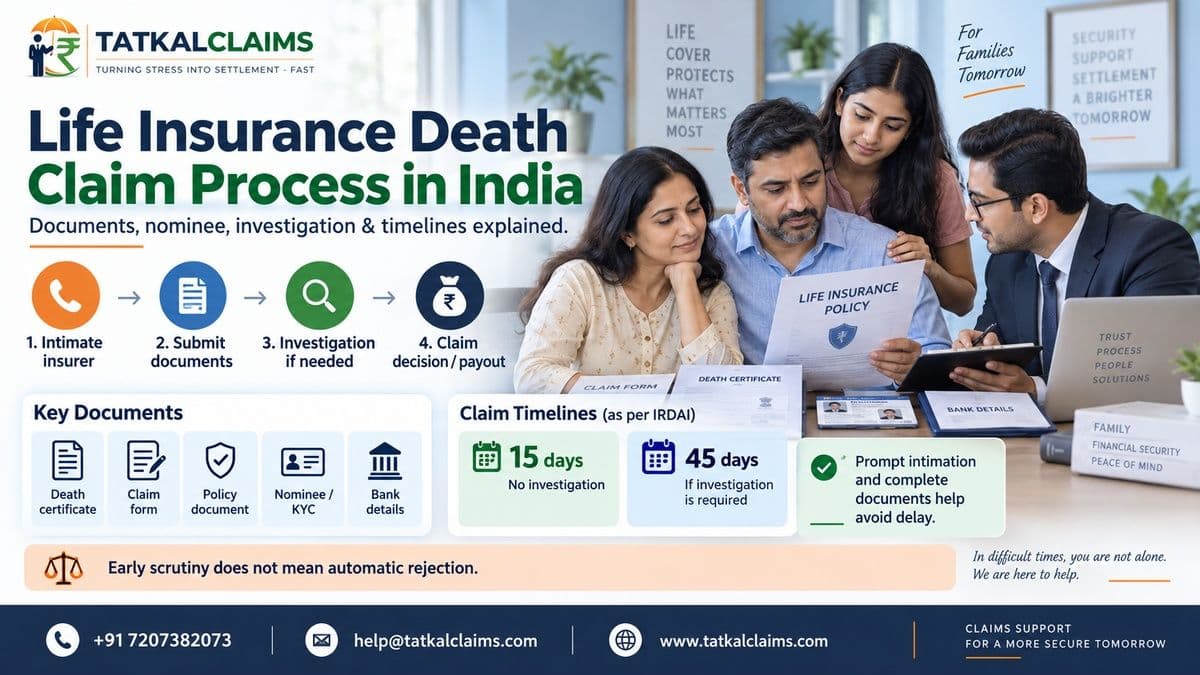
For the broader nominee/document process across life insurers, see our Life Insurance Death Claim Process in India.
Why LIC Asks for More Documents in an Early Death Claim
LIC’s current policy-conditions page states that if death occurs within three years from the date of risk or from revival/reinstatement, additional forms may be called for.
The listed records can include medical-attendant certificates, hospital records, earlier-treatment information, employer certification and police/FIR/post-mortem documents for accidental or unnatural deaths.
LIC explains that these records help it verify the genuineness of the claim and investigate whether material information affecting acceptance of the proposal was withheld.
Current LIC / IRDAI Claim Timelines: 15 Days and 45 Days
The current IRDAI policyholder-protection framework uses a 15-day turnaround for death claims not requiring investigation and a 45-day turnaround where investigation is warranted.
LIC’s current Citizen’s Charter also lists death claims not requiring investigation at 15 days and early-death claims requiring investigation at 45 days.
The practical step is to preserve the claim-intimation acknowledgement and every document submission. If LIC says the clock has not started because something remains outstanding, ask it to identify that item in writing.
| Date | Keep proof of |
| Claim intimation | Branch acknowledgement / online reference |
| First document submission | Receipt / email / upload proof |
| Additional requirement | LIC letter/email with date |
| Additional documents supplied | Receipt / courier / email proof |
| Investigation communication | Investigator call, visit, letter or questionnaire |
| 45-day point | Written status demand if no decision |
| Repudiation / payment | Final letter and payment advice |
LIC Says “Claim Under Investigation” — What Should You Ask?
An investigation means LIC is carrying out additional verification before deciding the claim. It is not the same as a repudiation.
Ask what issue is being verified: prior medical treatment, proposal disclosures, occupation/income, revival declaration, cause of death, policy status, nominee/title or an accidental rider.
Submit relevant documents, but avoid guessing from memory where records exist. If a family member gives a written statement to an investigator, read it before signing and keep a copy wherever possible.
| 1 | What specific issue is under investigation? |
| 2 | What documents are still required and why are they material? |
| 3 | On what date was the claim assigned for investigation? |
| 4 | Has LIC received all records already supplied? |
| 5 | What is the current expected decision date under the applicable 45-day benchmark? |
| 6 | If police/medical records are pending from a third party, can the undisputed part of the claim be processed separately? |
Section 45: The Three-Year Rule Still Matters in an LIC Repudiation
Section 45 of the Insurance Act says a life insurance policy cannot be called in question on any ground whatsoever after three years from the latest of policy issuance, commencement of risk, revival or rider.
Within that three-year window, a policy may be questioned on fraud or qualifying material misstatement/suppression, subject to the statutory tests.
For a non-fraud material-misstatement case, the fact must have a direct bearing on the risk and the insurer bears the onus of showing that it would not have issued the policy had it known the fact. The statute also requires written communication of the grounds and materials relied upon.
Do not calculate the three years only from the original policy date if the policy was revived later. Section 45 expressly includes revival and rider dates.
Common LIC Death-Claim Dispute Areas
| Ground raised | What to check |
| Medical non-disclosure | Proposal questions, pre-policy medicals, earlier treatment and Section 45 timing |
| Occupation / income information | What was asked, what was disclosed and whether it was material to underwriting |
| Policy lapse | Premium due date, grace period, revival and paid-up status |
| Revival declaration | Date of revival, questions asked and medical/financial disclosures at revival |
| Accidental death rider | FIR, post-mortem, police report and rider definition |
| Nominee / title issue | Nomination, assignment, MWP Act, succession/title documents |
| Age discrepancy | Whether age was admitted and what adjustment the policy permits |
| Suicide / exclusion | Exact policy version, date and exclusion wording |
Claim Rejected Because LIC Says the Policy Had Lapsed
A lapse dispute should be handled separately from non-disclosure. Check the premium due date, grace period, any revival, and whether the policy had acquired paid-up value.
LIC’s policy-conditions page states that where death occurs within the applicable grace period, the life assured remains covered for the full sum assured, subject to policy terms.
If LIC says the policy was not in force, ask for the premium ledger and the exact policy condition used. Do not rely only on an agent’s verbal statement.
If LIC Has Issued a Formal Repudiation Letter
A repudiation changes the task. Stop sending general status reminders and audit the actual decision.
Mark every factual assertion in LIC’s letter and identify the evidence behind it. If the letter says “investigation revealed non-disclosure,” ask what medical record, proposal answer, date and underwriting materiality LIC relies on.
If the policy falls within Section 45’s contestability window, check whether the statutory ground is fraud or non-fraud material misstatement. Do not treat the two as interchangeable.
If LIC’s decision ignores evidence already on file—such as disclosed alcohol use, occupation, prior medical test or revival record—attach that evidence directly to the appeal rather than merely saying LIC overlooked it.
LIC’s Internal Appeal: Zonal Claims Dispute Redressal Committee
LIC operates an internal review mechanism specifically for repudiated death claims. Its current public guidance describes Claims Dispute Redressal Committees at all eight Zonal Offices and at the Central Office in Mumbai.
LIC says that when a claim is repudiated, the claimant is informed of the grounds and given the address of the Zonal Office Claims Dispute Redressal Committee (ZO-CDRC) for an appeal.
The Zonal Committee includes senior officials and a retired District Court or High Court judge. If repudiation is upheld, LIC’s current guidance says the claimant may be directed either to the Insurance Ombudsman or, depending on the claim amount and route, to the Central Office Claims Dispute Redressal Committee (CO-CDRC).
This internal review is a valuable LIC-specific step because it allows a structured challenge to the repudiation before or alongside considering external remedies.
| Section | Include |
| Policy chronology | Issue / commencement / revival / rider dates |
| Claim chronology | Death, intimation, documents, investigation and repudiation |
| Repudiation ground | Quote LIC’s exact allegation |
| Evidence response | Proposal, medical, employment, premium and revival records |
| Section 45 analysis | Three-year calculation and applicable statutory ground |
| Policy wording | Relevant grace, exclusion, rider or benefit clause |
| Relief requested | Review of repudiation and payment with applicable interest |
LIC Grievance Route for Delay or Service Failure
LIC’s current grievance page lists designated Grievance Redressal Officers at branch, divisional, zonal and central levels.
LIC also allows policy-related grievances through its Customer Portal/ICMS and through the dedicated email address co_complaints@licindia.com.
LIC’s current Citizen’s Charter lists same-day acknowledgement of a complaint and a 14-day benchmark for action and communication of the decision.
For a delayed claim, attach the claim number, policy number, claim-intimation date, complete document index and the exact number of days elapsed. Ask for a reasoned status—not another generic “under process” response.
When to Use Bima Bharosa
LIC’s current Customer Corner expressly lists Bima Bharosa as an escalation channel for grievances.
Bima Bharosa is useful when LIC’s internal grievance has not produced a satisfactory resolution or where the complaint needs to be logged with the regulator’s grievance system.
For a repudiated claim, keep the LIC repudiation letter and your appeal/grievance record ready so the external complaint is evidence-led rather than a fresh narrative from scratch.
Compare the routes in our Bima Bharosa vs Insurance Ombudsman guide.
Insurance Ombudsman: Current Eligibility Basics
The Council for Insurance Ombudsmen currently states that the policyholder, claimant/legal heir, nominee or assignee should first make a written complaint to the insurer.
If the insurer rejects the complaint, gives an unsatisfactory response, or does not respond within one month, an eligible complaint may be taken to the Ombudsman within one year, subject to the Ombudsman rules.
The current CIO procedure states that the value of the claim including expenses should not exceed ₹50 lakh for this route and that the same subject matter should not already be pending before or disposed of by a court, consumer forum or arbitrator.
This is important because some older LIC website pages still display outdated Ombudsman figures. For a current filing, use the current CIO rules and portal rather than an old insurer webpage limit.
What About Interest for Delay?
The current IRDAI policyholder-protection framework provides for interest where a claim is not settled within the specified turnaround time. The applicable rate is bank rate plus 2% under the current framework described in IRDAI’s Master Circular.
Do not make interest the only issue if the claim itself is repudiated. First establish entitlement to the claim; delay interest becomes consequential once payment is due.
For a pure delay case with no repudiation, specifically ask LIC to calculate and pay applicable interest along with the claim amount.
LIC Maturity or Survival Benefit Delayed
The investigation/Section 45 sections above are mainly death-claim issues. Maturity, survival benefit, annuity and pension payments have a different operational path.
LIC’s current FAQ says it endeavours to settle maturity claims on or before the due date and asks policyholders to submit the discharge receipt and policy document sufficiently in advance where required.
If a maturity payment is delayed, verify bank mandate/KYC, assignment, policy loan or discharge requirements, then use the same LIC grievance hierarchy if the payment remains unresolved.
Documents to Collect Before Challenging LIC
| Document | Why it matters |
| Policy bond / CIS | Benefits, exclusions and policy dates |
| Proposal form | Original disclosures |
| Pre-policy medicals | What LIC knew before issue |
| Revival papers | Fresh declarations and latest Section 45 date |
| Premium ledger / receipts | In-force, grace or paid-up status |
| Death certificate | Basic insured event |
| Hospital / prior medical records | Non-disclosure dispute |
| FIR / PM / police report | Accidental or unnatural death |
| Claim forms and branch receipts | What was filed and when |
| Investigator questionnaire/statements | What LIC investigated |
| Repudiation letter | Exact ground and materials cited |
| LIC grievance / CDRC correspondence | Internal escalation record |
Stronger Grounds for Challenging an LIC Repudiation
- The alleged undisclosed fact was actually stated in the proposal, medical examination or revival papers.
- Section 45’s three-year bar has expired from the latest relevant statutory date.
- LIC alleges non-fraud material misstatement but does not show that the fact directly affected underwriting or that the policy would not have been issued.
- The rejection relies on a condition or exclusion not matching the issued policy version.
- LIC treats an accidental-rider dispute as a reason to deny an otherwise payable base death benefit without explaining the policy basis.
- The premium ledger supports grace-period or paid-up coverage contrary to the lapse rejection.
- The repudiation letter makes a broad allegation but does not identify the underlying records or contradictions.
Grounds That Are Usually Harder to Challenge
- The policy was genuinely not in force and no grace/paid-up benefit applies.
- A material medical or financial fact was directly asked and clearly withheld within the Section 45 contestability window.
- The claim depends on an accidental rider but the event plainly falls outside the rider definition.
- The claimant has not supplied basic title/nominee/succession evidence required to establish who can receive payment.
- A revival shortly before death included an inaccurate declaration material to underwriting.
A difficult case can still deserve review, but the appeal should address the strongest policy and statutory issue rather than challenge every sentence in LIC’s file.
How to Appeal and Escalate an LIC Claim
- Get the complete written status or repudiation letter from LIC; do not appeal only from a verbal branch discussion.
- Build the policy and claim timeline, including every revival and rider date.
- Identify the exact policy clause and, for life-policy repudiation, the applicable Section 45 ground.
- Respond with documents to each factual allegation—medical, occupation, income, premium, revival or cause of death.
- If the claim is merely delayed, file a formal LIC grievance with the 15/45-day timeline and document index.
- If a death claim is repudiated, prepare a structured representation to LIC’s Zonal Claims Dispute Redressal Committee using the address given in the repudiation communication.
- If LIC maintains the decision, consider the Central Office CDRC route where applicable and/or external grievance options.
- Use Bima Bharosa and, where eligible, the Insurance Ombudsman within the current filing conditions and limitation period.
Questions to Put to LIC in Writing
| 1 | Is the claim pending, under investigation, repudiated or partly admitted? |
| 2 | What exact documents remain outstanding? |
| 3 | What issue is being investigated and on what date was investigation initiated? |
| 4 | Which policy clause is relied upon? |
| 5 | If Section 45 is invoked, what is the latest issuance/risk/revival/rider date used for the three-year calculation? |
| 6 | Is LIC alleging fraud or non-fraud material misstatement/suppression? |
| 7 | What documents and statements form the basis of the adverse decision? |
| 8 | If policy lapse is alleged, please provide the premium ledger and status calculation. |
| 9 | If a repudiated death claim is eligible for internal review, please confirm the ZO-CDRC address and appeal route. |
| 10 | If payment is due but delayed, please calculate applicable regulatory interest. |
How Tatkal Claims Can Help
Tatkal Claims can review the LIC policy bond, proposal and revival forms, premium history, death-claim papers, investigator communications and repudiation letter to identify whether the dispute is really about policy status, Section 45, medical non-disclosure, accidental-rider wording or claim delay.
Where the evidence supports a challenge, assistance can include preparing a document-indexed branch/grievance representation, a Zonal CDRC appeal, Bima Bharosa complaint or Ombudsman file. We cannot promise payment: a valid lapse, material non-disclosure within the statutory window or a clear exclusion can support LIC’s decision.
Frequently Asked Questions
Frequently asked questions
How long can an LIC death claim remain under investigation?
The current IRDAI framework and LIC’s current Citizen’s Charter use a 45-day turnaround for death claims requiring investigation. Keep proof of claim intimation and document submission and escalate if there is no reasoned decision within the applicable period.
Does an LIC claim under investigation mean it will be rejected?
No. Investigation is a verification stage. A rejection requires a separate reasoned decision based on the policy, evidence and applicable law.
Why does LIC ask for extra forms when death happens soon after policy issue or revival?
LIC’s current guidance calls for additional records where death occurs within three years from risk or revival/reinstatement to verify claim genuineness and proposal/revival disclosures.
Can LIC reject a life claim after three years?
Section 45 says a life policy cannot be called in question on any ground after three years from the latest of policy issuance, commencement of risk, revival or rider. The exact date calculation is critical.
How do I appeal a repudiated LIC death claim?
LIC’s current guidance provides an internal review through the Zonal Claims Dispute Redressal Committee. The repudiation communication should provide the relevant address. Depending on the route, Central Office CDRC and external remedies may follow.
Where can I complain if LIC is delaying my claim?
Use LIC’s formal grievance channels, including its Customer Portal/ICMS or dedicated grievance email, and keep the claim timeline attached. Bima Bharosa is also listed by LIC as an escalation channel.
Can I go directly to the Insurance Ombudsman?
You must first make a written complaint to the insurer. Under current CIO procedure, you can approach the Ombudsman after an unsatisfactory response or if the insurer does not respond within one month, subject to the other eligibility conditions.
What is the current Ombudsman monetary limit?
The Council for Insurance Ombudsmen currently states that the value of the claim including expenses should not exceed ₹50 lakh. Use current CIO guidance rather than older LIC webpages that may show outdated figures.
Can LIC reject a claim because premiums were not paid?
It depends on the policy status. Check the due date, grace period, revival and paid-up provisions. Ask LIC for the premium ledger and exact condition relied upon.
What is the strongest LIC appeal format?
Use a date-and-clause file: policy/revival dates, claim intimation, documents, investigation history, repudiation ground, Section 45 calculation where relevant, and a point-by-point evidence response with the exact relief requested.
Sources & Methodology
Primary-source review checked on 30 September 2026. LIC webpages occasionally retain older information alongside newer regulatory standards, especially on external escalation. This guide therefore uses LIC’s current pages for LIC-specific process and current IRDAI/Council for Insurance Ombudsmen material for regulatory timelines and Ombudsman eligibility. A live claim should always be checked against the issued policy, latest revival/rider dates and the actual repudiation letter.
Disclaimer: This guide explains LIC claim handling, current regulatory timelines, Section 45 and escalation routes in general terms. The validity of an LIC rejection depends on the exact policy, proposal and revival declarations, premium status, medical/financial evidence, cause of death, rider wording and the grounds stated in LIC’s decision. LIC webpages can contain legacy information, so current IRDAI and Council for Insurance Ombudsmen rules should be checked when filing an external complaint. This is not legal or financial advice for a specific claim.