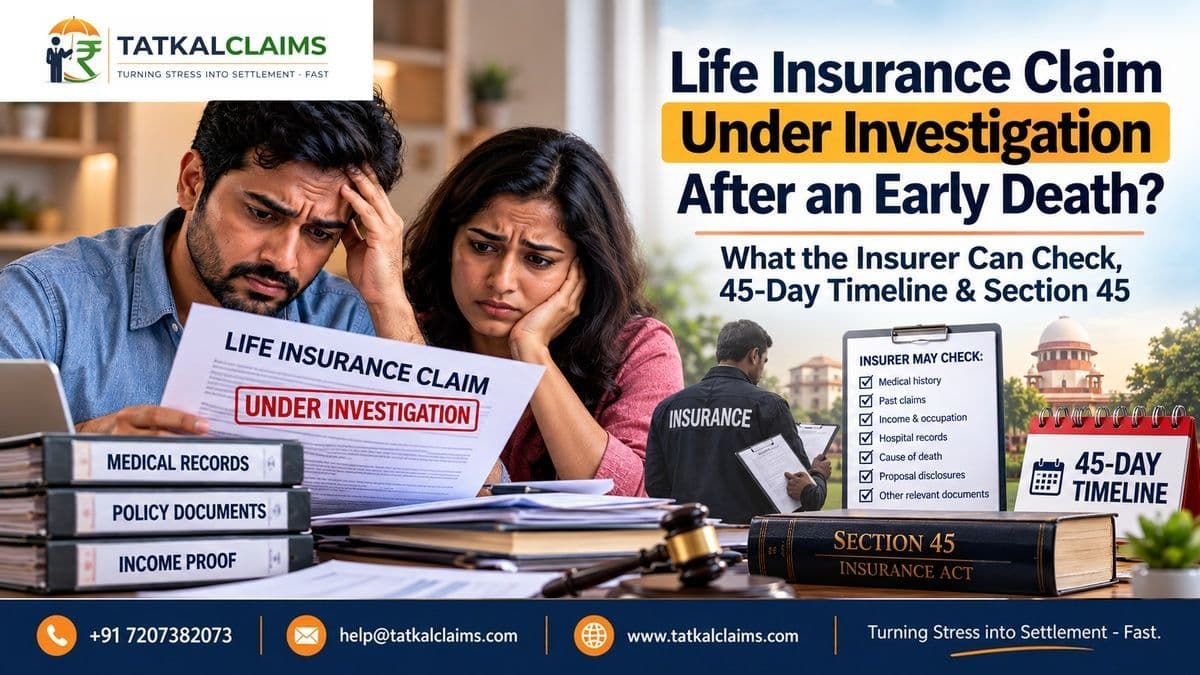
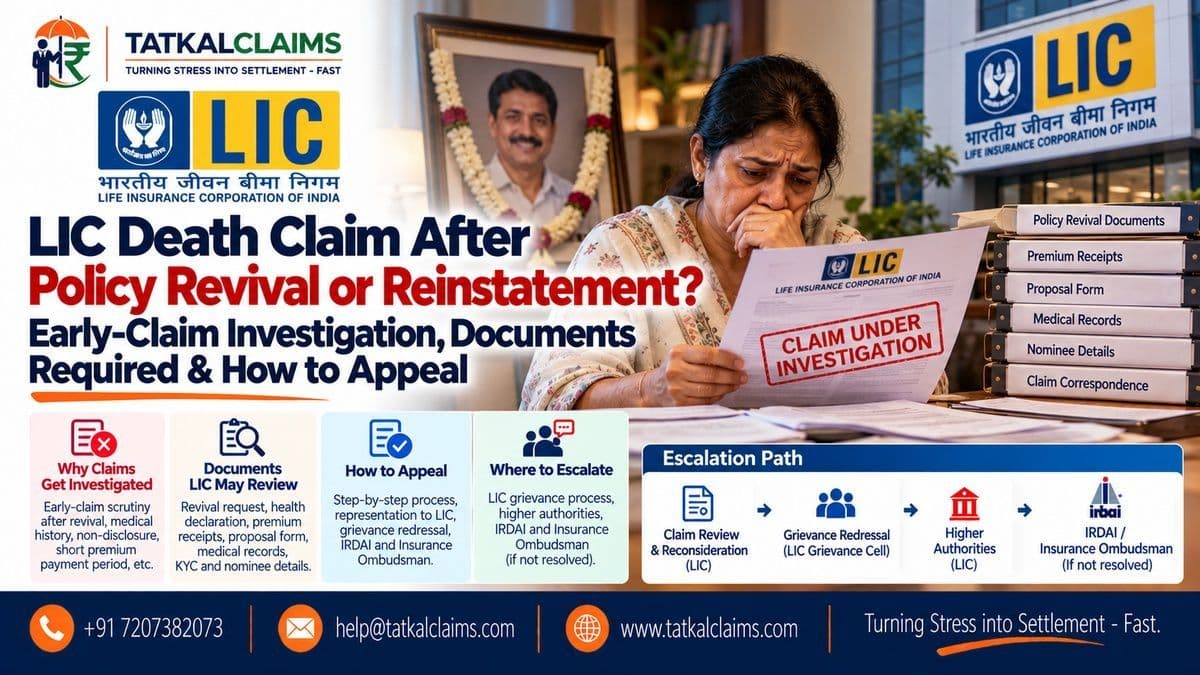
A nominee can receive an LIC death-claim query that looks alarming even though the policy had been running for many years. The reason may be simple: the policy lapsed, was revived, and the life assured died soon after that revival. In claim review, that revival date can matter as much as the original policy date.
The first mistake is to treat every post-revival claim as automatically suspicious. The second is the opposite: assuming an old policy cannot be questioned because it was originally issued more than three years ago. Both shortcuts can be wrong. You have to separate LIC's early-claim documentation process from the legal test under Section 45, and then examine exactly what was stated when the policy was revived.
Written by: Tatkal Claims, Claims Review Team
Reviewed by: Ankit L Kanoi, Founder
If the dispute is not specifically about revival or reinstatement, use our broader LIC claim rejection, delay and investigation guide instead.
Start With the Revival Status, Not the Claim Allegation
Before arguing about non-disclosure, establish whether the policy was actually revived and when that revival became effective. LIC's current policy conditions say a lapsed policy can be revived subject to proof of continued insurability and payment of arrears with interest, but LIC may accept the revival on original terms, accept it on modified terms or decline it. The revival takes effect only after LIC approves it.
That makes the revival approval date critical. Payment of arrears, submission of a health declaration and final approval are not automatically the same event.
| Situation | What it usually means | What to check first |
| Revival approved; death more than 3 years later | The revival-specific early-claim window may already have passed | Exact revival approval date, current premium status and any other later rider/revival event |
| Revival approved; death within 3 years | LIC may call for additional early-claim documents and investigate | Revival form, health declaration, medical requirements, approval date and cause-of-death records |
| Arrears paid but revival not yet approved | Do not assume cover was restored merely because money was accepted | Receipt, revival application, underwriting requirements and written revival approval |
| Death occurred while policy was still lapsed | The dispute may be primarily about lapse/paid-up/grace-period benefits rather than post-revival investigation | Premium ledger, policy terms, paid-up status and exact date of death |
| Revival involved Form 680 or another declaration | Statements made for revival may become central to the claim decision | Signed form, answers, branch receipt date and medical records existing on that date |
| Revival completed without any declaration or medical statement | The revival itself may present a different Section 45 issue | Evidence showing what LIC did—and did not—obtain during revival |
| Reinstatement of a surrendered policy | IRDAI has said reinstatement of a surrendered policy can be treated at par with revival for Section 45 analysis | Reinstatement application, statements made and approval date |
Why LIC Asks for More Documents After a Recent Revival
LIC's current claims-settlement page draws a clear operational line. If death occurs after three years from the date of risk or revival/reinstatement, the ordinary death-claim requirements apply, subject to the policy being in the required premium position. If death occurs within three years from the date of risk or revival/reinstatement, LIC directs the claimant to the servicing branch for additional requirements.
LIC's policy-conditions page is more specific about those additional requirements. It lists the following forms for deaths within three years from risk or revival/reinstatement:
| Document | What LIC says it is used for |
| Claim Form B — Medical Attendant's Certificate | Completed by the medical attendant during the deceased's last illness |
| Claim Form B1 | Used where the life assured received hospital treatment |
| Claim Form B2 | Completed by the medical attendant who treated the deceased before the last illness |
| Claim Form C | Certificate of identity and burial/cremation from a person of known character and responsibility |
| Claim Form E | Employer certificate where the life assured was employed |
| FIR, post-mortem and police investigation report | Typically required where death was accidental or otherwise unnatural |
LIC explains that these forms help it examine the genuineness of the claim and whether material information that could have affected acceptance of the proposal was withheld. In a post-revival case, however, the relevant question may also be what was disclosed or withheld at revival.
The Revival Form Can Become the Most Important Document in the File
LIC's current download page lists revival Forms 680, 700 and 720. Which form and medical requirements apply depends on the policy and LIC's revival process; do not assume every revival uses the same form.
Form 680, titled 'Personal Statement Regarding Health', is particularly important because it asks detailed questions about the life assured's health and insurance history. The current form asks, among other things, about medical consultations during the previous five years, hospital admission, absence from work on health grounds, specified illnesses, accidents or injuries, alcohol/tobacco or other substance use, other insurance or revival applications, and prior proposals that were withdrawn, deferred, declined or accepted on altered terms.
The declaration is not limited to the day it is signed. The current form also requires the life assured to notify LIC if, after submitting the health declaration but before revival, there is a relevant change in occupation, financial circumstances or health, or if another insurance/revival proposal is withdrawn, deferred, declined or accepted on altered terms.
| LIC allegation | Evidence to compare against it |
| Previous illness not disclosed | Form 680 answer, treating doctor's records, admission dates, prescriptions and diagnosis |
| Hospitalisation suppressed | Admission/discharge record, exact admission date and wording of the revival question |
| Wrong answer about other insurance | Other proposal/revival records, insurer correspondence and dates |
| Occupation or financial change not disclosed | Employment/business records and the timing of the change |
| Health changed after declaration but before approval | Date Form 680 was signed, date health changed, date LIC approved revival and any later communication |
| Revival obtained without health declaration | Branch/revival records showing whether LIC actually obtained any declaration, medical or statement |
Do Not Confuse LIC's Three-Year Claim Procedure With Section 45
There are two separate three-year concepts in this subject, and mixing them up can ruin an appeal.
| Question | LIC early-claim procedure | Section 45 |
| What triggers it? | Death within 3 years from date of risk or revival/reinstatement | The insurer questioning a life policy within 3 years from the latest specified statutory date |
| What does it lead to? | Additional claim documents and possible investigation | Legal limits and conditions on when the policy can be called in question |
| Does it automatically mean rejection? | No | No |
| What dates matter? | Date of risk and revival/reinstatement | Issuance, commencement of risk, revival and rider—whichever is later |
For the broader statutory framework, see our Section 45 life-claim guide.
How the Section 45 Clock Works After Revival
Section 45 of the Insurance Act uses the latest of the date of issuance, commencement of risk, revival or rider. That means a revival can create a later statutory reference date even where the original policy is much older.
| Event | Illustrative date |
| Policy issued | 10 January 2020 |
| Policy later lapses | — |
| Revival approved | 18 September 2024 |
| Death | 12 June 2026 |
In that example, looking only at 2020 would be incomplete. The 2024 revival is a later date that has to be considered for Section 45.
IRDAI's Section 45 clarification adds an important nuance. It says that if a policy is called in question within three years of the last revival for statements made at revival, revival is treated as a fresh contract for that purpose. It also says reinstatement of a surrendered policy can be treated at par with revival.
But the same IRDAI clarification also says that if a policy was revived or reinstated by collecting arrears with interest without obtaining any declaration of good health, medical information or other statement from the policyholder, there is no statement made at revival on which to found a revival-based repudiation within that three-year period.
A Very Important Timing Point: Death Date Is Not the Whole Section 45 Test
IRDAI has clarified that the three-year period is not simply measured from revival to death. The insurer has a three-year window to call the policy in question from the applicable statutory date, regardless of whether a death claim has arisen or when it is intimated.
This matters in a delayed-intimation case. A death may occur inside three years but the claim may be notified later. The Section 45 analysis should therefore record not only the date of death, but also the revival date and the date on which LIC actually called the policy in question.
| Date | Why it matters |
| Policy issuance | Possible Section 45 reference date |
| Commencement of risk | May differ from issuance |
| First unpaid premium | Shows when lapse began |
| Revival application | Shows when the insured sought restoration |
| Health declaration / medical date | Fixes what was represented and when |
| Revival approval | Critical for restored cover and Section 45 chronology |
| Rider commencement, if relevant | May be the latest statutory date for a rider dispute |
| Death | Determines claim event and LIC's early-claim process |
| Claim intimation | Starts the servicing chronology |
| Repudiation / policy-called-in-question date | Critical to test Section 45 timing |
What If LIC Says the Deceased Hid an Illness at Revival?
Do not answer with 'he was healthy' or 'we did not know'. Start with the exact revival question and the exact medical record LIC relies on.
Suppose LIC says the life assured failed to disclose a hospital admission. The appeal should identify the admission date, diagnosis, length of stay, what Form 680 asked, the answer given, whether the treatment occurred before or after the declaration, whether the health changed before revival approval, and whether LIC had any of that information through its own medical examination or branch records.
The strongest appeal is usually a chronology plus evidence matrix, not a long emotional representation.
| Question | Evidence |
| What exactly did LIC say was false or withheld? | Repudiation letter and revival file |
| What exact question was asked? | Signed Form 680/700/720 or other revival declaration |
| Was the fact already known to LIC? | Medical exam, earlier policy records, branch correspondence |
| Did the medical event occur before or after the declaration? | Hospital and doctor records |
| Was there a change between declaration and revival approval? | Dated medical/employment/financial records |
| Did LIC obtain no fresh declaration at all? | Revival processing records and receipts |
| Was the policy called in question within the applicable Section 45 window? | Revival/rider dates plus repudiation chronology |
If the claim is still being investigated rather than rejected, use our separate Early Death Investigation guide for the investigation-stage response.
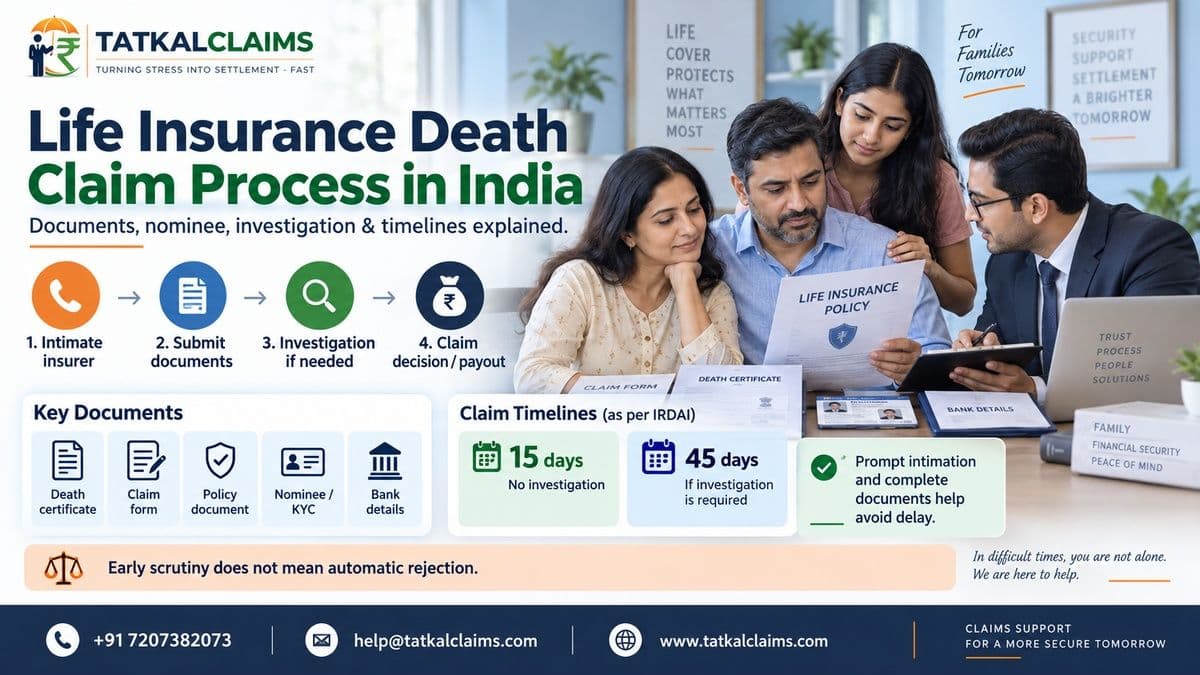
For the basic nominee claim process and ordinary documents, see Life Insurance Death Claim Process in India.
How Long Can the LIC Investigation Take?
IRDAI's 2024 Master Circular sets a 15-day settlement period for a death claim not requiring investigation and 45 days where investigation is warranted, measured from claim intimation. It says a claim should not be rejected or closed solely for want of documents or delayed intimation. If settlement exceeds the specified period, the circular provides for interest at the bank rate plus 2% from intimation until payment.
LIC's 2024 Citizen's Charter separately says it strives to settle death claims without investigation within 15 days after all requirements are submitted, and its service table lists 15- and 45-working-day benchmarks. Keep the intimation acknowledgement as well as a dated log of every requested and supplied document. Do not treat a later document request as automatically resetting the IRDAI period.
Documents and Evidence Checklist for a Post-Revival Death Claim
| Document | Why it matters |
| Policy bond and Customer Information Sheet | Policy dates, benefits, exclusions and servicing terms |
| Premium ledger / receipts | Lapse, arrears and premium status |
| Revival application and approval letter | Whether and when revival became effective |
| Form 680/700/720 or other revival declaration | Exact statements made for revival |
| Revival medical reports, if any | Information LIC had when it accepted revival |
| Claim Form A / 3783 or 3783A as applicable | Claimant's formal death-claim submission |
| Forms B, B1, B2, C and E where called for | LIC's early-death evidence set |
| Death certificate | Date and recorded cause of death |
| Hospital and treating-doctor records | Medical chronology |
| Employer records | Employment, sick leave and occupation disputes |
| FIR / post-mortem / police report where applicable | Accidental or unnatural death evidence |
| Investigator communication / statement | What was asked and what was recorded |
| Repudiation letter | Exact grounds and materials relied upon |
| All grievance acknowledgements | Escalation history and timing |
Escalate a Post-Revival Query or Repudiation
If LIC is still seeking early-claim material, ask the servicing branch for one written list of outstanding forms, the signed revival papers, the approval date and the claim-status record. Submit each item against an acknowledgement. A delay or unclear requirement belongs in a written grievance through LIC's portal or co_complaints@licindia.com; a phone call alone does not preserve the dispute.
If LIC repudiates the claim, request the written grounds and Zonal Claims Dispute Redressal Committee (CDRC) address. In the CDRC representation, put the exact revival question beside the answer, the contemporaneous medical record, the dates of declaration and approval, and the relevant Section 45 date. Saying only that the original policy was old does not answer a revival-specific allegation.
Bima Bharosa can record an unresolved insurer grievance. For an eligible Insurance Ombudsman complaint, first approach LIC; an unsatisfactory response or 30 days without one can open that route, subject to the current ₹50 lakh limit and generally one-year filing period. A consumer proceeding may be appropriate in other cases. Check forum and limitation rules before filing the same dispute elsewhere.
Can TatkalClaims Help With an LIC Claim After Revival?
Yes, particularly where the dispute turns on what happened at revival rather than on the original proposal alone. These files often need reconstruction before they need argument.
TatkalClaims can review the revival declaration, premium history, medical timeline, claim forms, investigation material and repudiation letter to identify whether LIC's allegation actually matches the question asked and the dates involved.
Where the record supports a challenge, we can help structure a branch/grievance representation or CDRC appeal, including the Section 45 chronology and evidence matrix. We do not promise that a claim will be paid: a clear and material false answer in a revival declaration, supported by reliable records and raised within the applicable legal framework, can materially weaken an appeal.
For an initial review, call +91 7207382073 or email help@tatkalclaims.com. The most useful first set is the policy document, premium/revival history, signed revival declaration, claim-status or repudiation letter, and a short medical chronology.
Frequently asked questions
Does death within three years of LIC revival mean the claim will be rejected?
No. LIC's current procedure treats a death within three years of risk or revival/reinstatement as an early claim requiring additional documentation and possible investigation. That is not the same as a finding that the claim is not payable.
If the LIC policy was originally issued more than three years ago, can revival still matter under Section 45?
Yes. Section 45 uses the latest of issuance, commencement of risk, revival or rider. A later revival can therefore become the relevant statutory reference date even though the original policy is much older.
What if LIC revived the policy without taking Form 680 or any health declaration?
IRDAI's Section 45 clarification says that where revival/reinstatement was done by collecting arrears with interest without obtaining any declaration, medical or statement from the policyholder, there is no revival statement on which to base a revival-specific repudiation. That does not automatically decide every other coverage issue.
Can LIC rely on a health change that happened after Form 680 was signed but before revival approval?
The current Form 680 expressly requires the life assured to intimate specified changes occurring after the declaration but before revival, including relevant health, occupation, financial or other-proposal developments. The dates and actual facts therefore need careful examination.
Is payment of all overdue premiums enough to prove the policy was revived?
Not necessarily. LIC's current policy conditions say revival takes effect only after it is approved by the Corporation. Keep the revival approval or other written confirmation; a payment receipt by itself may not establish the effective revival date.
Should I appeal directly to the Ombudsman after LIC repudiates the death claim?
LIC has its own Claims Dispute Redressal Committee mechanism for repudiated death claims, and its repudiation communication should identify the Zonal CDRC route. External options such as Bima Bharosa and the Insurance Ombudsman remain subject to their own current eligibility and timing rules.
Sources & Methodology
Primary-source review completed 4 October 2026. LIC operational procedure, revival wording, forms and grievance details were checked against LIC's current website. Section 45 revival/reinstatement points were cross-checked against IRDAI's published clarification. Ombudsman eligibility was checked against the Council for Insurance Ombudsmen because LIC's own help page still displays an older ₹20 lakh monetary figure.
Disclaimer: This guide provides general information about LIC death claims after revival or reinstatement in India. Revival requirements, policy status, declarations, medical evidence, rider dates, Section 45 analysis and claim entitlement depend on the policy and facts. It is not legal advice and does not guarantee reversal or payment of a claim.