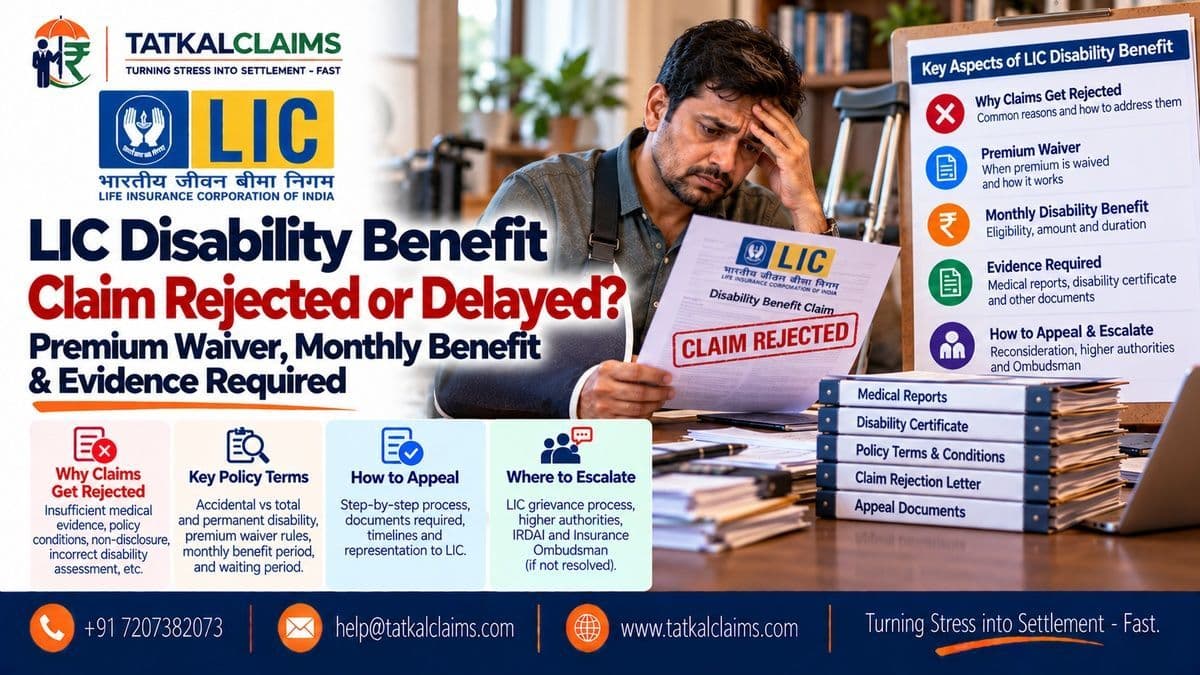
A disability claim under LIC is not the same as showing that an accident caused a serious injury. Under the current Accidental Death & Disability Benefit Rider, the dispute usually turns on four things: whether the rider was in force on the accident date, whether the accident meets the policy definition, whether total and permanent disability arose within 180 days independently of other causes, and whether the disability meets LIC's current functional test.
That distinction matters because LIC's older generic claims page still uses a broad earnings-based description, while the current rider endorsement uses a specific Activities of Daily Living test plus certain catastrophic-loss alternatives. For a current rider claim, the rider schedule and endorsement should control.
Written by: Tatkal Claims, Claims Review Team
Reviewed by: Ankit L Kanoi, Founder
For the accidental-death side of the same rider family, see our LIC Double Accident Benefit claim guide.
Which LIC Rider Actually Provides the Disability Benefit?
LIC currently lists two different accident riders, and they should not be confused.
| Rider | UIN | Disability benefit? |
| LIC's Accident Benefit Rider | 512B203V03 | Accidental-death benefit only; no disability instalment benefit |
| LIC's Accidental Death & Disability Benefit Rider | 512B209V02 | Yes — accidental death plus total-and-permanent disability benefit |
| LIC's Premium Waiver Benefit Rider | 512B204V04 | Different rider with its own trigger; do not confuse with ADDB disability premium waiver |
What the Current LIC Disability Benefit Pays
| Benefit | Current rider position |
| Disability amount | Accident Benefit Sum Assured |
| Payment method | Equal monthly instalments spread over 10 years |
| Rider premium | Future rider premium is waived |
| Base-policy premium | Waived only for Basic Sum Assured equal to the Accident Benefit Sum Assured |
| Excess base cover | Premium for any Basic Sum Assured above the Accident Benefit Sum Assured continues |
| Other riders | Premiums for other riders continue unless their own terms provide otherwise |
| Death/maturity before 10 years ends | Remaining disability instalments not yet due are paid in lump sum |
This is why a rejection or short-settlement dispute should separately test the Accident Benefit Sum Assured, Basic Sum Assured and the part of the base premium LIC says still has to be paid.
The Disability Must Follow a Qualifying Accident Within 180 Days
The current rider defines an accident as a sudden, unforeseen and involuntary event caused by external, violent and visible means.
The accidental injury must, within 180 days of the accident, solely, directly and independently of all other causes result in total and permanent disability.
| Question | Why it matters |
| Was there a qualifying accident? | Illness or degenerative disease alone is not enough |
| Was the rider in force on the accident date? | The cover condition is tested at the accident date |
| Did total and permanent disability arise within 180 days? | Current rider contains this time condition |
| Was the disability caused independently of competing causes? | Medical records may show disease, prior disability or another cause contributing |
What Counts as Total and Permanent Disability Under the Current Rider?
For the current UIN 512B209V02 rider, LIC's functional test is more specific than an ordinary disability percentage certificate.
The rider treats disability as total and permanent where accidental injury, within 180 days and independently of all other causes, leaves the life assured permanently unable to perform at least 4 of 6 Activities of Daily Living without external help/support, including mechanical equipment or aids. An LIC-authorised medical examiner is to certify the disability.
| Activity | Current rider description in practical terms |
| Dressing | Putting on and taking off necessary garments/appliances |
| Washing | Maintaining adequate cleanliness and personal hygiene |
| Feeding | Moving prepared food from plate/bowl to mouth |
| Toileting | Using the lavatory or managing bowel/bladder functions |
| Mobility | Moving indoors room-to-room on level surfaces |
| Transferring | Moving between bed and upright chair/wheelchair |
The rider also deems certain catastrophic losses to be total and permanent disability: irrecoverable loss of the entire sight of both eyes, amputation of both hands at or above the wrists, both feet at or above the ankles, or one hand and one foot at those levels.
Why LIC's Older Claims Page Can Be Misleading
LIC's general Claims Settlement Requirements page still says disability benefit requires total and permanent disability that precludes the insured from earning wage, compensation or profit as a result of the accident.
That wording reflects older/general policy conditions. The current UIN 512B209V02 rider instead spells out the 4-of-6 Activities of Daily Living test and specified catastrophic losses. For a current rider dispute, quote the exact endorsement attached to the policy rather than relying on a generic website paragraph.
| Check | Action |
| Policy/rider UIN | Confirm the exact version attached to the policy |
| Rider commencement date | Identify which wording applies |
| Repudiation letter | Ask LIC to quote the exact clause used |
| Medical assessment | Compare it with the correct rider definition |
| Generic website language | Treat as background, not a substitute for the policy endorsement |
Premium Waiver Is Partial, Not Automatically the Whole Policy Premium
Once a disability claim is admitted, no further premium for the ADDB rider itself is charged.
The base-policy premium is waived only to the extent corresponding to Basic Sum Assured equal to the Accident Benefit Sum Assured. If the Basic Sum Assured is higher, premium on the difference continues. Premium for other riders also continues unless their own terms provide otherwise.
| Policy figure | Illustration only |
| Basic Sum Assured | ₹20 lakh |
| Accident Benefit Sum Assured | ₹10 lakh |
| Base premium waiver | Only the premium corresponding to ₹10 lakh of Basic Sum Assured |
| Premium that may continue | Base premium corresponding to remaining ₹10 lakh + other rider premiums |
What if the Base Policy Was Lapsed or Paid-Up?
The current rider does not acquire paid-up value. LIC's rider brochure says the disability rider benefit ceases if the base policy is in lapsed or paid-up condition, and the rider can be revived only along with the base policy, not by itself.
If the dispute involves unpaid premiums, grace period or revival, see our LIC policy lapse, grace period and revival guide.
Common Reasons an LIC Disability Claim Can Be Rejected
| Ground | What to test |
| No qualifying accident | FIR/MLC/hospital history/accident description and rider definition |
| Disability not total and permanent | Functional assessment against 4-of-6 ADLs or specified catastrophic losses |
| Disability arose after 180 days | Medical chronology from accident through permanent impairment |
| Competing disease/condition | Whether accident was still the sole, direct and independent cause |
| Rider not in force | Premium ledger, grace period, base-policy status and rider schedule |
| Base policy paid-up/lapsed | Whether rider cover had already ceased |
| Exclusion invoked | Exact exclusion wording and factual evidence |
| Insufficient medical certification | Whether LIC obtained/allowed the authorised medical examination contemplated by the rider |
| Wrong rider assumed | Whether policy actually carried UIN 512B209V02 or another disability benefit |
Current Rider Exclusions That Need Specific Evidence
The current rider contains exclusions including intentional self-injury/attempted suicide; intoxication or narcotic/drug use subject to the treatment exception; riots/civil commotion/rebellion/war; hunting, mountaineering, racing, paragliding, parachuting and adventurous sports; criminal acts with criminal intent; specified military/police-duty risks; and disability occurring after 180 days from the accident.
An exclusion should not be accepted merely because the rejection letter names it. Ask LIC to identify the facts and records that bring the accident within that clause.
Documents That Make a Disability Appeal Stronger
| Document | Why it matters |
| Policy schedule + rider endorsement | Proves rider UIN, Accident Benefit Sum Assured and dates |
| Premium ledger | Shows rider/base policy status on accident date |
| FIR / MLC / accident record if available | Supports occurrence and mechanics of accident |
| Hospital admission/discharge records | Builds immediate medical chronology |
| Operation and imaging reports | Shows objective injury |
| Rehabilitation/physiotherapy records | Shows persistence and functional limits |
| Treating specialist opinion | Addresses permanence, causation and prognosis |
| ADL assessment | Maps impairment to dressing/washing/feeding/toileting/mobility/transferring |
| Disability certificate | Useful supporting evidence, though not a substitute for rider wording |
| LIC medical examiner report | Critical where LIC has assessed total/permanent disability |
| Repudiation/deficiency letter | Defines exact issue to answer |
| Occupation/income evidence | Useful if an older policy version uses an earnings-based test |
If LIC Says the Disability Is Not 'Permanent' Yet
Some severe injuries improve with surgery, rehabilitation or assistive treatment, so permanence may not be medically established immediately after the accident.
The appeal should distinguish between a temporary inability to work and the current rider's contractual total-and-permanent test. Ask the treating specialist to state the diagnosis, treatment completed, expected recovery, residual deficits and whether the functional loss is considered permanent.
If LIC rejected the claim before the condition stabilised, ask whether the decision was a final repudiation or a request to reassess after the medical condition becomes determinable within the rider framework.
How to Challenge an LIC Disability Claim Decision
1. Servicing Branch
Request the written claim decision, exact rider clause, medical-examiner findings and list of missing evidence. If the claim is merely pending, ask what specific requirement remains outstanding.
2. LIC Grievance Redressal
Escalate factual, medical or policy-status errors through LIC's grievance machinery. LIC currently publishes co_complaints@licindia.com and its customer grievance portal/GRO structure.
3. Bima Bharosa
If the insurer response is unsatisfactory or the grievance remains unresolved, Bima Bharosa provides an IRDAI-visible complaint trail. Current contact details include 155255, 1800 4254 732 and complaints@irdai.gov.in.
4. Insurance Ombudsman
Current CIO procedure requires a complaint to the insurer first. If the insurer's response is unsatisfactory, or no response is received within 30 days, an eligible claimant may approach the Ombudsman subject to the current ₹50 lakh monetary limit, general one-year filing period and other forum conditions.
14-Day Action Plan After Rejection or Delay
| Day | Action |
| Day 1 | Get the written decision/deficiency letter and rider schedule. |
| Day 2 | Confirm UIN, Accident Benefit Sum Assured and accident-date policy status. |
| Day 3 | Collect accident, hospital and imaging records. |
| Day 4 | Build a date chronology from accident to current disability. |
| Day 5 | Map each current functional limitation to the six ADLs. |
| Day 6 | Obtain specialist opinion on permanence and causation. |
| Day 7 | Collect disability certificate and rehabilitation records. |
| Day 8 | Request LIC's authorised medical-examiner report/findings. |
| Day 9 | Check the 180-day condition and any cited exclusion. |
| Day 10 | Calculate which premium components should be waived if admitted. |
| Day 11 | Prepare a short clause-by-clause representation with annexures. |
| Day 12 | Submit to servicing branch and LIC grievance channel with proof. |
| Day 13 | Calendar insurer-response and premium due dates; do not allow the base policy to lapse. |
| Day 14 | Prepare Bima Bharosa/Ombudsman escalation if the decision remains unsupported. |
Can TatkalClaims Help With an LIC Disability Benefit Claim?
Yes. These disputes usually need a medical-policy comparison, not a generic complaint. TatkalClaims can review the rider schedule, premium status, accident chronology, hospital records, disability certificate, ADL limitations, LIC medical assessment and repudiation or deficiency letter.
We can then identify whether the real problem is rider eligibility, the 180-day condition, total-and-permanent disability, competing medical causation, an exclusion, or an incorrect premium-waiver calculation.
Where the evidence shows only temporary disability, a rider that was not in force, or a condition that does not meet the contractual definition, we will not present the claim as though a rejection is automatically wrong.
For an initial review, call +91 7207382073 or email help@tatkalclaims.com. Send the rider schedule/endorsement, rejection or deficiency letter, accident record, latest medical summary and disability certificate first.
Frequently asked questions
Does LIC pay the disability benefit as one lump sum?
Under the current Accidental Death & Disability Benefit Rider, the Accident Benefit Sum Assured is normally paid in equal monthly instalments over 10 years. If death or maturity occurs before that period ends, the remaining instalments not yet due are paid in lump sum.
Does an admitted disability claim waive the entire LIC policy premium?
Not necessarily. The rider premium is waived, and base-policy premium is waived only for Basic Sum Assured equal to the Accident Benefit Sum Assured. Premium for any excess Basic Sum Assured and other riders may continue.
Is a government 100% disability certificate enough by itself?
It is important evidence, but the current rider applies its own contractual test. LIC looks for total and permanent disability linked to the qualifying accident, generally inability to perform at least four of six Activities of Daily Living or one of the specified catastrophic losses.
Can LIC reject because I can still do some daily activities?
Potentially, depending on the exact functional evidence. Under the current rider's general ADL route, the insured must be permanently unable to perform at least four of the six listed activities without external help/support. The catastrophic-loss alternatives are separate.
What happens if the base policy was already paid-up?
The current rider brochure says the rider acquires no paid-up value and its benefit ceases if the base policy is in lapsed or paid-up condition. The exact accident date, premium status and any revival must therefore be checked carefully.
Does the LIC Claims Dispute Redressal Committee hear disability-benefit appeals?
LIC describes CDRC as an internal review mechanism for repudiated death claims. A living policyholder's disability-benefit dispute is generally better routed through LIC grievance channels, Bima Bharosa and the Insurance Ombudsman if eligible.
Sources & Methodology
Primary-source review completed 5 October 2026. The current LIC Accidental Death & Disability Benefit Rider endorsement and sales brochure for UIN 512B209V02 were treated as controlling for benefit mechanics, total-and-permanent disability, ADLs, 180-day causation, premium waiver, lapse/paid-up status and exclusions. LIC's older general claims page was used only to explain why some online wording still refers to inability to earn. Current grievance routes were checked separately.
Disclaimer: This guide explains LIC accidental-disability benefit disputes in general terms. Entitlement depends on the exact rider or in-built benefit attached to the policy, UIN/version, accident facts, medical causation, permanence, Activities of Daily Living, premium status, exclusions and LIC's medical assessment. It is not legal or medical advice and does not guarantee admission or reversal of a claim.