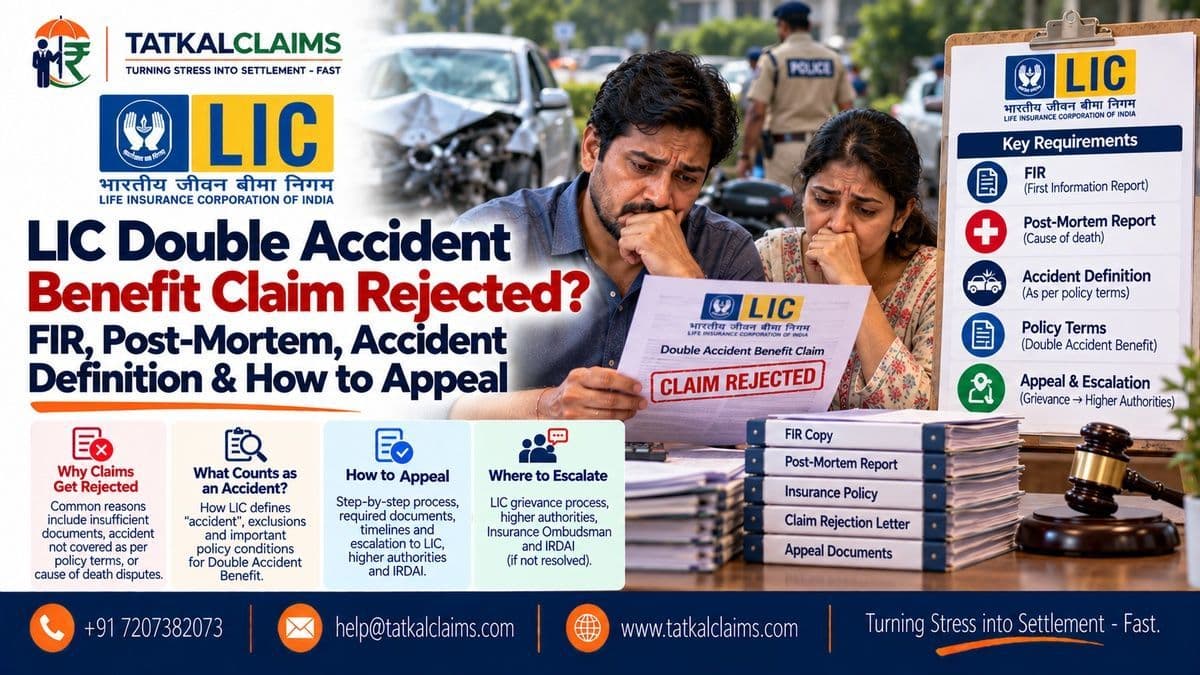
An LIC death claim can be paid under the base policy while the accident benefit is rejected separately. That usually happens because LIC accepts that the insured died, but disputes one of the rider conditions: whether the death was really caused by an accident, whether the rider was in force on the accident date, whether death followed within the required 180 days, or whether an exclusion applies.
The practical mistake is to argue only that 'the death was accidental'. For an accident-benefit claim, the evidence has to fit the wording of the rider actually attached to the policy.
Written by: Tatkal Claims, Claims Review Team
Reviewed by: Ankit L Kanoi, Founder
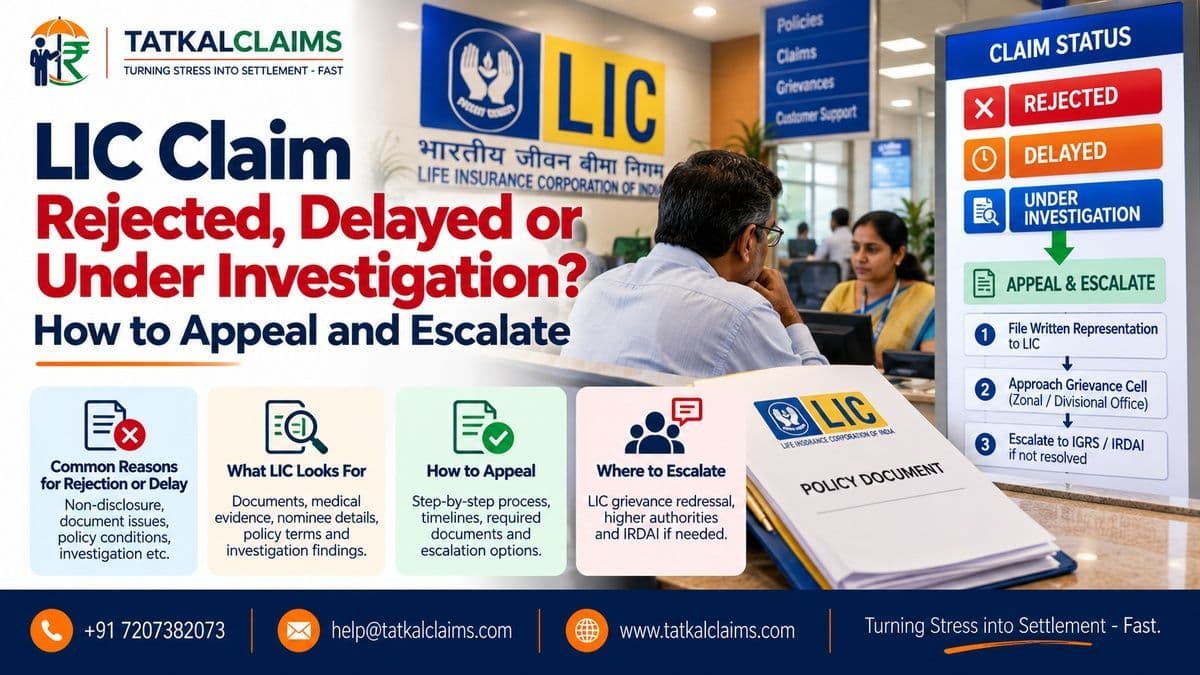
For a broader LIC repudiation or delay dispute, use our LIC claim rejection, delay and investigation guide.
First, Confirm What Accident Benefit Was Actually Attached
LIC's public claims pages still use the phrase 'Double Accident Benefit'. That legacy label is useful for search and for many older policies, but it can mislead a claimant reviewing a current policy.
LIC's current rider list includes LIC's Accident Benefit Rider (UIN 512B203V03), LIC's Accidental Death and Disability Benefit Rider (UIN 512B209V02) and a linked accidental-death rider for linked plans. The current Accident Benefit Rider pays the Accident Benefit Sum Assured stated in the rider schedule. That amount is payable in addition to the base-policy death benefit when the rider conditions are met.
| Scenario | What usually decides the rider claim | Evidence to obtain first |
| Road accident; FIR and post-mortem available | Accident definition, causation, rider in-force status and exclusions | FIR, PM report, inquest, MLC, hospital record, rider schedule |
| Fall at home; no FIR or post-mortem | Whether other evidence reliably proves a sudden external accidental event and causal death | Hospital notes, witness statements, death summary, local records, photographs if any |
| Accident followed by hospitalisation; death weeks later | Whether death occurred within 180 days and was caused solely/directly/independently by accident injuries | Complete treatment chronology, imaging, discharge summaries, death certificate, PM if done |
| Death after more than 180 days | Current rider wording can defeat the accident benefit even if the original accident is proved | Accident date, death date, exact rider version |
| Alcohol/drug allegation | Whether the exclusion is actually established and causally relevant under the wording | Toxicology, PM, MLC, police record, prescription records |
| Adventure sport / racing / riot / criminal-act allegation | Whether the facts fall within a listed exclusion | Police record, event facts, policy rider wording |
| Rider lapsed or base policy paid-up | Current Accident Benefit Rider has no paid-up value and can cease when the base policy is lapsed/paid-up | Premium ledger, rider premium status, accident date |
| Base death claim paid but accident benefit rejected | The dispute is only over the extra rider amount, not necessarily the base death claim | Settlement letter, rider schedule, repudiation letter |
What Counts as an 'Accident' Under LIC's Current Rider?
LIC's current Accident Benefit Rider defines an accident as a sudden, unforeseen and involuntary event caused by external, visible and violent means.
That definition is why the cause-of-death chain matters. A road collision, a fall or an external impact may fit the definition if the medical evidence supports it. A death caused principally by a disease process may not become an accident-benefit claim merely because the person happened to fall or collapse.
| Question | Why it matters |
| Was the event sudden? | A gradual medical condition is different from a sudden event. |
| Was it unforeseen and involuntary? | Intentional acts can fall outside the definition or within exclusions. |
| Was there an external, visible and violent cause? | The rider definition expressly uses these elements. |
| Did the accident cause the fatal injury? | The rider requires a causal link, not just temporal proximity. |
| Did death occur within 180 days? | Current rider wording imposes this outer limit. |
| Was the rider in force on the date of accident? | The current rider specifically tests cover at the accident date. |
| Does an exclusion apply? | Intoxication, criminal intent, specified hazardous activities and certain service-related risks can matter. |
The 180-Day Rule Is a Causation Rule and a Timing Rule
Under LIC's current Accident Benefit Rider, the accidental injury must result in death within 180 days of the accident, solely, directly and independently of all other causes.
This creates two separate issues. First, count the days correctly. Second, examine the medical chain. If the insured survives the accident but later dies after complications, LIC may examine whether the accident injuries remained the operative cause of death or whether an unrelated illness became the real cause.
| Event | Illustrative date |
| Road accident | 10 January 2026 |
| Multiple fractures and internal injuries documented | 10 January 2026 |
| Continuous hospital treatment | January-February 2026 |
| Death | 15 February 2026 |
| Claim issue | Timing is within 180 days, but causation still has to be proved from medical records |
FIR and Post-Mortem: Important Evidence, but Understand What They Prove
LIC's current claims-settlement page says that for Double Accident Benefit claims the claimant must prove that the accident meets the policy conditions and that documents such as the FIR and post-mortem report are normally insisted upon.
The FIR helps establish that an external incident was reported, when and where it happened, who was involved and how the police initially recorded it. A post-mortem can be even more important because it addresses injuries and medical cause of death.
But not every accidental death produces an FIR or a post-mortem. A fall at home may be taken directly to hospital. A rural family may proceed with cremation without police reporting. In those cases, the claimant needs an alternative evidence chain strong enough to prove the accident and causal death.
| Possible evidence | What it can help prove |
| Emergency-room / casualty record | History of accident recorded close to the event |
| Medico-legal case record, if any | Contemporaneous accident details |
| Hospital admission and discharge summaries | Injuries, treatment and complications |
| Doctor's certificate / death summary | Medical causal chain |
| Witness statements | How the accident occurred |
| Panchayat / local authority record | Contemporaneous local confirmation in some cases |
| Ambulance record | Time, place and condition of patient |
| Photographs / CCTV | External event and scene |
| Police inquest / final report | Accidental nature where formal FIR is not the only police record |
| Death certificate | Official death date and recorded cause, though often not detailed enough by itself |
An Older LIC Case Shows Why Missing FIR or Post-Mortem Is Not Always the End
In Life Insurance Corporation of India v. Harjinder Kaur, decided by the Punjab State Consumer Commission in 2010, the insured died when a tractor overturned and he was buried under it. LIC paid the ordinary policy amount but rejected the double accident benefit because no FIR or post-mortem report had been produced.
The Commission had more than the family's account. An application made to the SDM was referred to the police; the SHO and SDM reported accidental death, and the village Panchayatnama supported it. On that particular record, the Commission found the tractor accident sufficiently proved despite the missing FIR and post-mortem. The decision does not replace the medical-causation and rider-wording checks in a current claim.
The Rider Must Be In Force on the Date of Accident
LIC's current Accident Benefit Rider says the rider must be in force at the time of the accident. Its current brochure also says the rider does not acquire paid-up value and the benefit ceases if the base policy is in lapsed or paid-up condition.
That creates an important date distinction. If the accident occurs while the rider is in force and death follows later within the permitted 180-day period, the claim analysis starts from the rider status on the accident date.
| Check | Why it matters |
| Base-policy premium ledger | Shows whether the base policy was in force. |
| Rider premium entry | Confirms the accident rider was actually being charged. |
| Grace-period position | The rider follows the base policy's grace period. |
| Accident date | The key date for in-force status. |
| Death date | Relevant to the 180-day limit and base death claim. |
| Revival date, if any | A rider revival is considered with revival of the base policy, not in isolation. |
If LIC says the base policy or rider had lapsed before the accident, read our dedicated LIC unpaid-premium and lapse guide.
Current LIC Accident-Benefit Exclusions to Check
The current Accident Benefit Rider contains specific exclusions. The exact language of the rider attached to the policy controls, but the current V03 wording includes the following categories:
| Exclusion category | What to verify before accepting LIC's conclusion |
| Intentional self-injury / attempted suicide | Actual facts and police/medical evidence; do not infer intention merely from an unusual accident. |
| Intoxicating liquor, narcotic or drug | Whether intoxication is actually proved; prescribed treatment is treated differently in the wording. |
| Riots, civil commotion, rebellion, war | Whether the insured was taking part in the excluded activity. |
| Hunting, mountaineering, racing, paragliding, parachuting or adventurous sports | Whether the activity fits the rider's listed wording. |
| Criminal act with criminal intent | The current wording requires criminal intent, not merely any technical legal violation. |
| Certain armed-forces or military-service accidents | Check the duty status and the rider's stated exceptions. |
| Police-duty accidents | Check whether police-duty accident cover was specifically opted for and paid. |
| Death after 180 days | The current rider expressly excludes a death occurring after 180 days from the accident. |
Do Not Let LIC Collapse 'Accident' and 'Disease' Into One Line
Some of the hardest claims involve both trauma and illness. For example, an insured may suffer a fall, head injury and prolonged admission, while also having diabetes, heart disease or another condition.
The appeal should not simply say 'there was an accident'. It should ask whether the accident independently produced the fatal injury and whether the medical records support LIC's claim that disease—not trauma—was the proximate cause.
| Evidence | Question to answer |
| FIR / inquest | What external event occurred? |
| Post-mortem | What injuries were found and what was the cause of death? |
| Hospital admission note | What was the history given immediately after the event? |
| Imaging / surgery notes | What traumatic injuries were objectively documented? |
| Death summary | What complications led to death? |
| Pre-existing medical records | Was there a competing disease cause? |
| LIC medical opinion / investigator report | What exactly is LIC relying on to break the accident-death link? |
Documents to Collect Before Challenging a Rejected Accident Benefit
| Document | Why it matters |
| Policy bond and rider schedule | Proves the accident benefit was attached and states the sum assured/UIN |
| Premium ledger | Shows rider/base policy status on accident date |
| Death-claim settlement letter | Shows whether base death benefit was already admitted |
| Accident-benefit repudiation letter | Exact reason for rejecting the extra benefit |
| FIR / DDR / inquest / police papers | Accident occurrence and investigation |
| Post-mortem report | Injury and cause-of-death evidence |
| MLC / casualty record | Contemporaneous accident history |
| Complete hospital file | Causation from accident through death |
| Death certificate | Death date |
| Witness statements / scene evidence | Alternative or corroborative proof |
| Toxicology report, if relevant | Tests intoxication allegation |
| Driving / vehicle records where relevant | May answer factual allegations, though the rider wording—not assumptions—controls |
| Rider/product wording applicable to the policy | Accident definition, exclusions and 180-day condition |
| All LIC requirement letters | Shows what evidence LIC asked for and what was submitted |
How to Read the Repudiation Letter
| LIC reason | What the appeal should test |
| 'No FIR / post-mortem' | Do those documents exist? If not, what contemporaneous evidence independently proves accident and causation? |
| 'Death not accidental' | What rider element does LIC say failed: sudden, unforeseen, involuntary, external, visible or violent? |
| 'Death due to disease' | What medical evidence shows disease displaced the accident as the effective cause? |
| 'Death beyond 180 days' | Verify accident/death dates and the exact rider version. |
| 'Rider not in force' | Audit premium ledger, grace period and accident date. |
| 'Intoxication' | Demand the toxicology/medical basis; avoid assumption from smell, allegation or social history alone. |
| 'Excluded activity' | Match the actual activity to the exact exclusion language. |
| 'Criminal act' | Current wording refers to a criminal act with criminal intent; test whether LIC has proved both. |
Challenge the Rider Decision, Not the Base Death Claim
Ask LIC for the written accident-benefit decision, the rider schedule and UIN, and the premium status on the accident date. If the base death claim was paid, state clearly that the disputed amount is the additional rider benefit. Make LIC identify whether it contests the event, medical causation, 180-day period, rider status, a named exclusion or missing evidence.
Send the branch or grievance officer a clause-by-clause response with the accident-to-death treatment record and available police, medical and witness material. Explain why an FIR or post-mortem does not exist if it is missing; do not manufacture one. For a repudiated death-rider claim, request the Zonal CDRC appeal address and focus that submission on the exact weakness LIC identified.
Bima Bharosa offers a tracked grievance route. An eligible Ombudsman complaint follows an insurer complaint and an unsatisfactory response or 30 days without one, subject to the ₹50 lakh limit and generally one-year period. A consumer proceeding may be another route; check forum restrictions before starting parallel cases.
Can TatkalClaims Help With an LIC Accident-Benefit Claim?
Yes. These disputes are often won or lost on evidence sequencing rather than on the words 'accidental death'. The file has to show that the correct rider was in force, the event met the policy definition, the medical chain supports accident as the cause and the cited exclusion does not fit.
TatkalClaims can review the rider schedule, premium status, FIR/inquest, post-mortem, hospital chronology, LIC investigator material and repudiation letter to identify the real weak point in the claim.
Where FIR or post-mortem is missing, we can help assess whether the remaining contemporaneous record is strong enough to build an evidentiary appeal. Where the medical records point primarily to disease, the rider was not in force, death fell outside the contractual period or a clear exclusion applies, we will not present the claim as stronger than the documents support.
For an initial review, call +91 7207382073 or email help@tatkalclaims.com. Send the policy/rider schedule, accident-benefit rejection, FIR/inquest if available, post-mortem if available, and the complete hospital/death summary first.
Frequently asked questions
Does LIC always require both an FIR and post-mortem for Double Accident Benefit?
LIC's current public guidance says FIR and post-mortem are normally insisted upon. If one does not exist, the claimant should not invent or back-create it; instead, obtain the strongest contemporaneous police, medical and witness evidence available and ask LIC to assess the accident on that record.
If LIC paid the ordinary death claim, does that mean the accident benefit must also be paid?
No. The base death benefit and accident rider have different conditions. LIC can admit the ordinary death claim but still dispute the rider because of accident definition, causation, rider status, the 180-day rule or an exclusion.
If the insured dies in hospital several weeks after the accident, can the rider still pay?
Potentially yes if death occurs within the contractual 180-day period and the accident injuries are shown to have caused death solely, directly and independently of other causes. The hospital chronology becomes crucial.
Does a policy being paid-up preserve LIC Accident Benefit Rider cover?
The current Accident Benefit Rider brochure says the rider acquires no paid-up value and the rider benefit ceases when the base policy is in lapsed or paid-up condition. The exact rider version attached to the policy should still be checked.
Can LIC reject the accident benefit merely because the deceased had a pre-existing disease?
A pre-existing disease does not automatically defeat the rider. The real issue is causation: whether the accidental injury, independently of other causes, produced the death under the applicable wording. Medical records must resolve that question.
What if the accident happened while the rider was in force but a premium fell due before death?
Current Accident Benefit Rider wording focuses on the rider being in force on the accident date. It also provides for deduction of certain rider premiums falling due after the accident up to the relevant policy anniversary in an admissible death claim. Check the exact rider wording and premium chronology rather than assuming later non-payment automatically defeats the claim.
Sources & Methodology
Primary-source review completed 4 October 2026. Current rider identity, accident definition, 180-day requirement, in-force condition, paid-up treatment, exclusions and grievance wording were checked against LIC's current Accident Benefit Rider materials and current LIC claims pages. The older Harjinder Kaur consumer decision is used only as an evidentiary illustration, not as a substitute for current policy wording.
Disclaimer: This guide provides general information about LIC accident-benefit and 'double accident benefit' death claims in India. Entitlement depends on the exact rider or in-built benefit attached to the policy, UIN/version, accident facts, medical causation, premium status, exclusions and evidence. It is not legal advice and does not guarantee payment or reversal of a rejected claim.