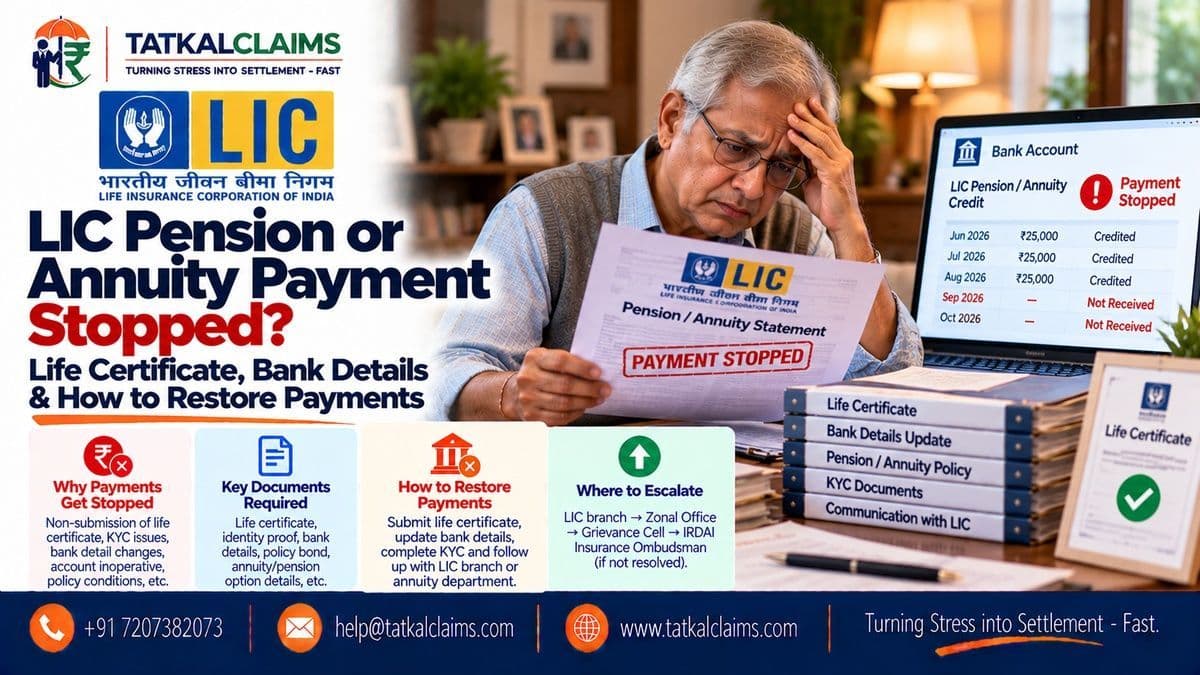
When an older LIC annuitant stops receiving a monthly payment, the family may discover the problem only after rent, medicines or household expenses become difficult to manage. The branch may say a life certificate is due. The pensioner may insist it was already submitted. Another person might be receiving a joint-life annuity after a spouse's death and be told the original payee's account has been closed.
The first task is to identify the actual stoppage: was the payment not yet due, put on hold for a Certificate of Existence, credited to an old bank account, affected by a change of annuitant, or stopped because the annuity contract ended? These are different issues, and sending the same documents repeatedly will not resolve all of them.
Written by: Tatkal Claims, Claims Review Team
Reviewed by: Ankit L Kanoi, Founder
Step One: Confirm Which LIC Pension or Annuity You Hold
An LIC annuity is not necessarily a government-service pension. An individual may have purchased an immediate annuity such as Jeevan Akshay or Saral Pension, selected a deferred annuity such as New Jeevan Shanti, or be receiving benefits under an employer's group superannuation arrangement. The servicing route, number used to identify the payment and certificate requirements may differ.
| Arrangement | What to check |
| Individual immediate annuity | Annuity/policy number, option, commencement date, payment mode and servicing IPP Cell |
| Individual deferred annuity | Deferment-end date, vesting/commencement of payout and first payment due date |
| Joint-life annuity | Primary and secondary annuitant details and what happens after the first death |
| Group annuity / superannuation | Master policy, member or annuity number, employer/trustee and P&GS unit |
| Other pension-related LIC plan | Whether it is already in annuity payout mode or remains in accumulation/deferment |
Do not rely on the word 'pension' on a passbook entry alone. The policy schedule and annuity option determine whether money is currently due.
A recurring monthly or quarterly annuity should not be confused with a money-back policy's scheduled survival instalment. If your payment was due at a specific policy anniversary rather than under an annuity mode, follow our LIC survival-benefit payment guide instead.
A Payment May Not Be Late: Check the Mode and First Due Date
LIC's Jeevan Akshay VII policy terms describe immediate-annuity instalments as payable in arrears, according to the chosen mode. Under that example, a monthly instalment first becomes due after one month, quarterly after three months, half-yearly after six months and yearly after one year from commencement.
Deferred annuities work differently. LIC's New Jeevan Shanti terms explain that nothing is payable as an annuity during the deferment period; payments begin after deferment, subject to the policy's selected option and mode. A missing payment during a genuine deferment period is not an overdue annuity.
| Record | Question |
| Policy commencement date | When was the annuity purchased or issued? |
| Immediate versus deferred | Has payout actually commenced? |
| End of deferment / vesting | Has the event triggering annuity payments occurred? |
| Monthly/quarterly/half-yearly/yearly mode | Which contractual due date applies? |
| Arrears payment provision | Is the payment made at the end of the period? |
| Last actual credit | Which instalment is the first one missing? |
LIC's Life Certificate and Certificate of Existence Rules
LIC's current Download Forms page lists a 'Certificate of Existence' for Individual Pension Policy (IPP) servicing. It is used to establish that the annuitant remains alive where continuing payments depend on survival. The certificate is not simply an Aadhaar/KYC update; it is a separate attested confirmation of existence.
I checked LIC's two-page IPP Certificate of Existence and a separate Pension & Group Schemes life-certificate proforma. Both are published by LIC, but their descriptions and option codes differ. They must be read in the context of the particular issued policy and the due-date notice from the responsible servicing unit.
| Published form / annuity category | Frequency shown on that form |
| IPP Certificate of Existence — options A/G/H/I | Yearly |
| IPP form — options B/C/D/E | Yearly after the guarantee period, as indicated on the form |
| IPP form — options F/J | Once every five years |
| P&GS life-certificate proforma — life-annuity option | Once a year |
| P&GS proforma — annuity with return-of-capital option | Once every five years |
A particularly important printed instruction on LIC's P&GS form is that the certificate should be completed on or after the specified due date. A form signed too early may not satisfy that specific certification cycle. Request the actual due-date notice rather than submitting a backdated certificate.
Who Can Attest an LIC Existence Certificate?
LIC's published IPP certificate lists several acceptable certifying persons, including a bank branch manager, gazetted officer, registered medical practitioner, postmaster, school/college principal, specified Class-I officers, LIC Development Officer and an LIC agent with the applicable stamped code. The form requires the annuitant to appear and sign in the certifier's presence, with the certifier's signature and identification.
The P&GS proforma similarly provides for the annuitant's signature, certifier's signature, designation, address and rubber stamp, including registration number or code where applicable. Use the version instructed by the servicing unit instead of assuming that a signature on plain paper is enough.
| Problem | What to correct |
| Signed before the specified date | Obtain a correctly dated certificate within the stated cycle |
| Annuity/policy number missing | Add every affected annuity number accurately |
| Certifier has no rubber stamp or registration/code | Complete the attestation as LIC's form directs |
| Annuitant signature missing or inconsistent | Confirm required identity/signature procedure with LIC |
| Certificate reached a branch but not the servicing unit | Obtain acknowledgement and IPP/P&GS receipt or processing confirmation |
| Different annuity type/option than assumed | Use the correct form and cycle for the actual contract |
Where to Submit the Certificate and How to Prove LIC Received It
LIC's published Certificate of Existence intimation says annuitants may submit the certificate at any LIC branch help desk and obtain an instant acknowledgement, or submit it to the responsible IPP Cell. LIC's customer-service pages also list assistance with Life Certificates (Pension Policies) at Customer Zones.
The practical issue is frequently not whether the pensioner can prove being alive, but whether the certificate was correctly mapped to every annuity number at the processing unit. If payment has stopped after submission, ask for confirmation of the certificate's date of receipt, acceptance status, next due cycle and whether the annuity has been released for payment.
Can You Use Jeevan Pramaan or a Digital Life Certificate?
The Government of India's Jeevan Pramaan system supports biometric/digital life certification for pensioners whose pension-sanctioning authority is onboarded. Its own guidance makes that eligibility conditional on the authority's participation and requirements.
LIC historically documented integration of Jeevan Pramaan into its individual pension-policy processing, but that does not establish that every current LIC individual or group annuity option automatically accepts any digitally generated certificate or that LIC has linked a given Pramaan ID to an annuity.
Before using Jeevan Pramaan in place of the LIC form, obtain confirmation from the IPP Cell or P&GS unit that your annuity type and authority are supported, which identity/annuity number must be selected, and whether the digital certificate has been received and accepted. If the annuitant cannot use digital authentication, ask for the currently accepted attested physical certificate route.
For the government system's eligibility rules and official application guidance, consult Jeevan Pramaan's official website.
When the Life Certificate Is Accepted but the Bank Credit Still Fails
LIC's current forms index contains a separate IPP-NEFT Mandate Form for annuity payments. The form asks for the annuitant's policy number, bank name and address, account type, account number, IFSC, mobile/email and bank proof such as a cancelled cheque or a passbook page. These details need to match the receiving account.
The error may be an old IFSC following a bank merger, a closed/dormant account, the wrong account type, name mismatch or an account frozen after a death notification. Do not assume a rejected bank credit means LIC has stopped the annuity permanently.
| What LIC says | Evidence to ask for |
| Payment on hold | Exact reason and pending requirement |
| Payment approved | Scheduled credit date and whether an outward payment instruction exists |
| NEFT sent | Transfer date, destination and bank reference to trace |
| NEFT returned | Return reason and instructions for correcting the mandate |
| Bank details changed | Date the new mandate was accepted and which payment it applies to |
Use the IPP-specific mandate when the annuity is serviced as an individual pension policy, or ask the P&GS unit for the corresponding group annuity update procedure. Keep bank account and identity information within verified LIC submission channels.
The official LIC Download Forms page links the IPP-NEFT form and Certificate of Existence.
Joint-Life Annuity: What Happens After One Annuitant Dies?
Not every annuity ceases on the first death. Under LIC's Saral Pension joint-life last-survivor option, the annuity continues at 100% to the survivor and ends on the death of the last survivor; the purchase-price benefit then follows the chosen plan terms. LIC's New Jeevan Shanti joint-life deferred-annuity policy document similarly provides for continued annuity on first death after the deferment period.
By contrast, a single-life annuity may cease on the covered annuitant's death. Certain guaranteed-period annuities can continue to the nominee for the remainder of the guaranteed term; other options provide a return of purchase price or another contractual death benefit. Which event happened and which option was chosen matter more than the label 'LIC pension'.
For a surviving spouse whose credit stopped after the first death, ask LIC whether the policy is joint life, whether the surviving annuitant is correctly recorded, which bank mandate/identity documents are needed, and whether any payment is due for the transition period.
Group Annuity Death Claims Use a Different Process
LIC's April 2026 Download Forms page links 'Annuity Claim forms' under Pension & Group Schemes. I inspected the two scanned pages: they are for claiming benefits on an annuitant's death and a return-of-capital discharge, with the forms directed to trustees under a master policy. They are not the ordinary form for reinstating a living annuitant's suspended monthly credit.
If an employer or trust arranged the pension, request the master policy number, annuity/member number, P&GS servicing unit, trustee or administrator contact, and the actual annuity option. A surviving spouse's benefit, a deceased member's return-of-capital claim and a living member's uncredited payment may follow different administrative routes.
Where the broader dispute concerns who receives death benefits rather than a stopped living annuity, our nominee versus legal heir guide explains the entitlement distinction.
The Amount Is Lower Than Before: It May Not Be a Complete Stoppage
Before treating the reduced credit as a cancelled pension, compare the gross contractual annuity with the net bank credit. Ask for a payment statement that identifies any tax deduction at source, lawful loan recovery, or contract-specific adjustment rather than assuming the annuity rate itself has been changed.
Annuity rates fixed at policy inception are generally determined by the selected plan and option, but the bank credit can differ for taxation or permitted adjustments. Avoid mixing a TDS query with a claim that the entire annuity has been repudiated.
What LIC Publishes About Annuity Payment and Complaint Timelines
LIC's currently linked Turnaround Time document for Pension & Group Schemes identifies 'Annuity payouts' among benefits with an 'On due date' service standard. The same document gives immediate complaint acknowledgement and a 14-day benchmark for action and communication of decision.
Those are published service benchmarks, not proof that every payment was due on the day someone expected it. Check the mode, arrears provision, deferment period and survival/death conditions first, then compare actual credits with the policy's scheduled due dates.
If a valid certificate was acknowledged and the next contractual payout still did not arrive, include the certificate receipt, due instalments and bank details in a formal grievance. Ask for an itemised written explanation of all unpaid months or quarters rather than a vague assurance that the case is being 'processed'.
The Right LIC Office for a Pension Complaint
Individual pension policies have IPP Cells, while group superannuation and annuity schemes may be serviced by P&GS Units. LIC's current grievance page explicitly has special zonal and unit-level grievance officers for P&GS policies as well as ordinary branch, divisional, zonal and central grievance officers.
Start with the unit that actually maintains the annuity record. File the grievance there with the annuity number and certificates/NEFT trail. LIC also allows customer-portal grievances and lists co_complaints@licindia.com for policy grievances. Do not assume that every P&GS annuity dispute is managed by the branch where the original single premium was paid.
LIC's current Grievance Redressal page lists its escalation structure and contact links.
If LIC Does Not Resolve the Problem
Once a formal LIC grievance is lodged, Bima Bharosa can be used to create an IRDAI-visible complaint trail. For eligible disputes, the Insurance Ombudsman ordinarily requires approaching the insurer first. The Council for Insurance Ombudsmen describes a 30-day insurer response stage, applicable one-year filing period, a monetary jurisdiction limit and restrictions on parallel proceedings. Check the current criteria for the claim amount and complaint type.
A practical complaint should not merely say 'pension stopped'. It should identify each missed due instalment, the applicable annuity option, the most recent accepted life certificate, the NEFT status and what exactly LIC has or has not explained.
How to Ask for Restoration and Arrears
State the annuity/policy number and option; set out the contractual payment frequency and missing instalments; attach the last bank credit, the certificate of existence and its acknowledgement, the NEFT mandate and any correspondence. Ask LIC to confirm the precise processing hold and release all instalments found payable after verification, giving dates, gross amounts, deductions and transfer references.
Where a life certificate was submitted late, ask the responsible unit which unpaid instalments can be released once existence is verified. Do not assume that every withheld amount is forfeited, and equally do not promise back-payment beyond the entitlement established under the policy and applicable rules.
Can TatkalClaims Help With an LIC Pension or Annuity Payment Delay?
TatkalClaims can examine the pension/annuity schedule, payment option, existence-certificate cycle, branch or IPP acknowledgement, bank mandate, group annuity records and any death or survivor documentation. The objective is to establish whether the withheld money remains due and which administrative step is preventing payment.
If LIC's reason is a missing certificate or payment-routing defect, we can help document that and prepare a branch/IPP/P&GS grievance. If the dispute turns on joint-life continuation, the guarantee period or the death benefit, we focus on the exact policy option rather than making generic assumptions about 'pension for life'.
For an initial review, call +91 7207382073 or email help@tatkalclaims.com. Send the annuity/policy number, plan or group-scheme details, last credited bank statement, copy and acknowledgement of the most recent life certificate, and LIC's last written reply.
Frequently asked questions
Does every LIC pensioner need to submit a life certificate every year?
No universal annual rule should be assumed. LIC's published forms specify annual requirements for certain annuity options, five-year requirements for certain return-of-capital options, and different treatment during guaranteed periods. Confirm your exact annuity option and the servicing unit's current due-date notice.
Can LIC restart annuity payments after a late Certificate of Existence?
If the benefit remains payable under the policy, ask the IPP Cell or P&GS unit to confirm receipt/acceptance of the certificate, release of the next due payment and treatment of previously withheld instalments. The amount and arrears depend on the contract and verification.
Is Jeevan Pramaan accepted automatically for all LIC annuities?
Do not assume so. Jeevan Pramaan eligibility depends on the participating pension-sanctioning authority, and LIC's annuity records must correctly receive and accept the certificate. Confirm the channel for your IPP or P&GS arrangement before relying solely on a Pramaan ID.
Why did my LIC pension stop after my spouse died?
A joint-life annuity can continue to the survivor if the chosen option provides for it, whereas a single-life annuity may cease on the covered person's death. Ask LIC for the policy option, survivor-record update and any separate contractual death benefit.
What if LIC says the annuity was sent but my bank account received nothing?
Ask for the transfer date, destination account and payment reference; check whether the bank returned the NEFT. If needed, submit the appropriate IPP or group-annuities bank-update mandate and obtain acknowledgement.
Is there a published LIC deadline for an annuity payout?
LIC's Pension & Group Schemes turnaround-time document lists 'On due date' for annuity payouts. The actual date follows your policy's payment mode, deferment, arrears provision and eligibility conditions.
Sources & Methodology
Research completed 6 October 2026. LIC's Download Forms page updated April 2026 was used to locate the actual Certificate of Existence, IPP-NEFT Mandate and P&GS annuity death-claim forms. The scanned pages of LIC's IPP certificate, P&GS life-certificate format, two-page group annuity death-claim/discharge document and P&GS turnaround-time document were inspected. LIC annuity plan materials were used only for product-specific examples; they do not override the version in a reader's policy. Digital-certification eligibility was checked against the government's Jeevan Pramaan rules. Complaint channels were checked against LIC's August 2026 grievance page and Ombudsman procedure.
Disclaimer: This guide concerns LIC annuity servicing, not universal government pension disbursement. Certificate frequency, due date, bank-update process, death/survivor benefits, deductions and arrears depend on the exact annuity option, policy version, servicing IPP/P&GS unit and applicable rules. It is general information and not legal advice or a guarantee of payment.