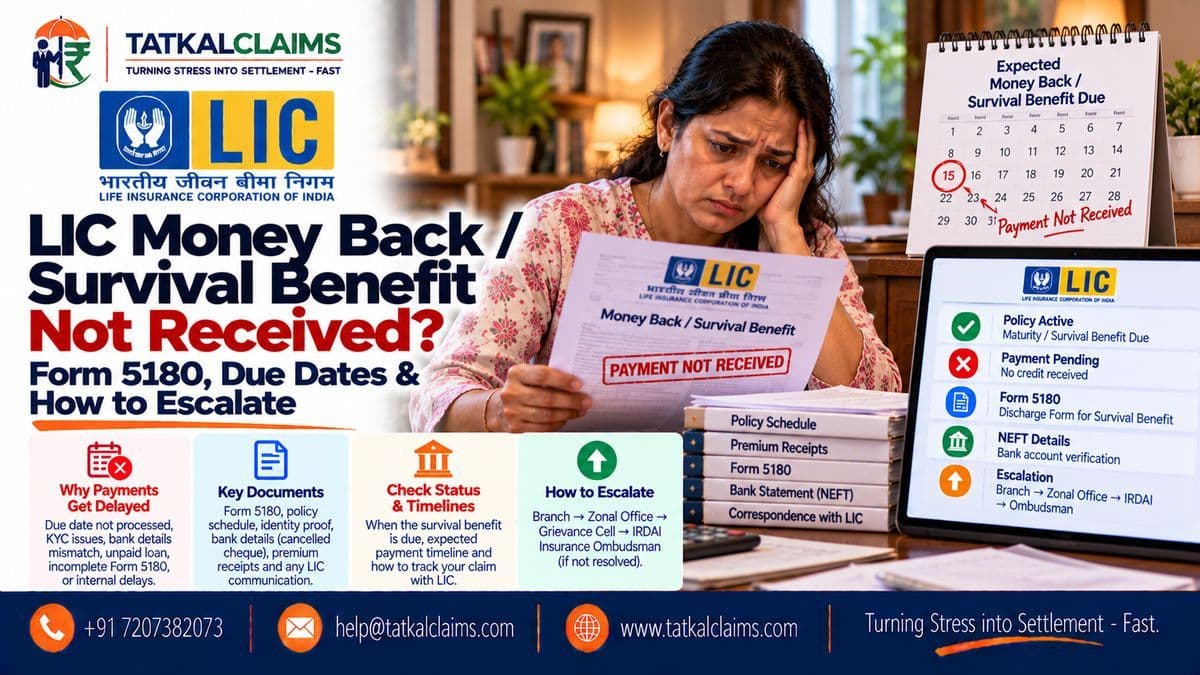
A money-back policy can feel frustrating when the promised payment date arrives and nothing reaches the bank account. The policyholder might have received the earlier instalment without any paperwork, yet the next remains pending while the branch asks for a discharge form. Or LIC may say a premium is unpaid even though it was deducted from salary.
These are not all the same problem. A survival benefit is a payment due while the insured person is alive at a specified policy duration. It is not the final maturity payout; its due date, percentage and conditions depend on the actual LIC plan and policy version. To resolve a delay, distinguish a dispute about eligibility from a pending document or a bank-credit failure.
Written by: Tatkal Claims, Claims Review Team
Reviewed by: Ankit L Kanoi, Founder
Was a Survival Benefit Actually Due on That Date?
Check the schedule printed in the policy—not an agent's generic illustration. A money-back policy normally defines percentages of Basic Sum Assured payable when the insured survives to particular policy anniversaries and satisfies the applicable conditions. The percentage and timing are plan-specific.
For example, LIC's New Money Back Plan–25 Years, UIN 512N278V03, lists survival benefits of 15% of Basic Sum Assured at the end of each of the 5th, 10th, 15th and 20th policy years while in force. This is an example of one plan, not a rule for all LIC policies.
| Policy detail | Why it matters |
| Plan number and UIN/version | New and withdrawn versions can use different terms |
| Commencement date | Determines the relevant policy anniversary |
| Survival payment schedule | Identifies the promised percentage and due date |
| Basic Sum Assured | The basis of the contractual calculation |
| Premium and paid-up status | Can alter eligibility or amount |
| Deferral election, if available | A deliberately deferred payout may not arrive on its original date |
If the policy has completed its full term and the final payment is missing, consult our LIC maturity-claim delay guide instead.
LIC Form 5180 Is Still Listed—What Does It Do?
LIC's official Download Forms page continues to provide Form No. 5180. I reviewed all four pages of the linked scanned document. It covers anticipated instalments and survival payments under several historical LIC plan types; it records the amount due, unpaid premium, premium interest, policy loan, loan interest, other deductions and net payable sum.
The scanned form also refers to demand drafts and money orders, reflecting its legacy printing. Those references should not be read as a new instruction to demand paper instruments today: LIC's published servicing guidance describes payment by NEFT into the entitled person's bank account. Follow the servicing branch's current mandate and payment instructions.
| Branch says | Ask for |
| Discharge receipt mandatory | The policy-specific reason the simplified-payment exception does not apply |
| Original bond required | The applicable benefit threshold, assignment or plan exception |
| Witness/signature problem | Exact missing page, signature or attestation requirement |
| Payment is reduced | A written gross-to-net calculation, including each deduction |
| Legacy draft/cheque wording | Clarification of the current NEFT process |
Why the ₹5 Lakh No-Discharge Exception Matters
LIC's Claims Settlement Requirements and Policy Conditions pages state that certain money-back survival benefits of up to ₹5,00,000 are released without calling for a discharge receipt or original policy document, provided the premium requirements are met. The wording is conditional and may include product-specific exceptions; it is not an unconditional right for every contract.
LIC also mentions a separate Jeevan Anand exception framed by its own sum-assured limit. Do not transfer a product-specific exception to an unrelated money-back plan.
There is an inconsistency between LIC public pages: an older 'Help Us to Serve You Better' page still describes an up-to-₹2 lakh streamlined arrangement for an unassigned policy with up-to-date premiums, while the general Claims Settlement Requirements and Policy Conditions pages describe up to ₹5 lakh. If a branch insists on documents for a smaller benefit, request a written explanation of the applicable current rule and plan conditions instead of assuming either webpage is decisive.
A Premium Deduction Is Shown, but LIC Says the Policy Is in Arrears
Survival instalments typically require the relevant premiums to have been paid up to the policy anniversary. A delay can arise because a premium really was missed, because LIC's ledger was not updated, or because a salary-savings deduction was never remitted or correctly allocated.
If salary slips show an LIC deduction but the policy account does not, collect payroll records, any employer remittance certificate, the bank or collection reference and the LIC premium ledger. A salary deduction is important evidence but does not by itself prove LIC received and credited the premium.
| Evidence | What it helps establish |
| LIC receipts / portal premium history | Payments actually credited on LIC's records |
| NACH, UPI, bank or card reference | The date and amount sent |
| Salary slip / employer remittance statement | Whether the employer collected and forwarded the amount |
| LIC's asserted first unpaid instalment | The period of the alleged interruption |
| In-force/paid-up/revival communication | Which policy status LIC is applying |
| The exact survival clause | How policy status affects this instalment |
A paid-up policy need not retain the original scheduled survival payments on the same terms. Ask LIC for the applicable plan clause and calculation rather than treating every low or missed instalment as wrongful rejection.
For related premium, lapse, paid-up and revival disputes, use our LIC lapse and grace-period guide.
NEFT Payment Was Approved but Never Appeared
Ask the branch whether the benefit is awaiting processing, approved but held, or already transmitted through NEFT. These three answers require different actions. If LIC says it paid, request the date, destination details and transaction reference; then trace the credit with the bank.
Check whether the registered account is open and operational, the IFSC is current after any bank merger, and the beneficiary name matches LIC and bank records. If details are wrong, submit the current NEFT mandate through the official servicing channel and keep an acknowledgement.
An Assignment or Policy Loan Can Change the Payment
Before treating the missing credit as an ordinary delay, determine whether a lender or another person is still recorded as assignee. Confirm whether an assignment was released and reassignment registered, rather than assuming loan repayment automatically cleared it.
Form 5180 has separate fields for policy-loan and interest deductions. If LIC shows less than the contractual gross benefit, request a claim statement itemising the original survival amount, adjustments and net payment.
If the original bond is unavailable because it was lost or retained by a lender, see our LIC lost policy bond guide.
Some Plans Permit a Voluntary Deferral
An instalment that was deliberately deferred under a valid policy option is different from an unpaid instalment. LIC's published terms for certain Children's Money Back plans include an option to defer survival benefits, with specific notice and calculation conditions. This is not a standard feature in every LIC money-back product.
If LIC alleges a deferral, ask for the policy-specific provision, signed/electronic election and date received, the resulting payment or enhanced-benefit formula, and the event or date when the deferred amount is now payable. Do not assume it receives a fixed interest rate merely because payment is delayed.
Why the Amount Received Could Be Lower Than You Expected
A scheduled survival instalment is commonly a percentage of Basic Sum Assured, not the entire sum assured plus all future bonuses. For illustration only: if the contract calls for 15% of a ₹10 lakh Basic Sum Assured on a particular anniversary, that gross instalment is ₹1.5 lakh before any applicable adjustments.
If the bank credit is less, ask for the gross benefit calculation, each premium or loan deduction, and the record authorising it. Do not dispute the net figure without first separating the percentage calculation from offsets and payment adjustments.
What If a Survival Instalment Has Been Missing for Years?
For older unpaid benefits, ask LIC for the history of the specific instalment—whether a payment was processed, returned, never claimed or moved into the unclaimed/outstanding policy-money process. The path for recovery may be different from a new current-year delay.
For old uncredited benefits and account tracing, consult our Unclaimed Life Insurance Money guide.
How to Escalate With a Clear Payment Trail
1. Establish the payment stage with the servicing branch
Provide the policy number, plan/UIN, due anniversary, premium evidence, registered bank details and a copy of the missing benefit notice if received. Ask whether the item is blocked for Form 5180, bond, premium, loan/assignment, deferral or NEFT; require any deficiency in writing.
2. Use LIC's grievance channels
LIC's August 2026 grievance page lists the Senior/Branch Manager, divisional Manager CRM, zonal Regional Manager CRM and central Executive Director CRM. Registered policyholders can lodge and track complaints through the Customer Portal; LIC also gives co_complaints@licindia.com. Preserve proof of the original payment date and each complaint acknowledgement.
3. Escalate externally if the insurer response is not satisfactory
Bima Bharosa provides an IRDAI-visible complaint route. The Council for Insurance Ombudsmen requires an insurer-first complaint, describes a 30-day insurer response stage, a ₹50 lakh monetary limit including expenses, a general one-year filing period linked to the relevant decision, and restrictions on duplicate forum proceedings. Check current eligibility and limitation periods for the particular dispute.
LIC's 2024 Citizens' Charter sets an 'on due date' servicing benchmark for settlement of survival benefits and says policy-payment information should normally be given one month in advance. The charter itself says it is not a legal document creating new contractual rights; use it alongside the actual policy terms.
A Payment Reconciliation Usually Works Better Than a Generic Complaint
Write one page stating the policy's actual survival-benefit clause, scheduled anniversary, expected gross instalment, premium status, any assignment or deferral, and the bank details LIC has on record. Then ask LIC to provide one of three things: the transfer reference if paid; a precise list of missing documents if processing is held; or a clause-based written decision if it says the benefit is not payable.
This makes follow-up measurable. A wrong payout percentage is a policy calculation issue; a missing premium requires a ledger; and a bank-credit failure needs a transaction trail.
Can TatkalClaims Help With an LIC Survival Benefit Delay?
TatkalClaims can examine the policy schedule/UIN, survival-benefit anniversary, premium and assignment records, Form 5180 request, optional deferral, bank mandate and LIC correspondence to identify what actually blocked the payment.
Not every missing credit is an insurer error: the policy may fail a benefit condition, or LIC may already have sent a correct transfer that needs bank tracing. We can distinguish these situations and prepare the appropriate evidence-based representation without guaranteeing a settlement.
For an initial review, call +91 7207382073 or email help@tatkalclaims.com. Send the policy schedule, survival-benefit notice if available, relevant premium records, bank statement showing the missing credit and LIC's last written response.
Frequently asked questions
Is Form 5180 compulsory for every LIC money-back payment?
No. LIC currently lists Form 5180 for survival claims, but its general policy-conditions guidance allows certain eligible payments up to ₹5 lakh without calling for the discharge receipt or original bond. Ask the servicing branch whether your plan and benefit meet those conditions.
Why is LIC asking for the original bond for a benefit below ₹5 lakh?
A plan-specific exception, assignment, missing premium or other servicing condition may apply. Ask LIC to give the precise reason in writing, because the general ₹5 lakh simplified-payment rule is conditional rather than universal.
Can I use Form 3825 instead of Form 5180?
No. LIC lists Form 3825 for maturity claims and Form 5180 for survival-benefit claims. Check which contractual event is due.
What if LIC deducted a premium or loan from my money-back payment?
Ask for the gross survival amount, each deduction and its supporting premium or loan ledger. Form 5180 includes fields for unpaid premium, interest, policy loan and other deductions.
Does a delayed survival instalment automatically earn interest?
Not automatically. The applicable law, policy terms, exact reason and duration of delay determine any interest entitlement. A policy-authorised deferral benefit is different from compensation for an insurer-caused payment delay.
What if the policy has lapsed or become paid-up?
The plan's survival-benefit terms and premiums due through the relevant anniversary govern. A paid-up policy may have different benefits, so request the exact clause, recorded status and claim calculation before challenging or accepting LIC's decision.
Sources & Methodology
Primary-source review completed 6 October 2026. LIC's April 2026 Download Forms page and all four scanned pages of Form 5180 were examined. The general conditional ₹5 lakh no-bond/no-discharge statements are from LIC's Claims Settlement Requirements and Policy Conditions, while the different older ₹2 lakh statement is identified separately. NEFT, due-date benchmarks, grievance routes and plan-specific percentages/deferral were checked against official documents. No insurer case outcome has been invented.
Disclaimer: The entitlement and procedural requirements for an LIC money-back or survival benefit depend on the exact policy/UIN, due anniversary, premium position, assignments, deferral options and applicable laws. This guide is for general information, not legal advice or a guarantee of payment.