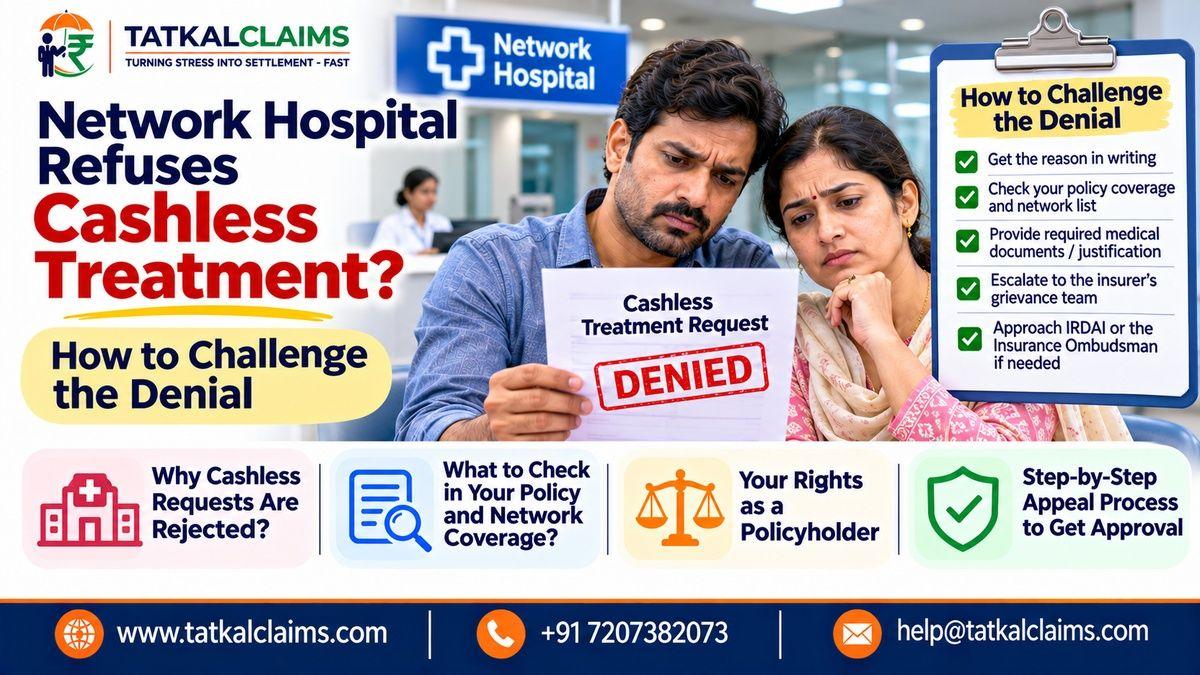
You checked the insurer’s website, saw the hospital listed for cashless treatment and arrived with an active health insurance policy. At admission, the hospital desk says “cashless not available”, “TPA problem”, “our package is blocked” or “pay first”. This is frustrating, but it does not establish that your treatment is excluded or that the insurer has rejected the claim.
There are two separate questions: was the hospital actually authorised to provide cashless service for your insurer and policy on that date, and did the insurer receive and decide a cashless pre-authorisation request? The answer changes what to do next. In an emergency, prioritise necessary medical care and ask a family member to collect the administrative evidence.
Five Different Reasons a Listed Network Hospital May Refuse Cashless
| What you hear | What it may actually mean | First proof to request |
|---|---|---|
| “This hospital is not on the network” | Outdated list, a different branch, or tie-up ended | Dated insurer network listing and insurer’s written network-status response |
| “We cannot raise pre-authorisation” | Desk, portal, TPA mapping or member-data issue | Help-desk note and insurer/TPA ticket showing whether a request was submitted |
| “Cashless is not available for this procedure” | Treatment/package restrictions, hospital arrangement or policy eligibility | Specific insurer explanation and relevant coverage clause |
| “Approval is pending/rejected” | Insurer has received and is processing, querying or denying the request | Pre-authorisation ID, time received, decision letter and query |
| “We can do cashless only if you deposit money” | Co-payment, non-payables, short authorisation or an administrative demand | Authorisation letter and written deposit calculation |
Do not let a generic front-desk statement stand in for the insurer's decision. Equally, do not assume every refusal is misconduct: an inactive policy, a valid coverage exclusion or a genuine termination of the hospital arrangement can change the result.
Step 1: Confirm the Hospital Is Currently Networked for Your Exact Policy
Use the insurer's own website or app, preferably while logged into the correct health plan. Check the hospital's full legal name, branch, address and network status on the date of admission. Save a dated screenshot including the insurer's URL and the hospital listing. A third-party aggregator or old PDF is less useful than the insurer's live listing.
Ask the insurer to confirm in writing whether that branch was on its cashless network for your policy, and whether any delisting, restricted specialty, temporary suspension or plan-specific exception applied. For employer policies, check the group member record and the correct insurer/TPA arrangement too.
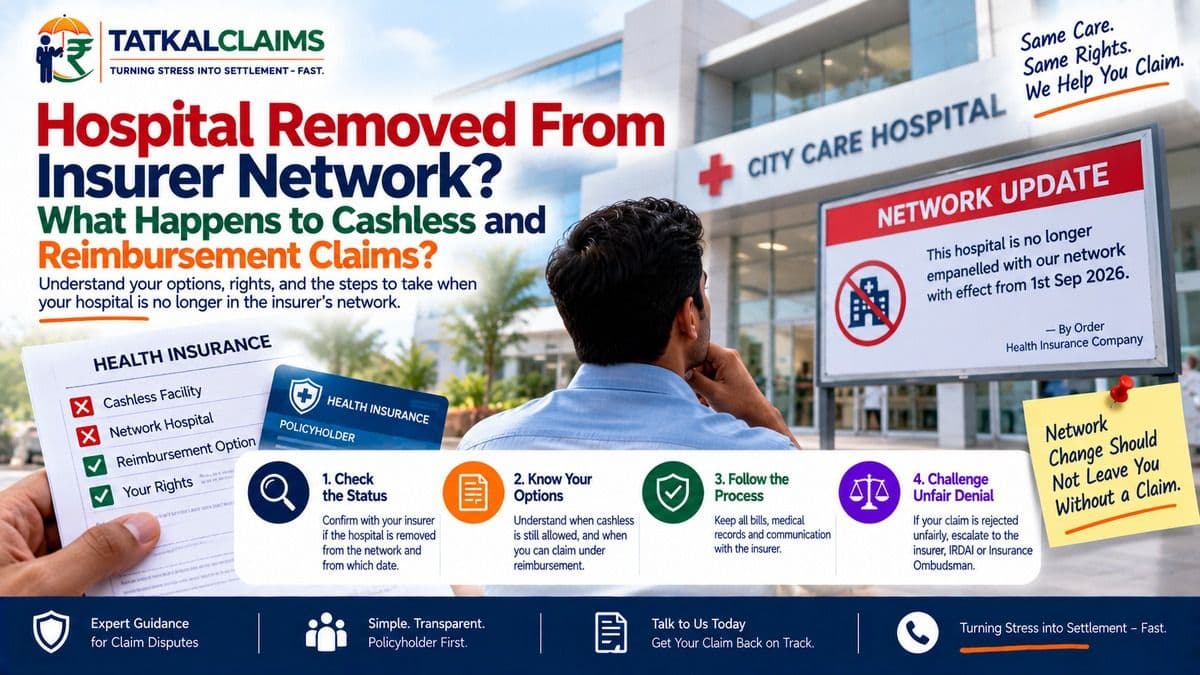
If the hospital was actually removed from the network, follow our separate guide on delisted hospitals and reimbursement claims; that is a different dispute from a currently active network hospital refusing service.
Step 2: Find Out Whether a Cashless Request Was Ever Sent
Ask the admission/cashless desk for the pre-authorisation request number, submission time, insurer or TPA portal, member details used, diagnosis, proposed treatment and any portal error or query. If no request was submitted, an insurer response-time clock may not yet have started. Ask the insurer to help the hospital transmit the request or provide the alternative submission channel.
If a request was submitted, obtain the insurer's acknowledgement, time of receipt and written response. Distinguish “pending information”, “partial approval”, “denied cashless facility” and “claim repudiated”. These do not mean the same thing, and a cashless refusal does not automatically decide later reimbursement admissibility.
Step 3: Separate Hospital Refusal From Insurer Refusal
The hospital itself will not process cashless
Ask a senior cashless coordinator or hospital administrator for a written reason and contact the insurer's cashless helpline while at the hospital. Provide the hospital's network listing and request that the insurer contact its hospital relationship/network team. Take note of the names, dates and ticket numbers of each person contacted. Do not misstate when the hospital submitted the request.
The insurer or TPA declines authorisation
Request the actual decision and policy clause. Common explanations include policy not active, member details missing, treatment not covered, required documents awaited or the network arrangement not applicable. If the insurer cites missing information, ask precisely what it needs from the hospital. Preserve the clinical reason for admission separately from the administrative issue.
Cashless is sanctioned, but the hospital still wants an advance
This is a different dispute from “cashless never initiated”. Obtain the approval letter and the written breakdown of the amount requested, including permitted co-pay, deductible, non-payable items, bill amount exceeding the current authorisation, or a refundable security deposit. Do not assume the entire hospital bill must be paid cashlessly.
If the insurer has approved cashless but the hospital demands money, use our focused cashless-approved but deposit demanded guide to check for duplicated or unsupported collections.
What the IRDAI 2024 Rules Actually Say
IRDAI's 29 May 2024 Master Circular on Health Insurance Business directs insurers to strive for cashless settlement, maintain defined claim procedures, display network hospitals on their websites and decide cashless pre-authorisation requests immediately and not later than one hour after receipt. Its discharge-final-authorisation rule concerns a different event: the insurer's receipt of the hospital's final discharge request, for which the circular specifies three hours.
These are insurer-side processing requirements; they do not turn every hospital listing into unconditional payment of every procedure. The first question remains whether a request reached the insurer. The one-hour pre-authorisation rule should not be described as a guarantee of approval, and the three-hour discharge rule should not be applied to the initial admission.
The September 2024 Master Circular on Protection of Policyholders' Interests also addresses claim communication and requires reasoned decisions with references to relevant policy terms when a health claim is rejected or partially disallowed. Pursuant to intimation, the insurer/TPA is expected to collect necessary hospital documents. These requirements help frame a request for an itemised, written explanation.
Do not rely on the 2021 network-hospital circular as if it were current
A 22 April 2021 IRDAI circular specifically addressed cashless refusals by empanelled hospitals, including in the COVID-19 context. But IRDAI's May 2024 Health Insurance Master Circular lists that circular among superseded circulars in Annexure 6, item 51. It is useful historical background, not an independent current-law basis for an appeal. Refer instead to the applicable 2024 framework, current policy and the insurer's actual cashless arrangement.
Does “Cashless Everywhere” Mean Every Hospital Must Accept Cashless?
No automatic entitlement should be assumed. Insurers have been encouraged to broaden cashless access and common hospital empanelment, but a hospital's participation, treatment arrangements, communication with the insurer and policy eligibility still need checking. If a hospital outside your normal network is offered through a wider cashless initiative, ask for written confirmation of the facility and any stated procedural conditions before admission when feasible.
Do not confuse this with PM-JAY empanelment or a government scheme; those operate under different programme rules. The present guide is for private and employer/group health insurance claims.
If Treatment Is Urgent, Protect the Patient and the Claim File
Do not delay necessary emergency treatment solely to resolve an insurance portal problem. Ask a family member to call the insurer, seek a higher-level hospital cashless coordinator, record calls/ticket numbers and preserve the admission advice. If you must pay, request itemised bills, official receipts and copies of every pre-authorisation response. Do not rely on an oral promise that the insurer will repay the full amount.
Before signing payment papers, identify whether any amount is an advance, a refundable deposit, a non-refundable charge, or a policy co-payment. If needed, state in writing that payment is made to avoid interrupting necessary treatment and does not mean you accept the disputed denial. This statement alone does not establish legal entitlement; the contract and evidence still matter.
Evidence Checklist: Build a Timeline, Not Just a Complaint
| Record | Why it matters |
|---|---|
| Screenshot of the insurer's network page, dated | Supports the branch/listing shown to you before admission |
| Policy schedule, UIN, CIS, active membership | Establishes who was covered and which version applied |
| Hospital refusal message, desk notes and staff details | Shows whether the hospital refused to submit or honour cashless |
| Pre-authorisation number, submission time, portal acknowledgement | Distinguishes a request never made from insurer delay or refusal |
| Written insurer/TPA decision, query and policy clause | Identifies the actual decision-maker and stated reason |
| Admission note, treating doctor's advice and itemised bills | Establishes medical need, dates, treatment and expenses |
| Payment receipts, written complaint, ticket and response | Supports later reimbursement or grievance review |
If the insurer's website showed the hospital as active before admission but later shows it as removed, preserve the original dated listing and any admission-time confirmations. Ask for the effective date of the network change. A current screenshot taken after the event may not prove the earlier status.
What to Say When You Contact the Insurer
Subject: Listed network hospital refusing cashless — request immediate assistance and written decision
I am covered under policy [number], member [name], and sought admission at [full hospital name and branch] on [date]. Your network listing dated [date] showed this hospital as eligible for cashless service. The hospital informed us [exact words]. Please confirm whether the hospital and branch were covered under our policy on the admission date, whether a pre-authorisation request was received and at what time, and what specific administrative or policy reason is preventing cashless access.
Please arrange contact between your cashless/network team and the hospital desk, supply the pre-authorisation reference and written decision with relevant policy clauses, and confirm the reimbursement procedure if cashless cannot be arranged. Our admission and hospital records can be provided through the insurer's secure channel.
What If You Paid the Hospital Anyway?
Cashless failure and reimbursement eligibility are separate questions. If cashless was not available, ask the insurer for the reimbursement process, submission route and any timeline in the issued policy. Send the insurer's decision, detailed bill, discharge papers, proof of payment and evidence of the hospital's network status. A reimbursement claim can still face legitimate coverage, waiting-period, cap or documentation issues.
If the insurer declines reimbursement because the hospital was allegedly not networked, ask whether network status was truly a reimbursement eligibility condition in your contract, rather than simply a cashless-facility condition. Obtain the relevant clause and any hospital exclusion/blacklist notice. The network dispute must not be confused with treatment at an expressly excluded hospital.
Escalating the Dispute
If you cannot resolve cashless access promptly, lodge a dated complaint with the insurer's grievance officer and obtain an acknowledgement. Include the hospital branch, proof of network listing, claim/pre-authorisation reference, the written refusal and the treatment timeline. Ask for a reasoned resolution and, where appropriate, reimbursement of amounts actually covered by the policy.
IRDAI's September 2024 policyholder-protection circular sets out a grievance-resolution period of 14 days; the public Bima Bharosa portal's FAQ may display older wording. If your complaint is unresolved or the decision is unsatisfactory, you can register or track it through IRDAI's Bima Bharosa portal. Depending on the nature of the dispute, the Insurance Ombudsman may also be available subject to its current jurisdiction and procedural rules.
How Tatkal Claims Can Help
Tatkal Claims can review whether the insurer's network listing, the admission-time communications, the pre-authorisation record and the final settlement tell the same story. We can identify missing evidence, separate hospital-level administrative failure from insurer claim denial and help prepare a structured grievance or reimbursement challenge. We cannot promise cashless acceptance or guaranteed reimbursement for an otherwise excluded expense.
Frequently asked questions
Is cashless treatment compulsory at every hospital shown on my insurer's network list?
A current listing supports the expectation that a cashless arrangement exists, but the exact branch, policy, service agreement, eligibility and treatment still matter. Ask the insurer to confirm the reason for refusal in writing.
What if the hospital refuses to send pre-authorisation?
Ask for a written reason and any portal error, contact the insurer's cashless and network teams, and request an alternative submission route or an insurer–hospital call. Keep evidence of when a request was actually received.
Does IRDAI's one-hour rule mean my insurer must approve my claim within one hour?
No. The May 2024 circular requires the insurer to decide a cashless pre-authorisation request within one hour of its receipt; it does not make an excluded treatment automatically payable.
Is the three-hour discharge rule relevant at admission?
No. The three-hour rule addresses final authorisation after the hospital submits a discharge request, not the first admission or an initial pre-authorisation request.
What if the insurer says the hospital is not in its network but its website lists it?
Keep a dated screenshot of the exact branch listing and request the effective date of any suspension or delisting, plus written confirmation for your policy. A current network list may differ from the admission-date list.
Can I claim reimbursement if a listed hospital refused cashless treatment?
You may be able to submit a reimbursement claim if the policy and circumstances allow. Cashless denial does not automatically extinguish reimbursement eligibility, but limits, exclusions and other policy conditions still apply.
Does the Cashless Everywhere initiative guarantee cashless treatment anywhere?
No blanket guarantee should be assumed. Ask the insurer whether that particular hospital participates and what eligibility, network or prior-notification conditions apply.
What should I send Tatkal Claims for a case review?
Provide the policy and CIS, a dated network listing, hospital refusal, pre-authorisation records or insurer tickets, admission details, bills and insurer correspondence. Remove or securely share sensitive health information rather than posting it publicly.