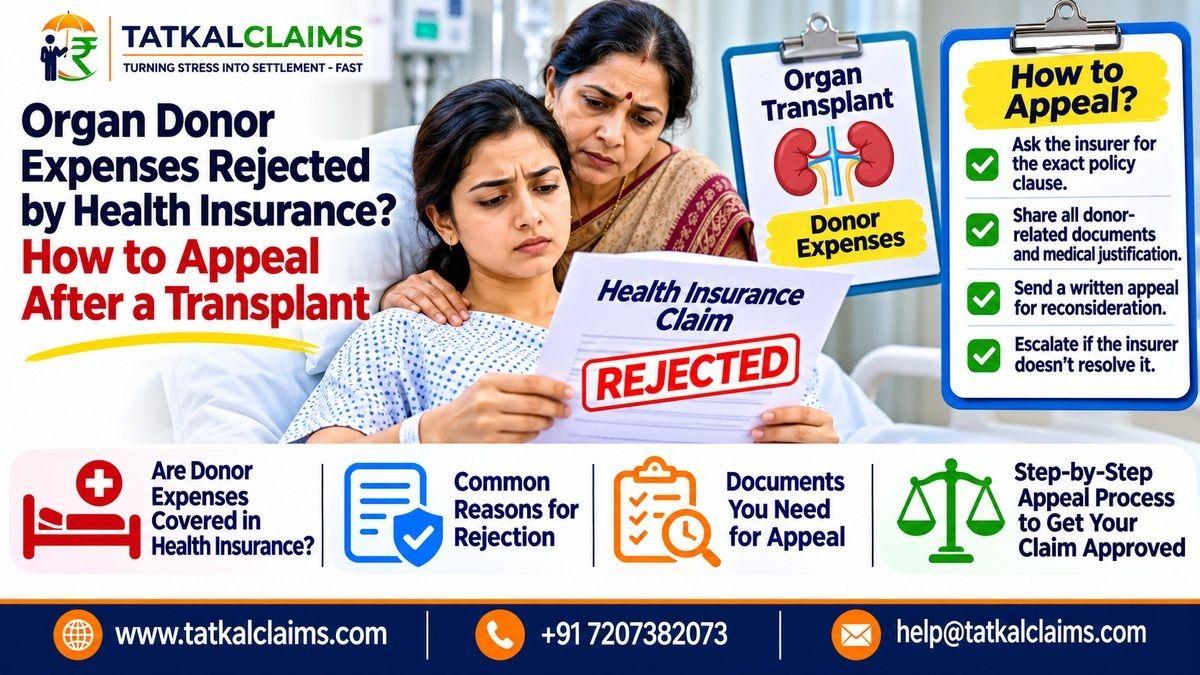
Your insurer pays for your kidney transplant. The hospital hands you another bill in your sister’s name for the surgery to remove the kidney she donated. Then the insurer marks her whole bill as inadmissible. Before you challenge it, get the two claim decisions and find the organ donor benefit in the recipient’s policy. The wording may cover the donor’s admission for surgery and set different rules for tests before admission or care after discharge.
Why the transplant and donor bills can have different outcomes
In a living-donor kidney or liver transplant, the recipient and donor receive different care. For the insurance claim, identify which person received each service, when it was provided and which policy benefit the insurer assessed. Policy wordings often call the surgery to remove the donated organ “harvesting”. Look for that term alongside “organ donor expenses” or “organ donor cover”.
The recipient’s policy may make donor cover conditional on its decision on the recipient’s hospitalisation. Niva Bupa ReAssure 2.0, under clause 4.5 of the version cited below, ties donor hospitalisation expenses for organ retrieval to payment of the recipient’s hospitalisation claim. The clause also has separate wording for organ retrieval when the insured person is the donor.
HDFC ERGO’s my: Sampoorna Suraksha wording covers eligible retrieval hospitalisation expenses when the insured person is the recipient and the relevant hospitalisation claim is admissible. It expressly excludes the donor’s pre- and post-hospitalisation expenses and other medical expenses or hospitalisation consequent to the retrieval. Use the version, schedule and endorsements that applied on the date of admission.
Match each donor charge to the policy wording
| Charge or issue | What to check | Evidence to ask for |
|---|---|---|
| Donor’s surgery and inpatient stay for organ retrieval | The organ donor benefit, any requirement for the recipient’s claim to be paid or admissible, and the applicable limit | Donor’s itemised inpatient bill, discharge summary and an operation record or hospital certificate linking both admissions |
| Donor screening, compatibility tests or consultations before admission | Whether the donor clause includes these expenses and what dates or conditions apply | Dated invoices, prescriptions or test orders and the donor’s admission date |
| Donor follow-up, complications or a later readmission | Any wording for donor post-discharge care or expenses arising from retrieval. If the care was during the original admission, ask how the insurer classified it. | Dated treatment notes, discharge or readmission records, and itemised charges |
| Recipient’s follow-up or medicines | The recipient’s own post-hospitalisation clause, time window and linkage to the transplant claim | Recipient’s prescription, bills and settlement statement |
| A package with a single total for both patients | Whether the insurer can identify each patient’s charges and what it included in the allowed amount | An authenticated breakdown showing the services billed to each patient and any package adjustment |
Suppose the donor’s bill is ₹1.60 lakh, made up of ₹1.30 lakh for the surgical admission, ₹20,000 for tests before admission and ₹10,000 for follow-up. If the insurer rejected the full bill using a pre- and post-hospitalisation exclusion, start your challenge with the ₹1.30 lakh. Ask it to review the inpatient charges against the organ donor clause and explain any remaining deductions or limits.
An appeal is stronger when the recipient’s claim meets the linked condition and the insurer overlooked itemised donor surgery charges or used the wrong remaining balance. If the disputed charges are solely for pre-admission tests or later follow-up and the donor clause expressly excludes them, ask which lines were declined before deciding what to challenge.
How to challenge a refusal or deduction
- Get the written decision for both admissions. Ask for the recipient’s final settlement statement and the donor decision or deduction sheet. If there is only one claim number, ask which donor expenses were assessed under it. If only the cashless request has been refused, ask whether reimbursement is available and check your policy’s filing requirements.
- Ask for the exact clause and calculation. Under paragraph 17(b) of IRDAI’s Master Circular on Health Insurance Business, the insurer must give details of a rejected or partly disallowed claim and cite the specific policy terms. If it says the limit is exhausted, ask for the opening available sum insured, the recipient’s paid amount, the remaining balance, and any separate donor limit or co-payment it applied.
- Get the two bills and a document linking the admissions. Ask the transplant coordinator or billing office for dated, itemised bills and the relevant admission, discharge and operation records. If a charge has been assigned to the wrong person or date, ask for a dated correction from the hospital and keep the original for reference.
- If the dispute is about transplant approval documents, ask the insurer to specify what is missing and why it matters under the clause. Ask the hospital’s transplant coordinator for the applicable approval record. Rule 10 of the Transplantation of Human Organs and Tissues Rules, 2014 covers applications for approval of living-donor transplants.
- Send a short written grievance to the insurer. For each disputed line, give the service date, amount, policy clause and supporting document. Ask for reassessment of the eligible lines and a written reply explaining any deduction that stands.
If you paid the hospital after a cashless refusal, read the guide to filing a reimbursement claim after cashless denial.
Sample email to the insurer
Subject: Reconsideration of organ donor expenses under claim [claim number]
You settled the recipient’s transplant claim on [date]. Your decision dated [date] declined ₹[amount] billed for the donor. Please identify the policy term, expense category and calculation used for the deduction.
The attached donor inpatient bill lists ₹[amount] for the organ retrieval admission from [date] to [date]. The attached hospital records link it to the recipient’s transplant. Please review those charges under clause [number or name] of my policy and explain which charges are admissible, what limit you applied and how you calculated any remaining disallowance.
Where to escalate if the insurer upholds the decision
Keep the insurer’s grievance acknowledgement, both bills and the final written reply. You can use IRDAI’s Bima Bharosa portal to register or track an insurance grievance. For eligible disputes, the Insurance Ombudsman can consider a complaint after an unsatisfactory response to your written grievance or if the insurer has received it and a month passes without a reply. Check the applicable one-year filing deadline under Rule 14, the monetary limit and the restrictions on complaints about a dispute already pending or decided elsewhere.
See how to choose between Bima Bharosa and the Insurance Ombudsman.
How Tatkal Claims Can Help
Share the recipient’s settlement statement, the donor’s itemised bill and the clause cited in the denial. Tatkal Claims can check which expenses were assessed under the donor benefit, reconstruct any limit calculation from the paperwork and help prepare an appeal for disputed charges that the records support.
Frequently asked questions
Can the insurer pay the transplant bill and reject the donor bill?
Yes. The donor expenses have to meet the terms of the organ donor benefit, including any limits or exclusions. Ask whether the insurer reviewed the donor’s inpatient procedure and which charges it declined.
Does the donor need to be named on the recipient’s policy?
Check the donor benefit. Some wordings cover eligible retrieval expenses for the donor when the recipient is the insured person. If the insurer refused the claim because the donor was unnamed, ask it for the clause imposing that condition.
Can I claim the donor’s compatibility tests and pre-surgery screening?
That depends on the donor clause and when the tests were done. Keep dated test invoices and orders and compare them with the date of the donor’s inpatient admission and any pre-hospitalisation exclusion.
Will the recipient’s insurance cover complications after donation?
Check the exact scope of the donor benefit and whether the complication was treated during the retrieval admission or in a later visit or readmission. Ask the insurer how it classified the charges and which term supports that classification.
What if the insurer says the sum insured was exhausted by the transplant?
Ask for the claim calculation and check whether the donor benefit uses the same available sum insured or has a separate limit. Compare the insurer’s balance with the actual settlement statement and any benefits or endorsements applicable to the claim.
How do I challenge a donor bill rejected because the patient name is different?
Give the insurer the two itemised bills, the recipient’s claim number and an admission or transplant record linking the donor to the recipient. Ask it to assess the disputed expenses under the organ donor clause.
Sources & Methodology
This article compares two published policy wordings as examples and uses IRDAI, transplant rules and Ombudsman materials for the procedural guidance. The bill amounts are illustrative. This is general insurance information. Coverage and complaint eligibility depend on the policy and the records, and medical decisions should be discussed with the treating transplant team.