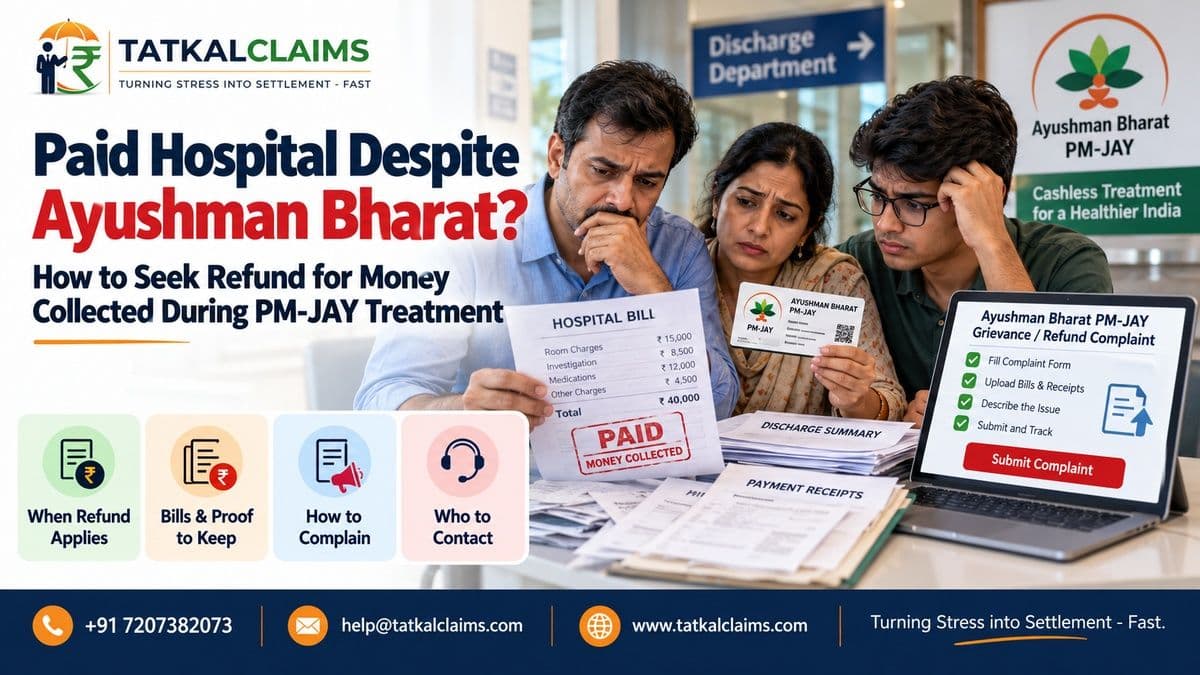
The patient has been discharged. The Ayushman Card was shown at the hospital, yet the family paid for medicines, a deposit or part of the bill. Now the hospital says the payment cannot be returned. Before accepting that answer—or assuming every rupee is automatically refundable—find out exactly which treatment was booked under PM-JAY and what the hospital charged for.
This guide is for a payment that has already been made. It explains how to test the charge against the approved PM-JAY Health Benefit Package, preserve evidence and request examination and refund of an allegedly improper collection through the scheme’s grievance system. It is different from the problem of getting a pre-authorisation approved or being admitted in the first place.
Written by: Tatkal Claims, Claims Review Team
Reviewed by: Ankit L Kanoi, Founder
Can You Claim a Refund When a PM-JAY Hospital Has Already Taken Money?
Yes, an improper collection can be challenged. PM-JAY is structured to provide cashless, paperless access to covered secondary and tertiary hospitalisation through empanelled hospitals. Its package arrangement is not an invitation to take the package payment from the scheme and collect that same covered cost from the family as well.
Older NHA hospital-empanelment guidance explicitly identifies “illegal cash payments by beneficiary” as a hospital offence and includes a full-refund remedy following enforcement. It also sets out penalties payable by hospitals to the State Health Agency (SHA). Crucially, that disciplinary table describes a recommendatory, case-specific process: it is not proof that every invoice is illegal or that every complaint produces an immediate refund.
A family may have paid during an emergency, before beneficiary verification, for an excluded service, or after a genuine package or specialty restriction. Those cases require checking the actual scheme transaction. A refund allegation is strongest when the bill and transaction record show that the same treatment component was already included within an authorised PM-JAY package.
First Identify Exactly What the Hospital Charged You For
Do not start with a complaint saying only “the hospital took money despite Ayushman”. Make one list, payment by payment. Note the amount, date, payer, recipient, description on the bill, patient’s admission date, and the hospital’s explanation. Separate deposits, medicines, investigations, procedures, consumables and amounts paid after discharge.
| Payment the family made | What to verify before asking for refund |
| Admission deposit or cash demanded for a covered package | Was the hospital empanelled, was the patient registered under PM-JAY, and was this treatment approved under the relevant package? |
| Medicines, investigations or consumables during covered admission | Were these items required for and included within the authorised package, or genuinely outside it? |
| Additional amount after discharge or at final billing | What does the PM-JAY discharge/transaction record show, and which billed item was considered outside the scheme? |
| Amount taken when the hospital says treatment was “private” | When and why was the admission booked outside PM-JAY? Was beneficiary/package verification attempted and documented? |
For example, suppose a family paid ₹12,000 at the hospital pharmacy during an approved PM-JAY admission. That amount is not automatically refundable simply because a pharmacy receipt exists. Ask whether the drugs were prescribed for the approved package and whether the hospital treated that expense as included. The answer—not the mere existence of the Ayushman Card—determines the dispute.
What Does the Approved Package Actually Include?
PM-JAY uses defined Health Benefit Packages (HBPs). The NHA package framework bundles specified treatment costs and related services within a covered hospitalisation, subject to package rules, limits and State-specific adaptations. That is why an extra demand for an item already covered by the approved package can be questioned.
Get the name and code of the package, the PM-JAY transaction or pre-authorisation number, the treatment dates, and what was approved or rejected. If the hospital claims a medicine, implant, test or procedure was outside the package, ask it to identify the package provision or transaction status on which it relies. Neither the ₹5 lakh annual headline nor a card photograph resolves a dispute over a particular item.
If the hospital says the package was rejected, pending, wrongly selected or unavailable, review the PM-JAY pre-authorisation and package-rejection guide before describing the payment as an illegal collection.
Get the PM-JAY Transaction Trail Before You Escalate
Speak to the Pradhan Mantri Arogya Mitra (PMAM), PM-JAY help desk or hospital medical coordinator. Ask for the beneficiary’s scheme admission or transaction reference; the package code and approval status; the discharge summary; the itemised hospital bill; and a written explanation of any money taken from the family. If the desk refuses a copy, record the date, name/designation of the person asked and the response.
Ask a second, more important question: did the hospital receive or submit a PM-JAY claim for the same hospitalisation? The beneficiary may not see every internal claim field, so request that the SHA or grievance authority verify the transaction rather than alleging double billing without evidence.
If you have a valid card but the hospital could not locate the beneficiary record, that is a separate verification issue. Recording a case under ordinary private billing and processing a completed PM-JAY transaction are not the same fact.
For beneficiary-not-found, Aadhaar or e-KYC errors, use our Ayushman Card verification and e-KYC guide to distinguish identification from treatment-package approval.
Build a Refund Evidence File the SHA Can Actually Check
Keep the hospital’s admission and discharge papers, diagnosis and doctor’s prescriptions, PM-JAY card or masked beneficiary-identification details, package/pre-auth references, bills and receipts, UPI or bank records, pharmacy invoices and any hospital correspondence. Save the date and exact words used when the hospital demanded payment or declined a refund.
If a family member paid, identify that payer and attach the relevant transaction record. If multiple payments were made, keep each amount separate instead of combining everything into an unexplained grand total. Mark which amounts you believe were charged for an approved package and which remain uncertain.
Have no receipt? Preserve the UPI reference, bank entry, SMS, WhatsApp conversation, payment acknowledgment or witness details. Ask the hospital in writing to issue or confirm the receipt. An unreceipted cash payment may be harder to prove; do not invent a receipt, inflate the amount or describe uncertain facts as established.
Do not send unmasked Aadhaar numbers, OTPs, banking passwords or unnecessary clinical identifiers over casual messages. A complaint may need beneficiary information, but share sensitive documents through an appropriate channel and redact what is not required.
Ask the Hospital for a Written Refund Decision
Tell the hospital the exact charges you dispute. Request its PM-JAY package/transaction explanation and a refund of amounts collected for services that should have been cashless under the authorised treatment. Ask it to answer in writing, including the item-by-item reason if it rejects the request.
Do not accept a blanket statement such as “Ayushman covers only surgery, medicines are always extra” without checking the actual package. Equally, do not insist that every out-of-hospital purchase is covered without evidence of a package obligation. The dispute turns on the specific service, approval and rules.
If the patient is still admitted or urgent care is affected, report the payment demand promptly rather than waiting for discharge. Keep the immediate treatment problem and the refund question clearly identified in the same chronology.
How to Register a PM-JAY Refund Complaint: 14555, CGRMS and SHA
The Union Health Ministry confirmed in March 2026 that irregularities involving empanelled hospitals can be complained of through the Centralised Grievance Redressal Management System (CGRMS) or the 24×7 toll-free helpline 14555. The PM-JAY grievance structure operates through District, State and National levels with designated nodal officers and committees. A written representation to the implementing State Health Agency is another recognised route.
When calling 14555 or using the official grievance channel, identify the beneficiary, hospital name and branch, state, admission dates and transaction number if available. State the disputed payments individually, explain which approved package they relate to, and ask the authority to obtain the hospital’s transaction record and investigate whether the amounts were properly chargeable.
Ask for a grievance acknowledgement or number. Save screenshots of the submitted complaint and subsequent replies. If the first response merely repeats the hospital’s claim that “these charges are extra”, request an itemised package-level explanation and escalation through the applicable District or State grievance mechanism.
The grievance route is PM-JAY’s NHA/SHA system, not automatically the IRDAI Bima Bharosa or Insurance Ombudsman process used for private insurance disputes. A combined State scheme, different payer or separate private policy may introduce additional rules; verify the actual coverage involved.
What Refund Should You Ask For—and What About Hospital Penalties?
Ask first for a reasoned finding on whether the identified payment was contrary to the applicable PM-JAY package and hospital obligations. If it was, request the return of the amount wrongly collected, with confirmation of how and to whom it will be paid. Include the payer’s details and evidence, especially if a relative paid on behalf of the beneficiary.
NHA’s earlier hospital-empanelment materials describe a full refund for illegal beneficiary cash collection and a separate penalty that the hospital pays to the SHA. That penalty is not automatically money owed to the family. The guidelines also say disciplinary measures are recommendatory and may vary by case and State adoption. Historical references to seven-day transfers arise only in that specific notice/enforcement sequence; they should not be presented as a universal seven-day refund promise from the day a beneficiary files a complaint.
You can quote the relevant guideline to ask the SHA to consider the full-refund remedy, but request confirmation of the currently applicable State rule and a written decision. If the hospital already refunded part of the amount, mention the credit and ask for review of only the remaining disputed sum.
What if the Hospital Says You Agreed to Private Treatment?
A hospital may claim the family consented to private admission, voluntarily bought additional services, or came before PM-JAY eligibility was verified. Request the signed admission/consent forms, billing classification and the reasons why cashless processing did not take place. Record whether the family actually had a meaningful choice, whether the scheme desk was approached, and what it said.
Private billing does not become PM-JAY billing just because a valid card is produced after discharge. Conversely, labelling a receipt “private” is not by itself a complete answer if the hospital had registered the eligible patient under an approved cashless package. The evidence must show which situation occurred.
Do not sign a fresh statement declaring all payments voluntary or unrelated to PM-JAY if it is factually wrong. If asked to sign a receipt or discharge document, read it and keep a copy; record a disagreement accurately rather than assuming you must accept the hospital’s wording.
If the Hospital Refuses, Has Closed the Grievance or Keeps Delaying
Keep one consistent grievance number and chronology. Ask the District Grievance Nodal Officer or State Health Agency to review the documents, obtain the hospital’s answer and provide reasons for any decision that the payment was allowable. Where necessary, seek review through the applicable higher grievance committee under the State’s process.
A closed ticket is not evidence that the disputed payment was lawful. But neither is an unresolved ticket evidence that the hospital must repay it. The purpose of escalation is a documented finding on the package, amount, transaction and obligation.
If the patient has died, the family can still preserve bills and transaction evidence and ask the scheme authority how an authorised representative should lodge or pursue the grievance. Do not assume that a nominee automatically has an unrestricted right to any particular payment; the authority may require proof of representation or the original payer.
If your immediate problem is still refusal of admission, deposit demanded before treatment, or a hospital saying it no longer accepts PM-JAY, see the broader Ayushman Bharat treatment-denial and hospital-complaint guide.
What TatkalClaims Can Review in a Paid-Hospital PM-JAY Dispute
Our first task is to separate the bill into charges that may be within the approved package, charges needing hospital explanation and charges genuinely outside the identified transaction. We then compare receipts with the scheme admission trail, treatment records and the applicable package and State guidance. The result should be a focused grievance, not a generic demand that “Ayushman is free”.
Where the evidence supports a challenge, TatkalClaims can help organise the documents and prepare a reasoned representation to the hospital, State Health Agency or PM-JAY grievance authority. We do not control the scheme’s decision and cannot promise a refund merely because an Ayushman Card was held.
For a review, call +91 7207382073 or email help@tatkalclaims.com. Begin with the disputed bill, the treatment dates, the package or transaction number (if available) and the hospital’s response; share only necessary, appropriately masked personal information.
Frequently asked questions
Can I recover money paid during treatment at an Ayushman Bharat hospital?
You can complain and request refund of money improperly collected for a covered PM-JAY transaction. The SHA or relevant grievance authority must examine the actual package, hospital status, bills and transaction evidence; a card alone does not prove every charge was wrongful.
Is a deposit at an empanelled hospital automatically refundable?
Not in every situation. Ask whether the patient was registered for a covered, approved PM-JAY package and why the deposit was demanded. If it was taken for a service included in that scheme transaction, seek an itemised explanation and grievance review.
What if I paid cash and the hospital did not give a receipt?
Preserve bank withdrawals, any message acknowledging payment, witnesses, dates and who received the cash. Ask the hospital to confirm the payment in writing. Lack of a receipt makes proof harder but does not prevent you from presenting the evidence you have.
Does the National Health Authority guarantee a refund within seven days?
No universal seven-day period can safely be promised from the day a complaint is lodged. Older empanelment documents describe specific timeframes after formal notices in a hospital-enforcement process. Ask the SHA which current State rule and remedy applies to your case.
Can the hospital charge separately for medicines and tests?
The answer depends on whether the medicine or test was part of the authorised Health Benefit Package and related treatment. Ask for the exact package and an item-wise explanation rather than assuming every separate bill is valid or invalid.
Can I get money back if PM-JAY pre-authorisation was rejected?
Not automatically. Verify the reason for rejection, the hospital’s booking of the treatment, any emergency pathway and whether the charge relates to an authorised package. Resolve the package dispute before asserting a refund entitlement.
Where should I complain about an illegal PM-JAY hospital payment?
Contact the official PM-JAY helpline 14555 or register a grievance through CGRMS, and ask the State Health Agency for investigation and itemised refund consideration. Retain your complaint acknowledgement and supporting documents.
Is the Insurance Ombudsman the right authority for PM-JAY refund complaints?
An ordinary PM-JAY service or billing dispute should generally use the NHA/State Health Agency grievance system, not the private-policy Insurance Ombudsman route. Check the specific scheme and payer if another insurance arrangement is also involved.
What if the patient has died and a relative paid the hospital bill?
Preserve the bill, payment record, treatment documents and hospital correspondence. Ask the SHA which representative or payer documents it needs and how a grievance or refund can be pursued. Do not assume a family member’s eligibility to receive funds without checking the applicable process.
Sources & Methodology
Reviewed 11 October 2026. The central PM-JAY cashless framework and current complaint channels are drawn from Ministry of Health & Family Welfare/PIB and National Health Authority materials. The refund/penalty mechanism is explained using older NHA empanelment guidelines, whose sanctions are described as recommendatory and subject to State application; it is not represented as an automatic nationwide refund deadline. Clinical package inclusions, exclusions, State adaptations and the precise transaction must be verified in each case. No private insurer grievance right is assumed for an ordinary PM-JAY dispute.
Disclaimer: This guide provides general information about PM-JAY hospital-payment disputes and is not a determination that a particular charge is illegal. Eligibility, hospital empanelment, package approval, item coverage, State/UT rules and payment records must be reviewed together. Obtain urgent medical care without delaying treatment for refund paperwork; legal and grievance routes may require case-specific advice.