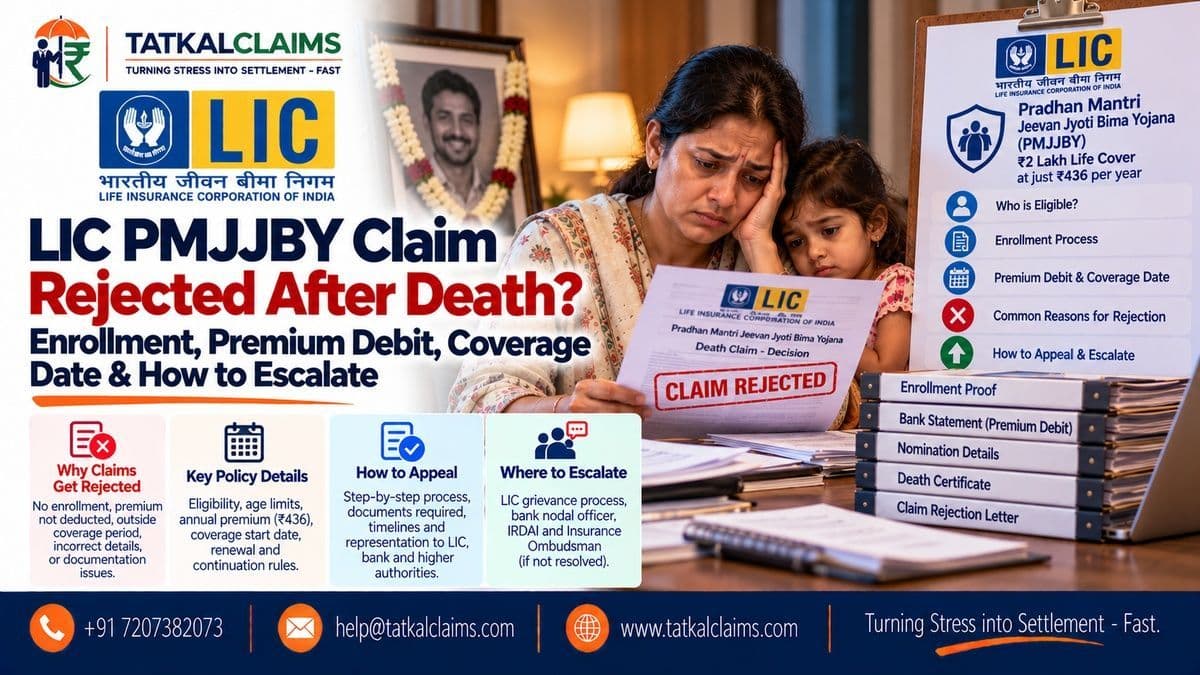
A common PMJJBY dispute starts with a bank statement that appears to show everything was fine: the premium was debited, the account was active and the family assumed the ₹2 lakh cover was in force. After death, however, the bank or insurer says the member was not covered, the premium was not remitted, the cover had lapsed, or the death fell inside the 30-day lien period.
Those are not the same problem. A PMJJBY appeal has to identify whether the failure sits with enrollment, auto-debit, bank remittance, insurer master-policy data, the coverage date, duplicate enrollment or the lien clause.
Written by: Tatkal Claims, Claims Review Team
Reviewed by: Ankit L Kanoi, Founder
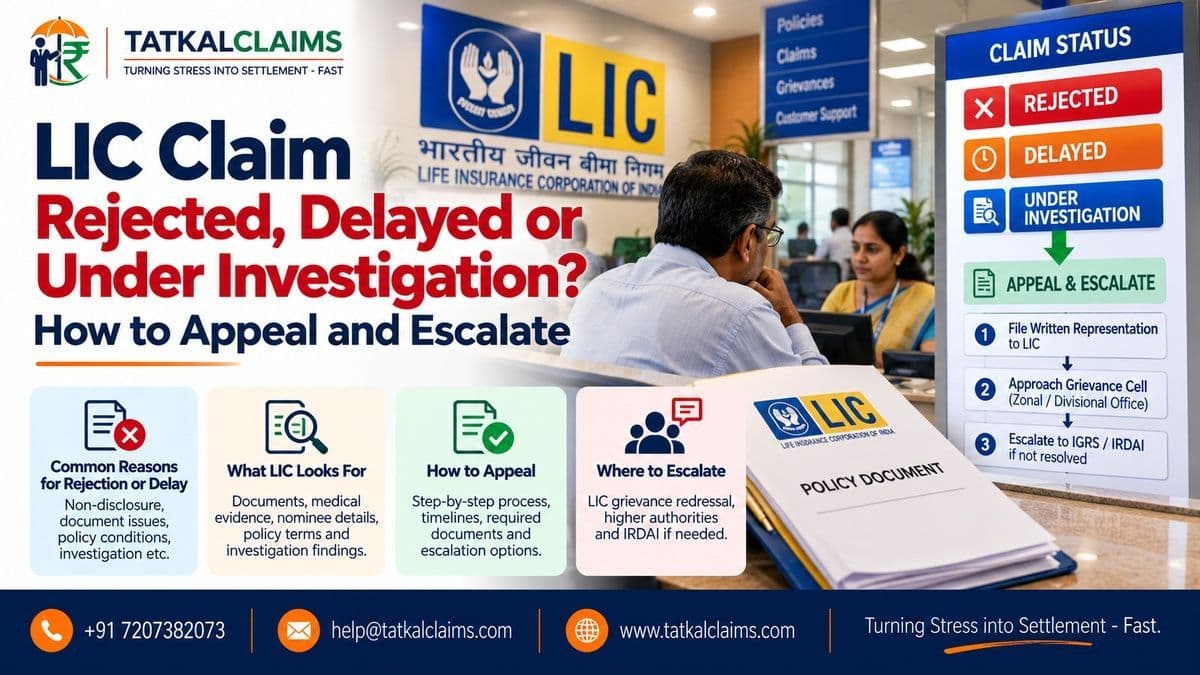
If LIC is confirmed as the PMJJBY insurer and the dispute extends beyond the scheme-specific enrollment record, use our LIC claim rejection, delay and escalation guide for the broader grievance route.
First, Confirm Who Actually Insured the PMJJBY Member
PMJJBY is not automatically an LIC policy in every bank account. The scheme can be offered through LIC or another participating life insurer tied up with the bank or post office.
If the deceased member's bank was mapped to LIC for that scheme year, LIC is the insurer. If another insurer issued the bank's master policy, the claim has to be assessed against that insurer's PMJJBY master policy.
Start with the bank or post office, not the insurer's name printed on an unrelated LIC policy. Obtain the member's PMJJBY enrollment or auto-debit consent, the exact account and scheme-year debit, and the bank's mapping to the master insurer. The bank's remittance batch and member-data submission should show whether LIC or another participating life insurer actually carried the risk.
Ask the insurer to confirm whether the deceased appears on its insured-member list and give the specific claim-return or rejection memo. These records separate an enrollment problem, a bank remittance failure and a lien-based rejection; each calls for a different response.
What PMJJBY Currently Covers
LIC's current PMJJBY scheme page lists UIN 512G300V01 and describes the plan as one-year renewable term insurance.
| Term | Current scheme position |
| Death benefit | ₹2,00,000 for death due to any reason, subject to scheme conditions |
| New-entry age | 18 to 50 years |
| Continuation | Up to age 55, subject to annual renewal |
| Scheme year | 1 June to 31 May |
| Standard annual premium | ₹436 |
| Maturity / surrender / loan value | None |
| Multiple accounts | A person may enroll through only one bank/post-office account; duplicate cover does not multiply the ₹2 lakh benefit |
Premium Amount Depends on the Month of Enrollment
Delayed enrollment is allowed prospectively with pro-rata premium. The current revised rules use quarter-based amounts.
| Enrollment month | Premium debited | Prospective coverage period |
| June, July or August | ₹436 | Up to 31 May |
| September, October or November | ₹342 | Up to 31 May |
| December, January or February | ₹228 | Up to 31 May |
| March, April or May | ₹114 | Up to 31 May |
For delayed enrollment, the current rules state that risk starts from the date the premium is auto-debited, subject to the lien clause and valid subscriber data/premium being submitted by the master policyholder.
The 30-Day Lien Can Decide the Claim
For subscribers enrolling for the first time on or after 1 June 2021, the revised rules say non-accidental death during the first 30 days from enrollment is not covered. The lien also applies when a person exits and later rejoins. LIC's current claim procedure also applies the rule to fresh enrollment after exit and late renewal situations.
| Situation | Likely PMJJBY position |
| Continuous annual renewal with no break | Do not assume a fresh 30-day lien; verify renewal records |
| First-time enrollment | 30-day lien applies |
| Exited earlier and later rejoined | 30-day lien applies again |
| Late renewal treated as fresh/rejoining cover | Claim procedure applies 30-day lien |
| Non-accidental death during lien | No PMJJBY claim is admissible under current rules |
| Accidental death during lien | Exception applies, subject to proof of accidental death and other scheme conditions |
Premium Debited but Claim Rejected as 'Not Covered'
This is the most important evidence dispute in PMJJBY.
The official claims procedure requires the bank/post office to confirm the auto-debit date, remittance to the insurer, nomination and enrollment data. The insurer then verifies whether the premium was remitted and whether the deceased was included in the insured-member list under the master policy.
The bank debit has four possible stories. No debit at all may indicate that enrollment or renewal never completed; check consent and account balance. If the debit and remittance/member data reached the correct insurer, insist on the member-list record and its reason for rejecting the claim.
If the bank debited the premium but did not remit it on time, LIC's published scheme procedure assigns the resulting liability to the bank or post office. Where the bank transmitted inaccurate or invalid member data, obtain the original enrollment and batch records and ask both parties to identify which entry caused the mismatch.
If the Bank Debited the Premium but Failed to Remit It
The PMJJBY claim-settlement procedure is unusually clear on this point. If the bank/post office did not remit a premium that had been debited from the insured member's account within the prescribed timeframe, the claim liability is to be passed to the bank/post office.
The procedure says that if such a claim reaches the insurer, it should be transmitted back to the bank/Department of Posts for settlement, with the claimant informed.
For a remittance dispute, assemble the account statement showing the debit and narration, the enrollment/auto-debit consent, and the bank's certification in the claim form. The critical additional record is the batch or transaction reference showing whether and when the bank sent the money and member details to the insurer.
Keep the insurer's rejection/return memo and the bank's written explanation together. If the bank acknowledges a processing or remittance failure, that reply can determine which grievance route is appropriate; a mere debit screenshot cannot settle that question.
Do Not Confuse Premium Debit Date With 1 June Automatically
For delayed enrollment, LIC's current scheme details say risk begins from the date of auto-debit, provided premium and valid subscriber data are submitted by the master policyholder in the same month.
This makes the exact date critical. If ₹342 was debited on 14 October and the member died on 28 October from illness, the claim can fail because death occurred inside the 30-day lien. If death was due to a qualifying accident, the lien exception may apply.
Build one timeline around the PMJJBY scheme year, which runs from 1 June to 31 May. Record the member's enrollment or consent, auto-debit, bank remittance, insurer receipt of member details and date of death. Do not assume that every delayed enrollment began covering risk on 1 June.
If death fell within the relevant 30-day lien, record the medical or accidental cause separately. The accidental-death exception is relevant only if the facts establish an accident under the scheme, and the other enrollment and coverage requirements are met.
Accidental Death During the 30-Day Lien
The current PMJJBY procedure defines accident as a sudden, unforeseen and involuntary event caused by external, violent and visible means.
If death occurs within 30 days of joining/rejoining, an accidental-death claim needs stronger proof because the lien exception is the reason the claim can be payable at all.
For an accidental-death claim during a lien period, obtain the death certificate and the accident records the scheme procedure calls for. The usual route includes FIR or panchnama with post-mortem evidence. The procedure also identifies specified alternative certification by an Executive or District Magistrate, and certain hospital records in circumstances such as a snake bite or a fall from a tree.
Use the alternative that actually fits the death and the scheme instructions. Do not treat every hospital note as interchangeable with a police report, or assume that every accident necessarily has the same available documents.
What Documents Does a PMJJBY Death Claim Need?
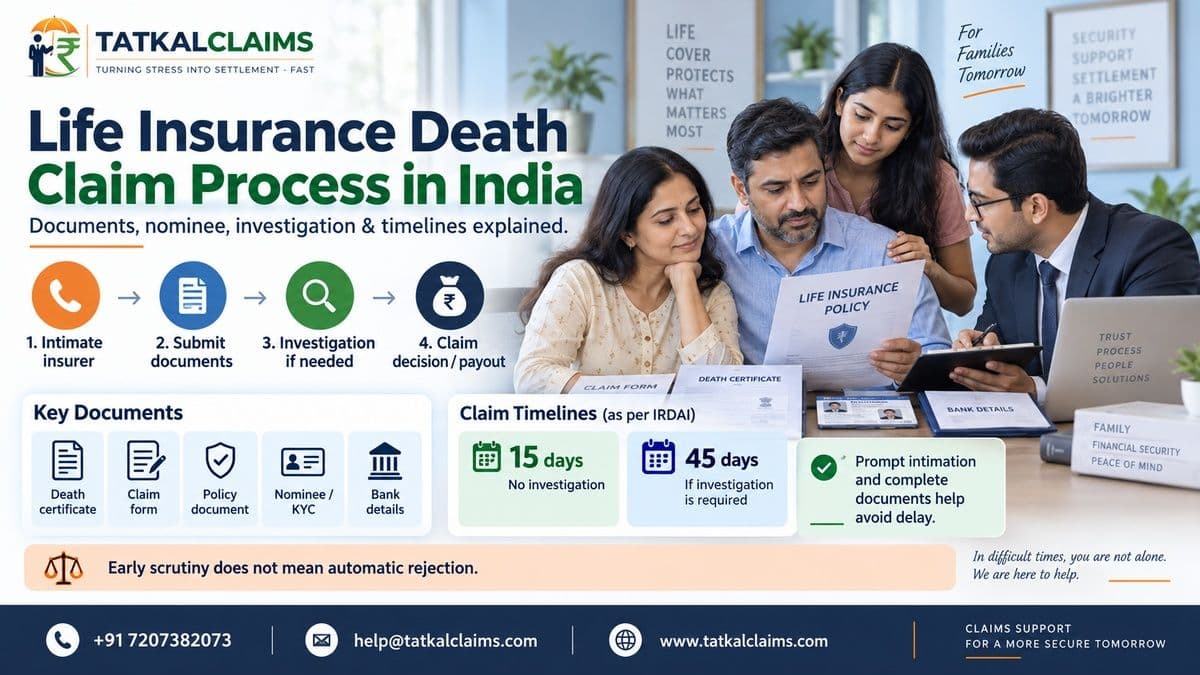
The nominee, appointee or eligible legal heir submits the claim-cum-discharge form to the concerned bank/post-office branch, preferably within 30 days of death.
| Document / detail | Current procedure |
| Claim-cum-discharge form | Submitted through bank/post office |
| Proof of death | Death certificate or other accepted proof |
| Accident proof if death falls in lien-period exception | Required to establish accidental death |
| Nominee/appointee/claimant KYC | Required |
| Claimant bank details | Passbook pages, account statement or cancelled cheque |
| Aadhaar / PAN details | Desirable under claim form; current form marks these as optional |
| Proof nominee predeceased insured | If applicable |
| Legal-heir proof | Required where claimant is not nominee/appointee |
| Advance receipt for discharge | Duly completed and signed |
Where there was no nomination, or the nominee predeceased the insured, the current procedure says payment can go to legal heirs on production of a succession certificate or legal-heir certificate from the competent court/authority.
How Fast Should the Claim Move?
The current PMJJBY claims procedure gives a short operational timeline.
| Stage | Published maximum |
| Bank/post office forwards a complete claim to insurer | 7 days from submission |
| Insurer processes and disburses after receipt | 7 days |
| Decision communication | Insurer sends payment/rejection intimation to bank/post office and SMS to claimant, and updates the Jan Suraksha portal |
That does not mean every incomplete claim must be paid within 14 days. It means unexplained inactivity after a complete claim file has been submitted is a legitimate escalation issue.
Duplicate PMJJBY Enrollment Does Not Create Multiple ₹2 Lakh Claims
The revised rules restrict a member to one PMJJBY enrollment through one bank/post-office account. If duplicate premiums are received through multiple accounts, cover remains restricted to ₹2 lakh.
The insurer's claim procedure also requires deduplication and permits rejection where the PMJJBY benefit for the same deceased member has already been paid by another insurer.
How to Read the Rejection Before You Escalate
Read LIC's rejection against the transaction trail. 'Member not enrolled' calls for the consent, account record and insured-member list; 'premium not received' requires separating no debit from a debit not remitted; 'cover ceased' calls for renewal, account balance and age records. For 'death within the lien', check the true start or rejoining date and evidence of any accidental-death exception.
A duplicate-enrollment response should be checked against the other accounts and any benefit already paid, while a nominee mismatch requires identity or legal-title evidence. If LIC cites 'late claim', the official form says preferably within 30 days: ask for the precise substantive basis rather than accepting that wording as a universal forfeiture. For an alleged data mismatch, put the bank's original enrollment fields beside its remittance record and the insurer's member list.
Escalation Route for an LIC-Insured PMJJBY Claim
1. Bank / Post-Office Branch
Start with the master policyholder. Ask for a written certification of enrollment, auto-debit date, premium amount, remittance date, insurer name, nomination and the date the claim was forwarded.
2. LIC P&GS / PMJJBY Servicing Unit
If LIC issued the bank's PMJJBY master policy, ask LIC for the exact reason the member was not found/admitted, the relevant master-policy record and the claim decision. LIC's PMJJBY page publishes a bank-wise grievance redressal resource for its scheme business.
3. LIC Grievance Redressal
For an LIC-insured scheme claim, LIC's current grievance page allows escalation through its grievance machinery and lists co_complaints@licindia.com. Keep the bank as a named party to the grievance if the dispute concerns debit, enrollment data or remittance.
4. Bima Bharosa
Bima Bharosa can be used to create an IRDAI-visible complaint against the insurer. IRDAI currently lists 155255, 1800 4254 732 and complaints@irdai.gov.in. If the core failure is purely a bank remittance/operational issue, keep the bank-side complaint active as well rather than treating the insurer grievance as a substitute.
5. Insurance Ombudsman
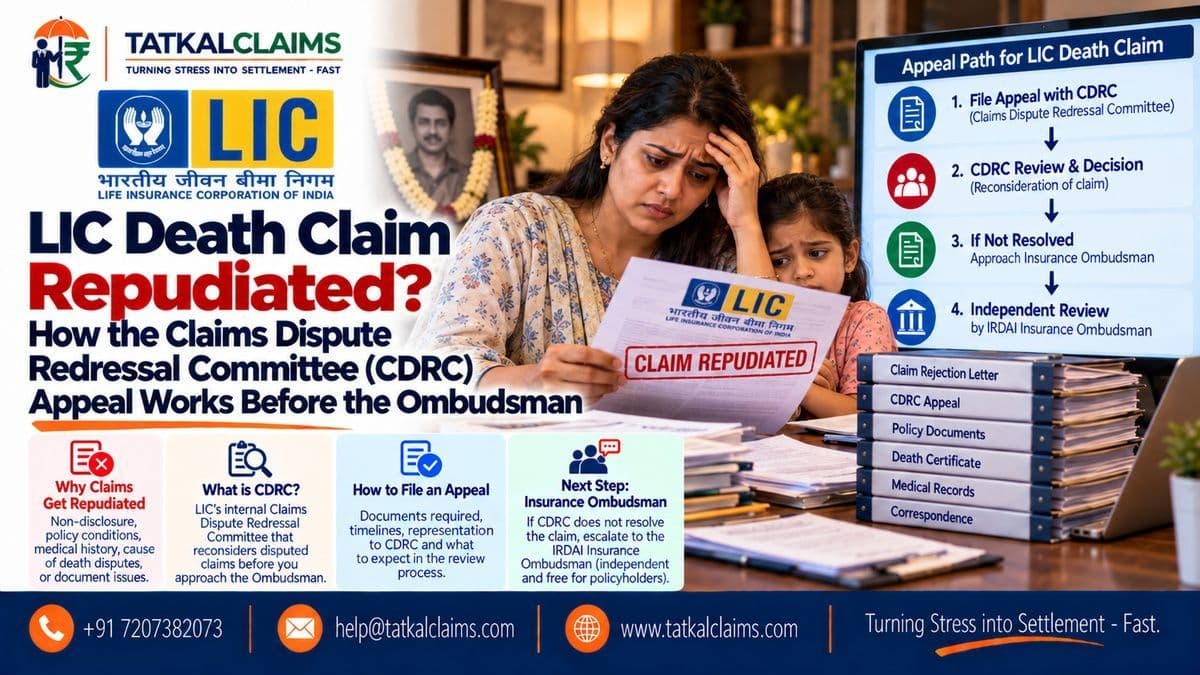
Current CIO procedure requires a complaint to the insurer first. If the response is unsatisfactory, or there is no response within 30 days, an eligible claimant can approach the Ombudsman subject to the current ₹50 lakh monetary limit, general one-year filing rule and no-parallel-forum condition.
6. Bank-Side / Consumer Remedy Where the Bank Caused the Failure
Where the premium was debited but the bank/post office failed to remit it and the PMJJBY procedure places liability on that institution, the dispute is no longer only an insurance-repudiation problem. Preserve the bank admission, transaction trail and claim-return communication for the appropriate banking/consumer grievance route.
Make the Bank and Insurer Reconcile the Same Record
Ask the bank or post office to certify enrollment, the debit date and amount, remittance, insurer mapping, member-data submission and when it forwarded the claim. Ask LIC, if it issued that master policy, whether the deceased appears on its insured-member list and which rule or record caused the return or rejection. Put both written replies beside the account statement and enrollment form.
Only then test risk start and any 30-day lien against the death date; collect the scheme's accident evidence if the exception matters. A debit without timely remittance points to the bank or post office liability route in the published claims procedure. A disputed insurer record or clause belongs in an insurer grievance. The scheme's seven-day forwarding and seven-day insurer-processing stages apply to a complete claim file; keep them separate from Ombudsman eligibility and its insurer-first process.
Can TatkalClaims Help With a PMJJBY Claim?
For PMJJBY, the first useful evidence is often not the death certificate but the link between the bank's debit and the insurer's member list. TatkalClaims can compare the enrollment consent, scheme-year dates, remittance record, lien position and the rejection to identify whether LIC, another participating insurer, or the bank/post office must answer the missing step. A debit does not itself establish uninterrupted coverage.
Send the debit entry, enrollment or nominee record, bank remittance response, rejection memo and death certificate to help@tatkalclaims.com, or call +91 7207382073. We will also flag a non-accidental death within an applicable lien, invalid enrollment or a duplicate benefit already paid when the records support that conclusion.
Frequently asked questions
How much does PMJJBY pay on an admissible death claim?
The current scheme benefit is a fixed ₹2 lakh on death due to any reason, subject to enrollment, coverage and scheme conditions. Duplicate enrollment through multiple accounts does not multiply the benefit.
If ₹436 was debited, is the PMJJBY claim automatically payable?
No. The debit strongly supports enrollment, but the bank/post office must also have remitted the premium and valid member data to the insurer. If the bank debited the premium but failed to remit it within the prescribed timeframe, the official claims procedure says liability passes to the bank/post office.
When does PMJJBY cover start for delayed enrollment?
The current revised rules say risk starts from the date of auto-debit for delayed enrollment, subject to valid premium/member-data submission and the applicable 30-day lien.
Is every death during the first 30 days rejected?
No. The lien applies to specified fresh/rejoining/late-renewal situations and excludes non-accidental death during those first 30 days. Accidental death is the stated exception, subject to acceptable accident proof and the other scheme conditions.
Can a nominee file a PMJJBY claim after 30 days from death?
The official claim form and procedure say the claim should preferably be submitted within 30 days. That wording is not the same as an automatic hard forfeiture at day 31. If a late-filed claim is rejected solely on timing, obtain the written basis and escalate on the actual scheme wording and facts.
What if there is no nominee?
The current PMJJBY procedure allows an eligible legal heir to claim where there is no nomination or the nominee predeceased the insured, subject to a succession certificate or legal-heir certificate from the competent court/authority and the other required claim documents.
Sources & Methodology
Primary-source review completed 5 October 2026. Current PMJJBY cover, premium, pro-rata enrollment, lien, risk-start, master-policy and age rules were checked against the Department of Financial Services' revised PMJJBY rules and LIC's current PMJJBY scheme page, which LIC last updated in July 2026. Claim-document, bank-remittance-liability and 7-day processing rules were checked against LIC's published PMJJBY claims procedure. Current grievance routes were checked separately because the scheme's operating documents and general insurer/Ombudsman grievance rules serve different purposes.
Disclaimer: This guide explains PMJJBY death-claim disputes in general terms. The result depends on the member's actual enrollment, bank/post-office account, auto-debit and remittance records, scheme-year insurer, coverage date, lien status, cause of death, duplicate-cover status and claim documents. PMJJBY may be insured by LIC or another participating life insurer. This guide is not legal advice and does not guarantee payment.