
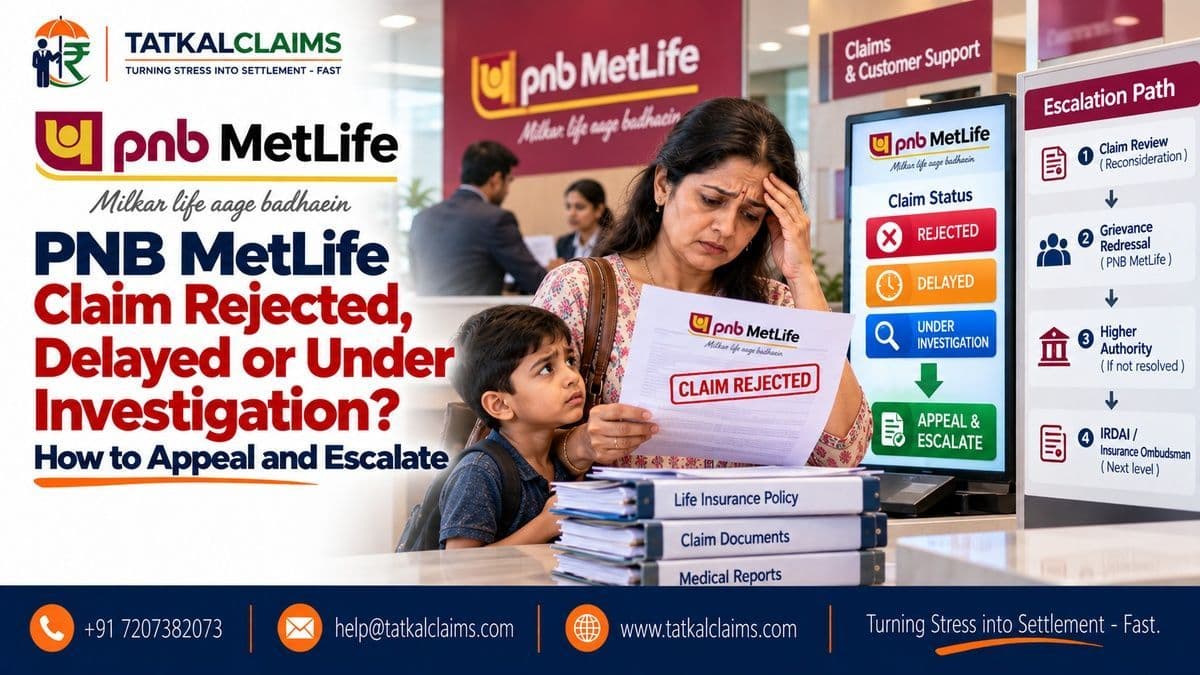
A PNB MetLife death claim can become difficult long before a formal rejection arrives. The family may keep receiving fresh document requests, the claim may be marked for investigation, or the insurer may say the file is still incomplete even though the nominee believes everything has already been submitted. In a loan-linked policy, there can be an added layer: the bank and insurer may not agree on whether cover was ever active.
Those situations should not be handled with the same generic complaint. A delayed claim needs a dated chronology. An investigated claim needs careful cooperation and a 45-day watch. A repudiated claim needs a reason-by-reason response. And a bank-linked cover dispute needs the premium trail, proposal, certificate and bank-insurer records put side by side.
Written by: Tatkal Claims, Claims Review Team
Reviewed by: Ankit L Kanoi, Founder
What This PNB MetLife Guide Covers
This page focuses on PNB MetLife India Insurance Company Limited: death-claim filing, claim documents, 15-day and 45-day timelines, investigation, repudiation, its Claim Assure fast-track facility, current grievance/GRO escalation, Bima Bharosa and the Insurance Ombudsman.
It does not replace Tatkal Claims’ broader pages on Section 45, early-death investigations, nominee law, general death-claim filing or credit-life disputes.
For the wider investigation framework, see Life Insurance Claim Under Investigation After an Early Death.
First Identify the Claim Status
| Status | What it usually means | Immediate response |
| Requirement pending | PNB MetLife says a document or clarification is outstanding | Ask for one consolidated written requirement list and submit with proof |
| Under investigation | The insurer is carrying out additional verification | Ask what issue is being verified and track the 45-day TAT |
| Delayed | The applicable claim period has passed without a decision | Raise a dated grievance with intimation and document dates |
| Rejected / repudiated | The insurer has made an adverse claim decision | Obtain the written reason and prepare a point-by-point representation |
| Bank-linked cover disputed | Bank and insurer disagree on whether insurance existed | Audit premium debit, proposal, certificate, underwriting decision and communication |
A portal or call-centre label such as “under process” is not enough. Ask whether the claim formally warrants investigation, what requirement remains open, when the claim was first intimated and what decision date PNB MetLife is using.
How a PNB MetLife Death Claim Can Be Intimated
PNB MetLife’s current claim-process page allows claim intimation online, by email, post, branch, the khUshi app and WhatsApp. The current claim page publishes `claimshelpdesk@pnbmetlife.com` for claim intimation and assistance and the toll-free number 1800-425-6969.
The insurer’s current death-claim form and claim pages list core documents such as the signed claim form, death certificate, treating-doctor certificate, nominee identity/address proof, PAN/Form 60 and bank proof. Additional medical, police or other records can be required depending on the cause and circumstances of death.
| Document | Why it matters |
| Policy schedule / policy bond | Confirms product, risk date, sum assured and riders |
| Proposal form | Central where non-disclosure or misstatement is alleged |
| Revival papers, if any | Can affect policy status and Section 45 timing |
| Death certificate | Core proof of death |
| Claim form and acknowledgement | Anchors the formal claim-intimation chronology |
| Doctor / hospital records | Relevant where medical history or cause of death is examined |
| Nominee KYC, PAN/Form 60 and bank proof | Supports claimant identity and payout |
| FIR / inquest / post-mortem / driving licence, if applicable | Relevant for accidental or unnatural death |
| All requirement letters and replies | Shows what PNB MetLife asked for and when the claimant responded |
For the broader filing and nominee process, see Life Insurance Death Claim Process in India.
Current PNB MetLife Death-Claim Timelines: 15 Days and 45 Days
PNB MetLife’s current claim-process page states that once mandatory claim-intimation documents are received, a claim that does not require investigation should be processed within 15 days from claim intimation.
If investigation is required because of inconsistencies or additional verification needs, the insurer states that the investigation should be completed and the claim decisioned within 45 days from receipt of claim intimation.
Its current Claims FAQ repeats the same 15-day non-investigated and 45-day investigated TATs and says interest is payable in case of breach of the regulatory turnaround time, subject to applicable IRDAI rules.
PNB MetLife Claim Assure: A Separate Fast-Track Facility
PNB MetLife also publishes a Claim Assure fast-track process for certain eligible individual death claims. This should not be confused with the ordinary 15-day/45-day claim TAT.
Under the current Claim Assure conditions, the policy must generally have remained active continuously for three years from issue or revival, whichever is later; the claim must not warrant field verification or investigation; mandatory documents and clarifications must be submitted with the signed claim form before 2 PM on a working day; and the eligible claim amount is capped at ₹50 lakh per life/person. Certain products and situations are excluded.
Where the stated Claim Assure conditions are met, PNB MetLife says payment will be processed the next working day.
If the Claim Is Under Investigation
Investigation is not a rejection. It is a verification stage. The nominee should cooperate with relevant requests, but should avoid guessing old diagnoses, treatment dates, income, occupation or other facts merely to complete an investigator’s questionnaire.
Common verification areas can include prior medical treatment, proposal answers, occupation or income, other insurance, premium status, revival, cause of death, claimant entitlement and document authenticity.
If a statement is recorded, read it before signing and retain a copy where possible. If you do not know a historical fact, say so and offer to obtain the record.
| 1 | What specific issue is PNB MetLife investigating? |
| 2 | What documents remain outstanding and why are they material? |
| 3 | Has every document already supplied been acknowledged? |
| 4 | What date is being treated as claim intimation? |
| 5 | Is the claim formally classified as requiring investigation? |
| 6 | What is the expected decision date under the 45-day TAT? |
If PNB MetLife Rejects or Repudiates the Claim
A repudiation should be answered on the insurer’s actual ground. A generic complaint about fairness is weaker than a structured representation that identifies the exact proposal question, policy clause, evidence relied upon and the claimant’s contrary evidence.
| Check | What to establish |
| Exact repudiation ground | What precisely is alleged — non-disclosure, lapse, exclusion, policy status, claimant issue or another reason |
| Proposal wording | What question was actually asked and how it was answered |
| Evidence relied on | Medical, financial, employer, investigator or other material supporting the allegation |
| Materiality | Whether the alleged fact could genuinely affect underwriting or the claim issue |
| Issue / revival dates | Whether Section 45 applies and which date starts the three-year period |
| Policy clause / rider | Whether the correct contractual provision is being applied |
If the rejection refers to records or investigator findings you have never seen, ask for the material relied upon or enough particulars to answer the allegation meaningfully.
Common Rejection Grounds — and What to Test
| Ground raised | What to examine |
| Medical non-disclosure | Proposal questions, pre-policy records, medical tests, materiality and Section 45 |
| Income / occupation misstatement | Proposal declarations, income proof, employment/business records and underwriting relevance |
| Other insurance not disclosed | Exact question asked, policies then in force, disclosure evidence and materiality |
| Policy lapse | Premium due date, grace period, debit/return evidence, auto-debit and policy status |
| Revival dispute | Revival form, declaration, medical evidence and revival date |
| Suicide or rider exclusion | Exact clause, relevant dates and cause-of-death records |
| Accidental rider denied | Rider wording, FIR, post-mortem and causal facts |
| Nominee/title issue | Separate admissibility of the claim from who is entitled to receive proceeds |
A PNB MetLife Loan-Linked Case Already Exists on Tatkal Claims
Tatkal Claims already has a separate case study involving J&K Bank and PNB MetLife where a consumer commission granted relief after an insurance premium was deducted before a borrower’s death and reversed afterwards. The decision turned on that specific chronology and the absence of convincing proof that no cover had arisen or that the borrower had been informed before death.
That case does not create a universal rule that every premium debit automatically proves insurance cover. In a similar dispute, the proposal, premium transfer, underwriting decision, certificate, communication and refund/reversal record must be examined together.
Read the separate case study: Bank Deducted Insurance Premium, Refunded It After Borrower's Death, Then Rejected the Claim.
Section 45 Still Controls Life-Policy Challenges
Section 45 of the Insurance Act sets the three-year framework for when a life insurance policy can be called in question. The relevant period is measured from the latest applicable date among policy issuance, commencement of risk, revival and rider.
Within that statutory window, the insurer may rely on qualifying fraud or material misstatement/suppression subject to the tests in the statute. The proposal question, alleged fact, materiality, dates and evidence matter.
Do not calculate the period only from the original policy issue date if the policy was revived.
For the full statutory framework, see Life Claim Rejected After 3 Years? What Section 45 Actually Protects.
PNB MetLife Grievance Escalation
PNB MetLife’s grievance page, updated 6 August 2026, says complaints can be raised through its toll-free number, `indiaservice@pnbmetlife.co.in`, post or a branch. The insurer says acknowledgement is sent within T+1 working day and final resolution/rejection should be communicated within 14 calendar days from receipt of the grievance.
If additional due diligence or investigation is needed because of complexity, the insurer says it may send an interim communication with the reason and a resolution timeline. A dissatisfied customer may come back within eight weeks of the company’s response; otherwise the grievance may be closed for non-response.
If the customer is not satisfied with the initial resolution, PNB MetLife’s current escalation page directs the grievance to its Grievance Redressal Officer at `gro@pnbmetlife.co.in`. After that, the customer may approach Bima Bharosa/IRDAI and, where eligible, the Insurance Ombudsman.
| Stage | Current route |
| Initial grievance | PNB MetLife customer service / branch / indiaservice@pnbmetlife.co.in |
| Insurer escalation | Grievance Redressal Officer — gro@pnbmetlife.co.in |
| Regulatory escalation | Bima Bharosa / IRDAI where the grievance remains unresolved or unsatisfactory |
| External dispute resolution | Insurance Ombudsman where eligibility conditions are met |
Bima Bharosa and the Insurance Ombudsman
Bima Bharosa is IRDAI’s grievance platform. The insurer should be approached first. IRDAI’s current portal says complaints registered through Bima Bharosa should be attended to within 14 days, and its FAQ states that an insurer grievance should generally be resolved within 15 days.
The Insurance Ombudsman is a separate external dispute-resolution route. Current Council for Insurance Ombudsmen guidance requires the insurer to be approached first; an eligible complaint can be filed after rejection or an unsatisfactory response, or after one month without a reply.
Current Ombudsman guidance uses a one-year filing period and a ₹50 lakh compensation ceiling, and the same subject should not already be pending before or disposed of by a court, consumer forum or arbitrator.
For a side-by-side explanation, see Bima Bharosa vs Insurance Ombudsman.
A 7-Day Working Plan After a PNB MetLife Rejection or Serious Delay
| Day 1 | Collect policy, proposal, revival papers, death certificate and claim acknowledgement |
| Day 2 | Build a chronology and mark claim-intimation and every document-submission date |
| Day 3 | Obtain and audit the rejection communication or pending-requirement list |
| Day 4 | Collect medical, financial, bank, employer or police evidence needed to answer the issue |
| Day 5 | Check Section 45 dates, exclusion wording and policy/revival status |
| Day 6 | Draft a reason-by-reason representation with indexed annexures |
| Day 7 | Submit through the correct grievance route and preserve acknowledgement |
When the Appeal Position May Be Stronger — or Weaker
| Potentially stronger | Potentially weaker |
| The alleged fact was already disclosed in the proposal or medical record | Signed proposal/revival records contain a clear contradictory answer |
| The insurer cannot identify reliable material supporting the allegation | Primary records directly support the insurer’s allegation |
| The proposal question is unclear or does not ask what is now alleged to have been suppressed | The question is specific and the omitted fact is material |
| Payment records contradict a lapse allegation | Policy status clearly shows no cover on the event date |
| The policy is outside the Section 45 challenge window using the correct relevant date | The dispute falls within the statutory window and evidence supports a qualifying ground |
| Delay continues after the claim file is demonstrably complete | A genuinely material claimant-side requirement remains outstanding |
These are indicators only. The actual policy, proposal/revival records, dates and evidence determine the strength of the case.
How Tatkal Claims Can Help
Tatkal Claims can review the PNB MetLife policy, proposal and revival records, claim chronology, repudiation communication, medical/employer evidence, investigator correspondence, bank-linked insurance records and grievance history to identify the actual dispute and the evidence that matters.
Where appropriate, assistance can include preparing a structured representation, organising annexures, identifying missing records, challenging unexplained delay and structuring escalation through PNB MetLife’s GRO route, Bima Bharosa or the Insurance Ombudsman. No claim outcome can be guaranteed.
Frequently Asked Questions
Frequently asked questions
How long should PNB MetLife take to decide a death claim?
PNB MetLife’s current claim pages state 15 days from claim intimation for non-investigated claims and 45 days from claim intimation for investigated claims, once mandatory claim-intimation requirements are in place.
What should I do if my PNB MetLife claim is under investigation?
Ask what specific issue is being verified, what documents remain outstanding, whether the claim is formally classified as investigated and what decision date the insurer is using under the 45-day TAT. Cooperate with relevant requests but do not guess facts you do not know.
What documents does PNB MetLife ask for in a death claim?
Current claim material lists the signed claim form, death certificate, treating-doctor certificate, nominee identity/address proof, PAN/Form 60 and bank proof, with additional medical or police records depending on the circumstances.
What is PNB MetLife Claim Assure?
Claim Assure is a separate fast-track facility for certain eligible, non-investigated individual death claims. Current conditions include continuous policy activity for three years from issue/revival, complete documents before 2 PM on a working day and an eligible claim amount up to ₹50 lakh. Other conditions and exclusions apply.
Does failure to qualify for Claim Assure mean the death claim is invalid?
No. Claim Assure is a special service route. A claim that does not qualify for the fast-track facility can still be processed under the normal death-claim process and assessed under the policy and applicable law.
What is PNB MetLife’s grievance timeline?
Its current grievance page says acknowledgement should be sent within T+1 working day and final resolution or rejection within 14 calendar days from receipt of the grievance.
What is the PNB MetLife GRO email?
The current grievance page lists gro@pnbmetlife.co.in for the Grievance Redressal Officer.
Can a PNB MetLife non-disclosure rejection be challenged?
Yes, where the evidence supports the claimant. The proposal/revival question, disclosure record, materiality, dates and Section 45 must be checked before assessing the strength of the appeal.
Can I complain through Bima Bharosa against PNB MetLife?
Yes. The insurer should be approached first. If the grievance remains unresolved or the response is unsatisfactory, Bima Bharosa can be used to register and track the complaint with IRDAI.
When can I approach the Insurance Ombudsman?
Current Ombudsman guidance requires insurer-first escalation. An eligible complaint may then be filed after rejection or an unsatisfactory response, or after one month without reply, subject to the one-year filing period, ₹50 lakh ceiling and other eligibility conditions.
Sources and Methodology
Disclaimer: This guide explains current PNB MetLife India Insurance Company Limited claim-handling information, selected insurer procedures, the Insurance Act and grievance/Ombudsman routes in general terms. Actual rights depend on the policy wording, proposal and revival records, premium status, cause of death, claimant entitlement, dates, evidence and applicable law. PNB MetLife procedures can change, so the latest insurer communication for the specific claim should be checked before filing. This is not legal advice and does not guarantee claim settlement.