
Your policy expired on Friday. You were admitted on Monday and paid the renewal premium on Wednesday. When the insurer rejects the bill, it is natural to ask what the grace period was for. The answer depends on which payment was overdue and whether the policy covered Monday’s admission.
What Does the Health Insurance Grace Period Protect?
Schedule III of the IRDAI (Insurance Products) Regulations, 2024 sets a grace period of 15 days for monthly premium payments and 30 days for other payment modes. The health insurance master circular also explains how that period applies. A qualifying renewal within the grace period protects accrued credits such as completed waiting periods, no-claim bonus and time counted toward the moratorium.
Those credits matter for future claims. To assess a bill incurred during the overdue days, check whether your policy term was still running and whether the overdue amount was an instalment under the insurer’s payment schedule. The 2024 regulations and circular provide for cover during the grace period when premiums are paid in instalments during the policy period. The schedule, payment status, applicable grace-period dates and claim terms still matter.
An annual premium can be an instalment inside a multi-year policy or the payment needed to renew an expiring policy. A monthly EMI on your credit card can also be a financing arrangement while the insurer receives its premium upfront. Identify the arrangement from the insurer’s schedule and receipts.
| What actually happened | What decides the dispute | Document to check first |
|---|---|---|
| Your term ended before admission and you renewed later | Whether your wording covers the unpaid interval and when renewed cover took effect | Old and renewed schedules and the renewal grace-period clause |
| An instalment was due during a term that was still running | Your insurer’s instalment schedule, the applicable grace dates and the payment status | Policy schedule and instalment receipt |
| Your bank shows a debit but the insurer recorded payment late | Whether the payment reached the insurer or an authorised collection channel, and whether it was later reversed | Transaction reference and insurer or payment gateway confirmation |
| You were already in hospital when the term expired | The treatment dates and any clause for a hospital stay that crosses expiry | Admission record, itemised bills and applicable policy wording |
Case 1. You Renewed After Expiry and Were Admitted Before Paying
Suppose your policy ended on 30 June. You were admitted on 5 July and the insurer accepted your annual renewal on 10 July, within the applicable grace period. Payment on 10 July can protect accrued continuity credits. Whether the 5 July admission is covered turns on the applicable policy terms and the insurer’s effective dates. Some retail policy wordings expressly exclude the unpaid days after the policy term ends, even when the renewal keeps continuity intact.
Ask the insurer to show the end of the old term, when the renewal took effect for claims, and the clause it used for the admission. If the denial cites a break in cover but you were admitted before the old term ended or after the renewed cover took effect, put those dates in the first line of your appeal. For a stay that crosses expiry, ask the insurer to explain how it treated the admission and each billed period under the policy. If the insurer has also refused to renew the policy after a past claim, our health insurance renewal-refusal guide explains the steps to take before expiry.
Case 2. You Missed an Instalment During an Active Policy Term
Suppose your schedule runs from 1 January to 31 December and shows monthly instalments payable to the insurer. The 1 July instalment is missed, you are admitted on 7 July, and the insurer receives the instalment on 10 July. If those dates fall within the applicable grace period, the policy schedule and receipt support a request to reconsider a denial based solely on the instalment being overdue at admission.
Ask the insurer to apply the grace-period cover provision to the admission and confirm how it has treated any outstanding premium under the policy. If the instalment remained unpaid beyond the grace period, ask when cancellation or lapse took effect and how the wording treats the admission. An overdue instalment by itself says little without the due date, grace deadline and payment history.
Case 3. The Bank Debited You but the Insurer Recorded the Payment Late
Suppose you used the insurer’s renewal portal on 29 June. The bank shows a debit that day, but the insurer’s system records the payment on 3 July and rejects a 2 July admission. Look for a successful transaction confirmation, a premium acknowledgement or an insurer receipt, and check whether the debit was reversed.
Send the transaction reference and screenshots with visible timestamps to the insurer. Ask it to trace the payment with its gateway or collection partner and tell you when the premium was received, when it was assigned to your policy and which date it used for claim coverage. A successful payment the insurer allocated late gives you a different dispute from an auto-debit mandate that failed or a debit that was reversed.
Which Dates and Documents Should You Put in the Appeal?
- Send both policy schedules and the relevant wording. Highlight the old expiry date and time, any instalment schedule and the start date shown on the renewal.
- Include the premium notice, proof of payment and insurer acknowledgement. For a failed or pending debit, provide the transaction reference and the status confirmed by the bank or gateway.
- Include the admission and discharge records with the date and time. Add dated bills if the hospital stay crossed expiry. Record the date you submitted the claim separately.
- Attach the written rejection and keep the claim reference, grievance number and prior replies. Ask the insurer to quote the relevant policy clause and give the dates its claims team used.
If the hospital’s cashless request was refused, keep the denial and the hospital bills. Our guide to reimbursement after a cashless refusal explains the separate filing process. The insurer will still need to decide whether the treatment fell within cover.
When Is a Challenge Stronger?
A challenge is stronger when the policy schedule places admission inside the insured term, the overdue payment was an in-term instalment paid within the grace period, or a receipt shows timely premium received against the right policy. The insurer may also need to reconcile contradictory dates across the receipt, policy schedule and denial letter.
A challenge is harder when admission began after the old term ended, the premium arrived after admission, and the wording clearly excludes the unpaid renewal interval. It is also harder when a transaction failed or was refunded and no other timely payment was received. In each case, ask for the insurer’s written timeline before deciding whether you can contest its finding.
If the insurer also says your waiting period started again because you switched companies, use the guide to waiting-period credit after porting to check the old and new insurers’ continuity records.
Sample Request to Reconsider a Grace-Period Claim Rejection
Subject: Request to review coverage dates for health claim [claim number]
Please reconsider your decision dated [date] on policy [policy number]. Admission took place on [date and time]. The premium due date was [date] and the attached records show [payment, receipt or gateway status] on [date]. Please confirm whether you treated this payment as a renewal or an instalment within the policy term.
Please provide the policy clause, the effective coverage dates and the start and end of the grace period used in the decision. If your system shows late receipt, please trace transaction [reference] and confirm the date on which the payment was received and applied to my policy. Once you have reconciled the dates, please review the claim and reply in writing.
Where to Escalate a Claim Rejected for Late Premium
Submit the appeal to the insurer's Grievance Redressal Officer and keep the acknowledgement. IRDAI's 5 September 2024 Master Circular on Protection of Policyholders' Interests specifies that insurers should resolve grievances within 14 days, with reasons if the complaint is not accepted. Some Bima Bharosa FAQ pages still display an older 15-day period. If the response is unsatisfactory or the issue remains unresolved, you can register or track the grievance through Bima Bharosa.
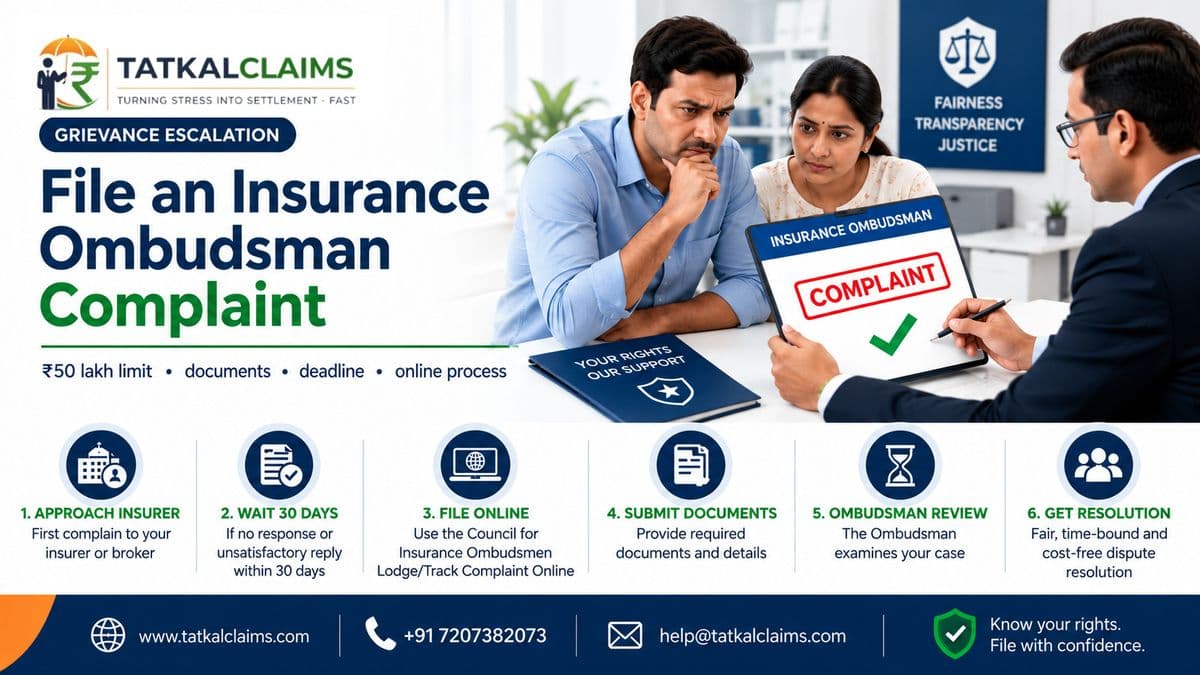
The Insurance Ombudsman has its own eligibility and timing rules. A complaint can generally proceed after an unsatisfactory insurer response or after 30 days without a response. Check the applicable filing deadline, the ₹50 lakh limit including relevant expenses and the restriction on cases already pending or decided in another forum. Keep the disputed dates and the insurer’s written response together.
Use our Bima Bharosa and Insurance Ombudsman comparison to choose the appropriate route for the dispute.
How Tatkal Claims Can Help With a Grace-Period Rejection
Tatkal Claims can compare your policy schedule, hospital records and payment trail to establish what was due and when the insurer received it. If those documents support a challenge, we can help you ask for a specific correction and prepare the grievance with the evidence in date order.
Frequently asked questions
Will health insurance pay for an admission during the grace period?
It depends on whether the unpaid premium was an instalment during the policy term or a renewal after the term ended. Check the coverage clause and effective dates. In-term instalments have grace-period cover under IRDAI’s framework, subject to the facts of the claim and the relevant payment provisions.
Do I get 15 days or 30 days after the premium due date?
The 2024 rules specify 15 days for monthly payments and 30 days for other modes. Confirm the insurer’s actual due date and premium mode. A credit-card EMI schedule may differ from the premium schedule issued by the insurer.
If I paid my annual renewal during the grace period, do my waiting periods reset?
For a qualifying renewal within the grace period, accrued credits are protected. Keep the renewal receipt and ask the insurer to correct the record if it has applied a new waiting period solely because your renewal was paid during the grace period.
Can the insurer reject a claim just because the instalment was overdue on admission day?
If the instalment was due during the policy term and admission occurred within the applicable grace period, ask the insurer to explain its decision against the grace-period coverage provision. Include the instalment payment history and the receipt if payment was made within that period.
Does a bank debit prove the insurer received my premium?
It shows a debit or attempt on the bank side. Use the transaction reference, gateway result, insurer receipt and any reversal entry to work out when the payment was received and assigned to the policy.
What if I was admitted before the policy expired but discharged afterwards?
Ask the insurer to identify the clause it applied to a stay that crossed expiry. Provide the admission timestamp, discharge summary and dated bills. The applicable wording and dates are needed to assess which expenses were covered.
Can I appeal if the insurer records the wrong policy renewal date?
Yes. Send the old schedule, renewal transaction proof, confirmation and new schedule to the insurer’s grievance team. Ask it to correct the dates and reconsider the claim under the corrected record.
Sources & Methodology
This guide uses the IRDAI regulations and 2024 health insurance circular, official grievance guidance and sample insurer policy wording to explain how payment mode and dates matter. The timelines are illustrative. Check the wording and schedule applicable to your claim, including any endorsements. This guide gives general information. Payment depends on the facts and coverage terms of the individual claim.