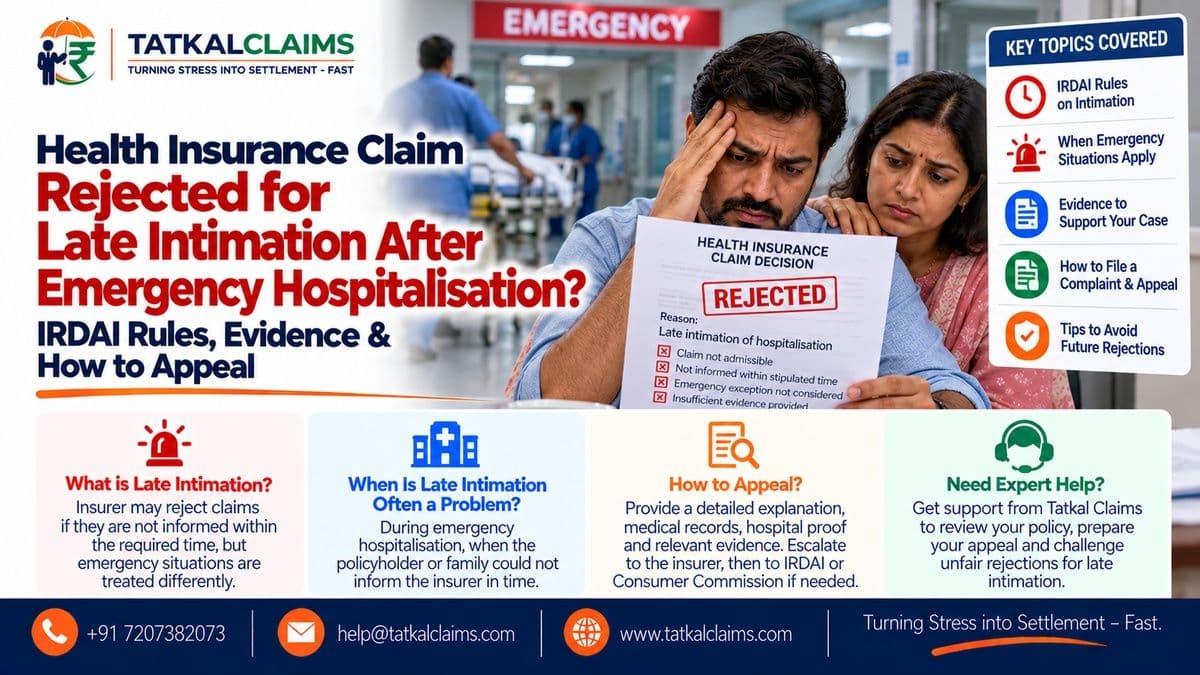
Your father was rushed to hospital late at night and taken straight to intensive care. For the next two days, the family was arranging treatment, speaking to doctors and finding funds. When you finally informed the health insurer, you were told that the policy required intimation within 24 or 48 hours—and that the claim would be rejected because you missed the window.
A missed reporting window deserves careful attention, but it is not the same thing as proving that the hospital treatment was excluded. IRDAI's September 2024 Master Circular on Protection of Policyholders' Interests says that a claim must not be rejected or closed merely for delayed intimation or want of documents. The insurer still has to assess the claim on relevant evidence and the applicable coverage terms. Your first move should be to obtain the exact repudiation reason and construct a truthful timeline of the medical emergency and notifications.
This guide addresses private and group health insurance claims already denied because notification was late following an emergency admission. It is not another guide to repeated deficiency letters, nor a guarantee of payment when the insured event, treatment or policy itself is in dispute. Government schemes such as PM-JAY have separate procedures.
Written by: Tatkal Claims, Claims Review Team
Reviewed by: Ankit L Kanoi, Founder
Can a Health Insurance Claim Be Rejected Only for Late Intimation?
The IRDAI Master Circular on Protection of Policyholders' Interests dated 5 September 2024 (IRDAI/PP&GR/CIR/MISC/117/9/2024) provides, under its claim-intimation requirements, that claimants should inform insurers at the earliest possible time through the insurer's available channels. Crucially, it also directs that claims should not be rejected or closed merely because intimation was delayed or documents were wanting.
Read both parts together. The policyholder should notify promptly, and a late report may make verification harder; however, a mechanical repudiation based only on a missed reporting deadline is a different matter from a reasoned finding that the claim itself is not covered or that necessary evidence does not support it.
The 5 September 2024 master circular is the principal regulator-wide source for present claim handling. IRDA's 20 September 2011 circular had earlier warned against mechanical denial of genuine claims for unavoidable intimation delays, but that 2011 circular is listed among the directions superseded by the 2024 master circular. Treat it as historical background only, not as an additional current operative rule. For any older claim, check the regulatory requirements and contract governing the relevant period.
Do not treat a WhatsApp screenshot, one call to a salesperson or a forwarded hospital message as automatically establishing valid intimation to the insurer. It may be useful evidence, but you need to identify the channel used, the recipient and whether the insurer actually received the notice.
Late Intimation, Late Claim Submission and Late Insurer Settlement Are Different
| Situation | What happened | What to examine |
| Late claim intimation | Insurer was notified after the stated reporting window | Notification clause, 2024 IRDAI protection, circumstances and transmission proof |
| Late reimbursement filing | Claim form or paid-bill packet was submitted after the policy's stated filing window | Claim-submission procedure, proof of underlying treatment, reasons for timing and applicable rules |
| Outstanding hospital records | Insurer/TPA says a discharge summary, case sheet or bill is missing | Hospital-held documents and insurer/TPA collection obligations; which records remain essential |
| Insurer processing delay | Claim was submitted or acknowledged but no decision arrived | Applicable settlement timeline, claim status, document receipt and grievance process |
| Cashless authorisation denied | The hospital did not obtain cashless approval, potentially due to admission/intimation procedure | Separate cashless operating conditions and whether a reimbursement claim remains assessable |
The article deals primarily with the first row: repudiation after an emergency because the notice arrived late. A refusal based on a missing reimbursement claim form is a different evidentiary and procedural dispute. Do not turn every query or payment delay into a supposed 'late intimation rejection'.
For insurer requests that remain open rather than rejected, our claim-query and deficiency-letter guide already explains how to deal with missing documents and repeated queries.
What Counts as an Emergency Explanation for Delayed Notification?
An emergency does not automatically excuse every period of silence. The useful question is what happened between the admission and the actual intimation—and what can be proved. A patient on a ventilator, an unaccompanied transfer between hospitals or an attendant managing a life-threatening crisis may have a stronger factual explanation than a person who simply forgot to tell the insurer despite having an easy opportunity.
Patient was unconscious or in the ICU
Get the emergency registration time, initial medical assessment, ICU chart or relevant physician certificate recording the patient's condition and any inability to communicate. If a family member handled notification later, show when that person obtained policy details or had a realistic chance to contact the insurer. Do not assert that everyone was 'unconscious' if medical records say otherwise.
Family could not locate the policy or insurer
Show when the family obtained the health card, employer insurance details or policy number, and how promptly notification followed. A genuine difficulty locating the right insurer can explain chronology, but should not be exaggerated into an unsupported claim that notification was impossible.
Emergency transfer or admission at a non-network hospital
If the patient was shifted from emergency ward to ICU or from one hospital to another, preserve both hospitals' admission and transfer records. Keep any pre-authorisation attempt, rejection message or contact with the insurer's assistance number. Explain whether cashless authorisation was being attempted or whether the family planned reimbursement from the outset.
Telephone, broker or hospital gave incomplete guidance
Ask the hospital or intermediary for its call log, claim-notification reference or email. You may have acted promptly but used a channel that did not generate the insurer's claim number. Explain that distinction honestly and ask the insurer to confirm whether an earlier contact was logged or forwarded. An undocumented statement that 'the agent was told' may be contested.
The Evidence That Makes a Late-Intimation Appeal Credible
| Evidence | What it establishes |
| Emergency registration and admission summary | First documented hospital contact, illness/injury and circumstances |
| ICU or treating-doctor notes | Severity, care needs and whether the insured could communicate |
| Transfers, ambulance logs and referral note | Movement between facilities, including changes in place of care |
| Call history, email, app or portal screenshots | Date, time, contact route and any notification attempt |
| Insurer/TPA claim acknowledgement or reference | Whether and when a formal notice or claim was recorded |
| Hospital insurance desk emails and pre-auth requests | Whether the hospital communicated with the insurer on the patient's behalf |
| Policy schedule, CIS and exact wording | Relevant intimation condition and available methods |
| Repudiation letter and related correspondence | The actual rejection ground and dates alleged by insurer |
Create one chronology, not three competing versions of events. Use times recorded in the original documents. If the insurer says you reported the claim on Thursday but the hospital sent a pre-authorisation on Tuesday, attach the Tuesday record and ask whether it reached an authorised insurer channel. If a message failed to send, mark it as an attempted communication—not a successful one.
Be exact about the missed period. For a hospitalisation beginning at 11:40 PM on Monday and a first confirmed insurer notice at 2:10 PM Thursday, calculate from the documented admission time rather than claiming vaguely that the delay was 'only two days'. The policy's time trigger may be accident occurrence, emergency admission or discovery of the event; check the actual wording.
What if the Insurer Cites a 24-Hour or 48-Hour Intimation Clause?
Some health policies and cashless operating documents prescribe an intimation window. Neither '24 hours' nor '48 hours' is a universal deadline that automatically defeats every Indian health insurance claim. First ask for the insured member's policy schedule, wording or claim procedure valid on the date of treatment, and the exact event from which the insurer started its count.
Next show the first proven notice and the circumstances for any lapse. Then distinguish the reporting condition from eligibility. If the insurer relies only on delayed intimation, cite the 5 September 2024 protection and request a reasoned reassessment. If it also asserts that notification affected factual verification, ask which specific claim fact it cannot now establish and what evidence is missing. Do not state that lack of prejudice is an express mandatory test in every insurance dispute; instead use it as a practical evidentiary question.
The insurer might still have a legitimate, independently supported ground—for example, treatment outside the insured benefit, a waiting period, an excluded service or a material contradiction in the records. The appeal should deal with those on their merits instead of assuming the intimation circular answers everything.
Does Emergency Cashless Intimation Follow the Same Rule as Reimbursement?
No. Cashless is an authorisation and hospital-payment process. Emergency admission can present short operational windows because the hospital needs to contact the insurer or TPA and secure eligibility review. The broader IRDAI protection against rejecting claims merely for late intimation should not be misrepresented as an unconditional obligation to approve a cashless authorisation request at any hospital or for every treatment.
If cashless was refused or not arranged, collect the hospital's written reason and original bills before considering reimbursement. The insurer can still assess a later reimbursement claim under the product's coverage provisions and applicable regulatory protections. Conversely, a refusal to provide cashless on administrative grounds does not by itself establish that the treatment is not covered.
For this different decision path, see cashless rejection and reimbursement.
Who Must Obtain Medical Records After the Insurer Is Notified?
The IRDAI Master Circular on Health Insurance Business dated 29 May 2024 describes an important health-claim process protection: after claim intimation, insurers and their TPAs must collect the required documents from hospitals. A claimant should not be caught in an avoidable loop of being asked repeatedly to fetch the same hospital-held case sheet.
That does not mean the family can ignore requests for identifying information, an explanation of notification timing, medical history within its knowledge, bank details or independent receipts within its possession. It also does not excuse falsified invoices or eliminate the need to establish that the insured treatment occurred.
If the hospital says it sent the file but the insurer says it was never received, record when the records were provided, which email or portal received them and any acknowledgement. Treat that as an evidence-sharing or deficiency issue distinct from the date the claim was first notified.
If the insurer and TPA keep directing you back to one another, our TPA versus insurer responsibility guide addresses that workflow.
How to Challenge a Rejection Based Only on Late Intimation
A focused first appeal should not begin with a long discussion of all insurance law. It needs a small bundle: the repudiation letter, policy clause, hospital admission/ICU record, actual notification date and evidence, and a short explanation of why the earlier deadline could not reasonably be met in the circumstances.
1. Verify that delayed intimation was the actual reason
Quote the reason exactly. A status of 'claim closed', 'cashless not approved' or 'documents pending' is not necessarily a final repudiation on the reporting deadline. Ask for a written decision identifying the policy clause and whether any alternative medical or contractual objection remains.
2. Show the emergency chronology without stretching it
Use a two-column record: time and source. For example: 'Monday 23:40 – emergency admission (hospital receipt); Tuesday 04:15 – ICU transfer (transfer note); Wednesday 16:10 – relative contacted insurer helpline (call record); Thursday 10:20 – formal claim acknowledgement (email).' This example is hypothetical, and it is not evidence that notification was timely in a particular case.
3. Explain what the insurer can still verify
Identify the signed case sheet, contemporaneous investigations, final bill, discharge summary and any records already provided by the hospital. If the insurer asserts that late notice stopped an investigation, ask it to specify the actual unresolved facts. Avoid claiming that the absence of a demonstrable loss to the insurer always creates an automatic right to full payment.
4. Ask for a reasoned reconsideration under the regulator's framework
Cite the September 2024 circular in terms relevant to your policy period and ask for reassessment of the claim's merits. If the insurer maintains a denial, request its written reasoning, the specific evidence relied on and details of the grievance route.
Example of a Concise Reconsideration Request
Subject: Request to reconsider claim repudiation for delayed intimation — Claim [number].
My claim was rejected on [date] because the insurer says notice of the emergency admission was received after [specified deadline]. The patient was admitted on [date/time] and [actual, documented medical circumstances]. Formal intimation was completed on [date/time]; earlier contact attempts, if any, are recorded in the attached [call/email/hospital] evidence.
Please review the repudiation against the policy wording and IRDAI's 5 September 2024 Master Circular on Protection of Policyholders' Interests, which directs that a claim should not be rejected or closed merely because intimation was delayed. I attach the admission notes, emergency-care chronology, notification record, hospital documentation and the repudiation letter. Please reassess claim admissibility on its merits and explain any separate ground for denial by reference to the applicable clause and evidence.
Replace bracketed fields with accurate facts and do not insert a claim of unconsciousness, missing records or an earlier notification unless the evidence supports it. This is a sample only; it does not establish an automatic right to settlement.
When Late-Intimation Protection Does Not Resolve the Whole Claim
The most important qualification is that evidence of an emergency and the timing protection do not erase other requirements. A claim can still be disputed over policy validity, sum insured, clinical eligibility, excluded treatment, waiting periods, factual inconsistencies or a fraudulent document. A successful challenge to the timeliness ground may result in reconsideration, not necessarily immediate payment.
Do not confuse a regulator's anti-technical-rejection direction with permission to ignore a hospital's or insurer's current operational channels during treatment. In future emergencies, use the insurer's notified intimation method as soon as practicable, keep the claim reference and preserve the hospital's transmission proof.
How to Escalate if the Insurer Refuses to Reconsider
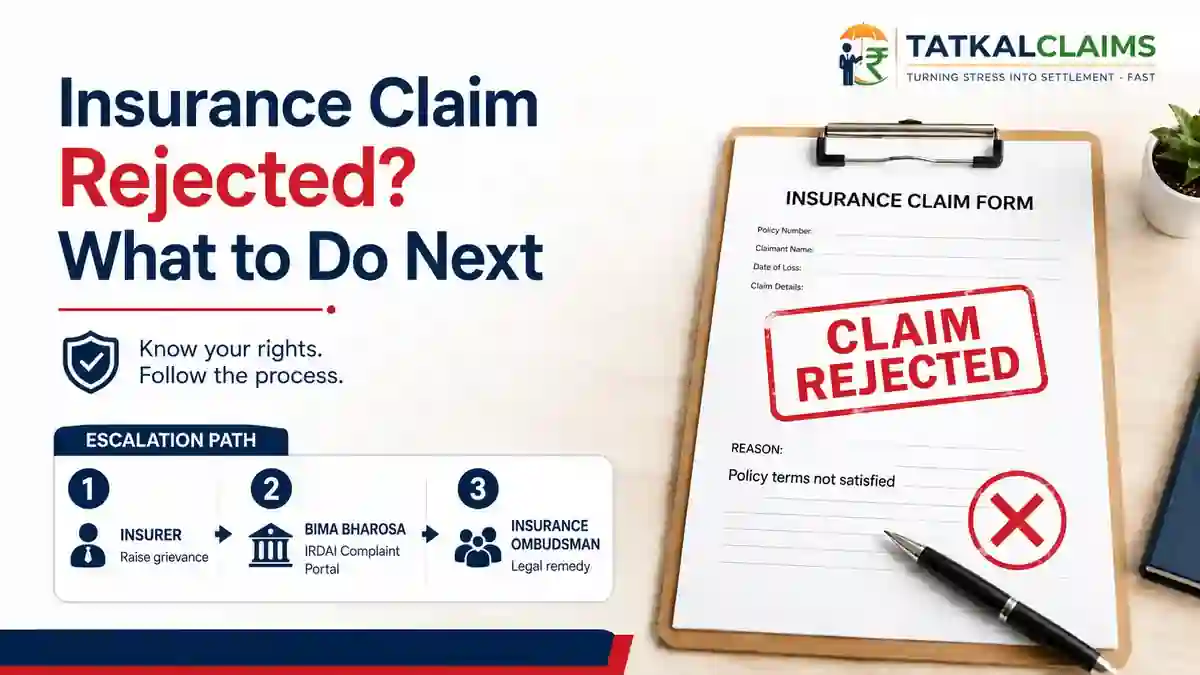
Send the evidence-led appeal to the insurer's Grievance Redressal Officer and retain the acknowledgement. The IRDAI Bima Bharosa platform can register and track an insurance grievance; it is not a decision that automatically compels claim payment. If the insurer's answer changes from late intimation to a medical exclusion, request a new reasoned response and address that particular ground separately.
The Council for Insurance Ombudsmen requires an insurer or broker complaint first. If the reply is unsatisfactory, or no reply arrives within one month, an eligible complaint may be filed subject to the Council's monetary, territorial, timing and other forum requirements. The Council currently describes a ₹50 lakh monetary ceiling including expenses, and a one-year filing framework tied to specified insurer responses or nonresponse. Check the exact trigger and jurisdiction before filing.
For the insurer-first procedure, deadlines and monetary eligibility, see our Insurance Ombudsman complaint guide.
How TatkalClaims Would Evaluate This Kind of Rejection
A family handling an emergency should not be forced to guess what happened between a hospital admission and a claim-office timestamp. We would start by reconstructing the facts from medical records, the insurer's rejection letter, policy wording and notification evidence. Then we would check whether late intimation was the only ground, whether the insurer considered the relevant policyholder-protection direction, and whether the remaining claim can be supported on its merits.
Tatkal Claims can help organise the evidence and grievance record and identify what a fair reconsideration request should ask. Call +91 7207382073 or email help@tatkalclaims.com. The outcome depends on the policy, applicable regulatory provisions and actual records; we cannot promise approval merely because a relative was dealing with an emergency.
Frequently asked questions
Can a health insurer reject my claim because intimation was given after 24 hours?
A 24-hour deadline is not a universal automatic ground for repudiation. IRDAI's September 2024 policyholder-protection circular directs that claims should not be rejected or closed merely for delayed intimation. Examine the applicable policy, notice evidence and any other stated rejection reason.
What if the patient was unconscious in the ICU for two days?
Preserve hospital admission, ICU and physician records confirming the condition and communication constraints. Explain when the family could practically notify the insurer and show the first proven contact; do not claim that ICU admission by itself guarantees payment.
Does the 2024 IRDAI circular mean I never need to intimate the insurer?
No. It directs claimants to notify at the earliest possible time while protecting against mechanical rejection merely for delayed intimation. Notify promptly and keep a usable acknowledgement.
Is late reimbursement document submission the same as late intimation?
No. Late intimation concerns when the insurer was first notified; reimbursement submission is the later claim packet or filing process. The disputed procedure and evidence can differ.
If cashless was refused after late intimation, can I claim reimbursement?
You may still be able to submit a reimbursement claim, subject to actual policy coverage and assessment. Cashless authorisation and final reimbursement eligibility should be distinguished.
What proof is useful if the hospital told the TPA before the family contacted the insurer?
Ask for the pre-authorisation request, hospital-insurance desk emails or portal logs, TPA acknowledgement and claim reference. Verify which authorised insurer channel actually received the notice.
Can the insurer ask why notification was delayed?
It may investigate the claim circumstances and verify the notice chronology. Provide truthful dates and an evidence-supported explanation; a question about timing should not substitute for a reasoned merits assessment.
Does a delay mean the insurer automatically owes interest?
Not solely because the claimant informed it late. Delay-interest liability concerns insurer payment or decision time under the applicable claim rules, not an automatic payment for every intimation dispute.
What should I do if the insurer also says hospital documents are missing?
Identify the outstanding document and who holds it. The May 2024 health master circular requires insurers/TPAs to collect required hospital records after intimation. You may still need to supply relevant personal information or other evidence within your control.
Where do I complain after the insurer refuses to reconsider?
Complain in writing to the insurer's grievance officer, then use IRDAI's Bima Bharosa for grievance registration/tracking as appropriate. The Insurance Ombudsman has separate insurer-first, eligibility, amount and limitation requirements.
Primary Sources and Editorial Method
Prepared in October 2026 with reference to the IRDAI 5 September 2024 policyholder-protection master circular, the 29 May 2024 health insurance master circular and the official grievance forums. References to the 2011 delayed-intimation circular are historical context, not a statement that its wording alone displaces the newer 2024 direction. The emergency scenario and time-stamped evidence example are fictional illustrations rather than claimed client cases or court holdings. The article does not assume every late-notified claim is covered or payable.
Disclaimer: General consumer guidance for India, not individual legal, financial or medical advice. A reporting delay should not automatically defeat a genuine eligible claim under applicable regulator directions, but the original policy, medical evidence, intimation record, and other claim conditions still matter. Don't fabricate notification attempts, alter records or delay necessary treatment to satisfy an insurance formality.