
Government data cited from a Rajya Sabha response recorded 80,539 insurance complaints in Q1 FY2026-27 (April–June 2026). The figures are useful for understanding complaint volumes and categories, but they should not be read as a league table of insurer quality because the data does not normalise for customer base, policy count, premium volume or market share.
Understanding the Scale of the Complaint Crisis
The insurance sector in India serves millions of policyholders across life, health, and general insurance categories. With over 80,000 complaints in a single quarter, the numbers indicate systemic issues that need immediate attention. The data, which was shared by the Minister of State for Finance in response to a parliamentary question, breaks down complaints by type and by insurer, providing a transparent view of the industry's performance from a consumer grievance perspective.
What makes this data particularly significant is that it comes directly from the government, offering an official and unfiltered look at the challenges policyholders face. The complaints cover everything from claim rejections to mis-selling, policy servicing delays, and proposal processing issues. This transparency is crucial for consumers who often feel helpless when dealing with large insurance corporations.
Claims and Mis-Selling: The Twin Evils Driving Complaints
The data highlights two primary areas of customer concern that together account for more than half of all complaints: claim settlements and unfair business practices including mis-selling.
Claims: The Biggest Source of Policyholder Frustration
Claims emerged as the single biggest issue, accounting for nearly 46% of all complaints. Insurers received 36,749 claim-related complaints in Q1 FY27. This category includes death claims, survival claims, and other claim-related grievances. Out of these, insurers attended to 32,535 complaints, leaving 4,214 pending at the end of the quarter.
The high number of claim-related complaints indicates that policyholders often face hurdles at the most critical moments when they need financial support the most. Whether it is a health insurance claim during a medical emergency or a life insurance claim after the loss of a breadwinner, any delay or rejection can have devastating consequences for families.
Breaking down claim complaints further:
- Survival claims: 4,905 complaints, with 4,598 attended and 307 pending
- Death claims: 1,746 complaints, with 1,553 attended and 193 pending
These numbers reveal that even the most straightforward claims are not being processed smoothly. Survival claims, which typically involve maturity benefits or survival benefits on policies, should ideally be processed without much dispute since they do not involve death. Yet, they generate thousands of complaints.
Mis-Selling: The Persistent Problem
Complaints related to unfair business practices, including mis-selling, ranked third with 8,503 complaints. Insurers attended to 7,826 of these, leaving 677 pending. This points to a persistent problem of agents and banks misrepresenting insurance products as fixed deposits, guaranteed investment schemes, or 'free insurance' to unsuspecting customers.
For policyholders facing this kind of sales dispute, our insurance mis-selling guide explains common warning signs, evidence and the complaint route.
Recent consumer court rulings have repeatedly highlighted cases where elderly citizens, especially those visiting banks for fixed deposits, were sold insurance policies without their informed consent. The Reserve Bank of India has also flagged that surrenders now exceed maturity payouts in life insurance, signaling widespread policyholder dissatisfaction and potential mis-selling.
Mis-selling takes many forms, including:
- Representing insurance as an investment product with guaranteed returns
- Hiding policy charges and lock-in periods
- Misrepresenting the premium payment term
- Selling unsuitable policies to meet sales targets
- Failing to explain exclusions and waiting periods
Full Breakdown of Complaint Categories
The government data provides a comprehensive breakdown of complaints by category, offering insights into the specific areas where policyholders face the most challenges:
Claim: 36,749 complaints (46% of total) - 32,535 attended, 4,214 pending
Others: 13,001 complaints - 12,078 attended, 923 pending
Unfair Business Practices: 8,503 complaints - 7,826 attended, 677 pending
Policy Related: 6,218 complaints - 5,742 attended, 476 pending
Survival Claims: 4,905 complaints - 4,598 attended, 307 pending
Policy Servicing: 3,849 complaints - 3,656 attended, 193 pending
Death Claims: 1,746 complaints - 1,553 attended, 193 pending
Refund: 1,441 complaints - 1,331 attended, 110 pending
Proposal Processing: 1,234 complaints - 1,151 attended, 83 pending
Premium: 1,071 complaints - 991 attended, 80 pending
Product: 643 complaints - 590 attended, 53 pending
Coverage: 487 complaints - 441 attended, 46 pending
Proposal Related: 378 complaints - 345 attended, 33 pending
ULIP Related: 290 complaints - 283 attended, 7 pending
Cover Note Related: 24 complaints - 23 attended, 1 pending
Overall, insurers attended to 73,143 complaints during the period, leaving 7,396 pending across all categories.
Life Insurers: LIC Leads in Complaint Numbers
Life insurers received 29,933 complaints during Q1 FY27. The data reveals significant variation in complaint volumes across different life insurance companies.
Life Insurance Corporation of India (LIC): LIC recorded the highest number at 11,489 complaints, accounting for more than one-third of all complaints in the life insurance segment. The insurer attended to 10,587 complaints, while 902 remained pending. As India's largest life insurer with the biggest customer base and agent network, higher complaint volumes are not unexpected. However, the absolute number and the high pendency are concerning.
Among private life insurers, HDFC Life reported the highest number of complaints at 2,341, followed closely by Axis Max Life Insurance with 2,197 complaints. SBI Life Insurance had 1,974 complaints, while ICICI Prudential Life Insurance recorded 1,560 complaints.
Other life insurers and their complaint numbers:
- Bajaj Life Insurance: 1,415 complaints
- Tata AIA Life Insurance: 1,342 complaints
- PNB MetLife India Insurance: 964 complaints
- Shriram Life Insurance: 840 complaints
- Birla SunLife Insurance: 730 complaints
- Star Union Dai-ichi Life Insurance: 702 complaints
- Bharti-Axa Life Insurance: 635 complaints
- Kotak Life Insurance: 608 complaints
- IndusInd Nippon Life Insurance: 532 complaints
- IndiaFirst Life Insurance: 529 complaints
- Pramerica Life Insurance: 404 complaints
- Go Digit Life Insurance: 392 complaints
- Generali Central Life Insurance: 336 complaints
- Canara HSBC Life Insurance: 237 complaints
- Edelweiss Life Insurance: 188 complaints
- Aviva Life Insurance India: 159 complaints
- Bandhan Life Insurance: 124 complaints
- Ageas Federal Life Insurance: 121 complaints
- Acko Life Insurance: 86 complaints
- Sahara India Life Insurance: 21 complaints
- CreditAccess Life Insurance: 7 complaints
The Pending Problem: Where Life Insurers Are Failing
While many life insurers resolved most complaints they received, some had concerning pendency numbers. Axis Max Life, Tata AIA, Birla Sun Life, Pramerica, Generali Central Life, Ageas Federal Life, and CreditAccess Life reported no pending complaints during the period. This indicates efficient grievance redressal mechanisms.
In contrast, Bharti AXA Life had 478 pending complaints out of 635 received, meaning nearly 75% of complaints remained unresolved. LIC had the highest number of pending complaints in absolute terms at 902. Shriram Life Insurance had 119 pending complaints, while SBI Life had 132 pending.
Health and General Insurers: A Large Share of Complaints
Non-life insurers received 42,692 complaints during Q1 FY27. Standalone health insurers accounted for 18,649 of these complaints, with health insurance policyholders having a large set of grievances.
Health Insurers Top the List
Star Health and Allied Insurance received the highest number of complaints at 7,434. Niva Bupa Health Insurance followed with 3,941 complaints, while Care Health Insurance recorded 3,634 complaints. Aditya Birla Health Insurance had 2,746 complaints, and ManipalCigna Health Insurance had 877 complaints.
General Insurers Also Face Challenges
Among general insurers, ICICI Lombard General Insurance received 3,384 complaints, followed by National Insurance with 3,200 complaints. Other major players included:
- The New India Assurance: 2,603 complaints
- HDFC Ergo General Insurance: 2,367 complaints
- Cholamandalam MS General Insurance: 2,236 complaints
- United India Insurance: 2,101 complaints
- TATA AIG General Insurance: 2,043 complaints
- The Oriental Insurance: 1,726 complaints
- Bajaj General Insurance: 1,694 complaints
- IFFCO TOKIO General Insurance: 1,669 complaints
- Reliance General Insurance: 1,491 complaints
- SBI General Insurance: 1,362 complaints
- Go Digit General Insurance: 1,256 complaints
The Pendency Crisis in Health and General Insurance
Public sector insurers reported some of the highest pending complaint numbers. United India Insurance had 1,068 pending complaints, while Oriental Insurance reported 891 pending cases. National Insurance had 487 complaints pending.
Health insurers also had significant pendency issues. Care Health Insurance had 587 pending complaints, Star Health had 489 pending, and Niva Bupa had 455 pending complaints.
By comparison, several private insurers reported relatively lower pending complaint numbers despite receiving substantial complaint volumes. HDFC Ergo General Insurance had only 36 pending complaints out of 2,367 received, while Bajaj General Insurance had just 15 pending out of 1,694. Go Digit General Insurance had 6 pending out of 1,256, and ManipalCigna Health Insurance had 5 pending out of 877.
If your complaint concerns a rejected, delayed or short-settled claim, use the insurer-specific escalation guides for Aditya Birla Health, Bajaj General, SBI General, HDFC ERGO or Go Digit General Insurance.
What the Numbers Really Mean: Context Matters
Context is essential. A large insurer can receive more complaints simply because it serves more customers. Raw pendency can also be affected by complaint mix and timing. Complaint rates per policyholder or per policy, resolution quality and ageing would be more informative for direct comparisons, but those measures are not provided by the raw table.
For example, while LIC had the highest absolute number of complaints, its pendency percentage (about 7.8%) is actually better than some smaller insurers. Bharti AXA Life, with only 635 complaints, had a pendency rate of over 75%. Similarly, United India Insurance had a pendency rate of over 50% of its complaints.
Common Reasons for Claim Rejections and Delays
Based on the complaint data and recent consumer court rulings, here are the most common reasons policyholders face claim rejections and delays:
Non-disclosure or misrepresentation disputes: insurers may reject claims where they believe material information was not disclosed, but the outcome depends on the proposal questions, evidence, policy terms and applicable law. Recent consumer decisions have sometimes rejected unsupported repudiations; they do not create a universal rule that every 'minor omission' is immaterial.
Processing delays: Despite IRDAI regulations mandating claim settlement within 30 days and cashless pre-authorisation within 1 hour, many insurers delay processing, causing significant hardship to policyholders.
Documentation issues: Insurers frequently reject claims citing missing documents, often using this as a tactic to avoid payouts.
Exclusion clauses: Policyholders often discover exclusions like specific treatments, procedures, or conditions only when filing a claim.
Hospital network issues: a recent Kerala High Court decision concerned MEDISEP and a patient who used a non-empanelled hospital because suitable empanelled facilities were unavailable. It should not be treated as a blanket rule overriding network conditions in every private health-insurance policy.
Mis-selling: Policies sold without proper disclosure of terms, exclusions, and charges lead to disputes when claims are filed.
Your Rights as a Policyholder
This data isn't just for news headlines; it is a tool for you. The government and regulators like IRDAI have established a clear, time-bound mechanism for grievance redressal.
Know Your Rights
If an insurer rejects your claim or delays payment, they must provide a written reason. In recent rulings, courts have repeatedly sided with consumers who were misled or unfairly denied claims. The Maharashtra consumer commission ordered an insurer to pay Rs 20 lakh after it rejected a child's cancer claim citing a minor childhood speech delay.
IRDAI has mandated that all insurers have a robust grievance redressal mechanism. The Bima Bharosa portal provides a single-window platform for policyholders to register complaints.
Follow the Escalation Process
If the insurer does not resolve the complaint, the next escalation step matters. Our IRDAI grievance-handling guide explains the insurer grievance process, senior-level accountability and the routes available after an unresolved complaint.
Step 1: Insurer Level
File a written complaint with the insurer's Grievance Redressal Officer and retain acknowledgement. IRDAI's current Bima Bharosa FAQ says the insurer should resolve the complaint within 15 days of receipt; if it is unresolved or the response is unsatisfactory, escalation routes are available.
Step 2: IRDAI
If you don't get a response or are unsatisfied, escalate to the IRDAI via the Bima Bharosa Portal (bimabharosa.irdai.gov.in) or by calling the toll-free helpline 155255. IRDAI has the power to investigate and direct insurers to take appropriate action.
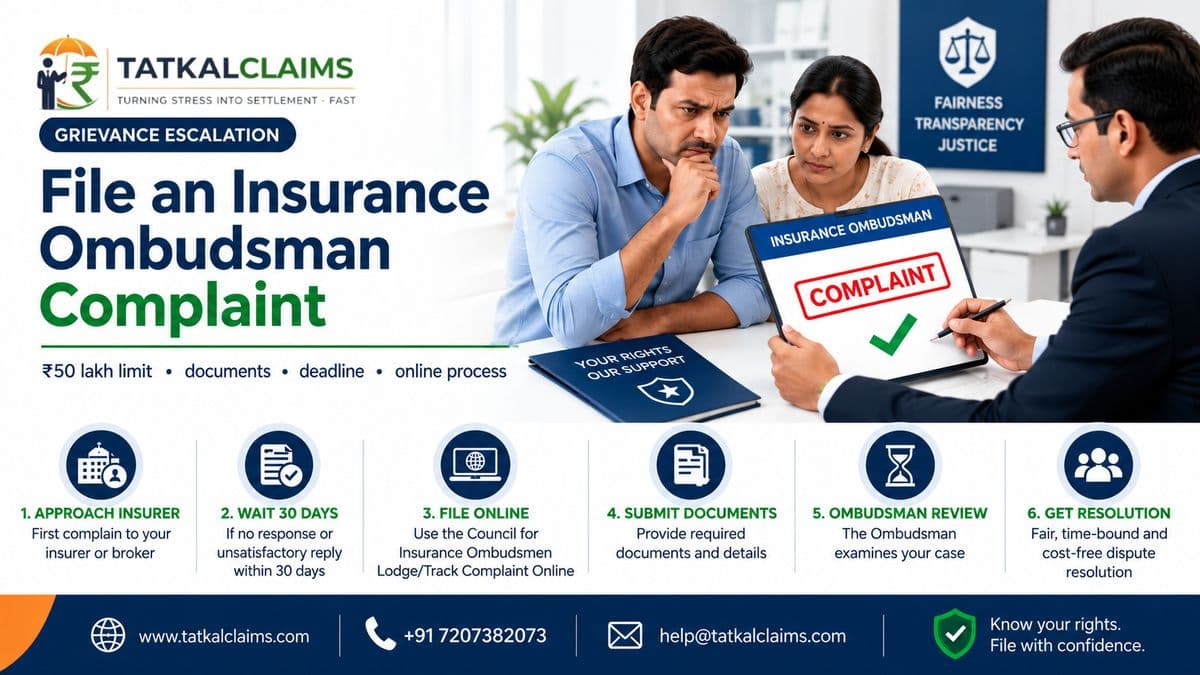
Step 3: Insurance Ombudsman
You may approach the Insurance Ombudsman where the complaint falls within its jurisdiction and eligibility rules. The process is designed to be cost-effective and impartial, but outcomes vary by case; this article should not imply that a fixed percentage of Ombudsman complaints are decided in favour of policyholders without a current official source.
To decide which escalation route fits an unresolved complaint, compare Bima Bharosa and the Insurance Ombudsman. If the Ombudsman is suitable, follow our Insurance Ombudsman filing guide for the current eligibility and process.
Step 4: Consumer Court
If you are still unsatisfied, you can approach the consumer court. Recent rulings show that courts are increasingly siding with policyholders against unfair practices by insurers.
Recent Consumer Court Rulings That Protect Your Rights
Several recent rulings have strengthened policyholder rights:
A Delhi consumer commission ordered relief in a stolen-vehicle dispute where the buyer had promptly applied for RC transfer but theft occurred before the transfer process was completed. The result was fact-specific and should not be generalised into a rule that policy-transfer requirements never matter.
The Telangana State Consumer Commission ordered ICICI Lombard to pay Rs 2.57 lakh after it terminated a health policy and denied a claim alleging non-disclosure of a 2005 surgery. The court called it unfair trade practice.
A Ropar District Consumer Commission ordered reimbursement in a dengue claim after finding that the insurer had not produced cogent evidence to substantiate its fraud allegations. The decision turned on the evidence in that case, not on a universal rule that every disputed claim must be paid.
The Raipur consumer court ordered Star Health to pay Rs 1.65 lakh after it rejected a cancer patient's claim citing pre-existing disease and lifestyle habits without producing any medical evidence.
How Tatkal Claims Can Help You
If you are facing an insurance claim rejection, delay, or any other dispute with your insurer, Tatkal Claims is here to help. Our team of legal experts specializes in insurance claim disputes and can guide you through the entire process.
We understand the frustration of dealing with insurance companies and the stress of navigating the complaint process. Our services include:
Assessment of your claim rejection or delay
Guidance on the documentation required
Representation before the Insurance Ombudsman
Legal support for consumer court proceedings
Advice on filing complaints with IRDAI
Don't let an insurance company deny you what is rightfully yours. Your claim matters, and we are here to fight for it.
Conclusion: The Takeaway
The Q1 FY27 complaint data is a wake-up call for the insurance industry. While a high claim settlement ratio is often advertised, the real test is how a company treats you when you file a grievance. The data clearly shows that even as insurers resolve most complaints, a significant number remain pending, leaving policyholders in a state of limbo.
For policyholders, the data is a reminder to document complaints, use the insurer's grievance process and escalate when necessary. Raw complaint numbers show where grievances are concentrated, but each claim or mis-selling dispute still has to be assessed on its own facts, policy terms and evidence.
Your insurance policy is a contract that promises financial protection when you need it most. If an insurer fails to honor that promise, you have every right to fight back. Stay informed, know your rights, and don't hesitate to seek professional help when needed.
Disclaimer: This article is for informational purposes only and does not constitute legal advice. Please consult a qualified professional for legal matters.