
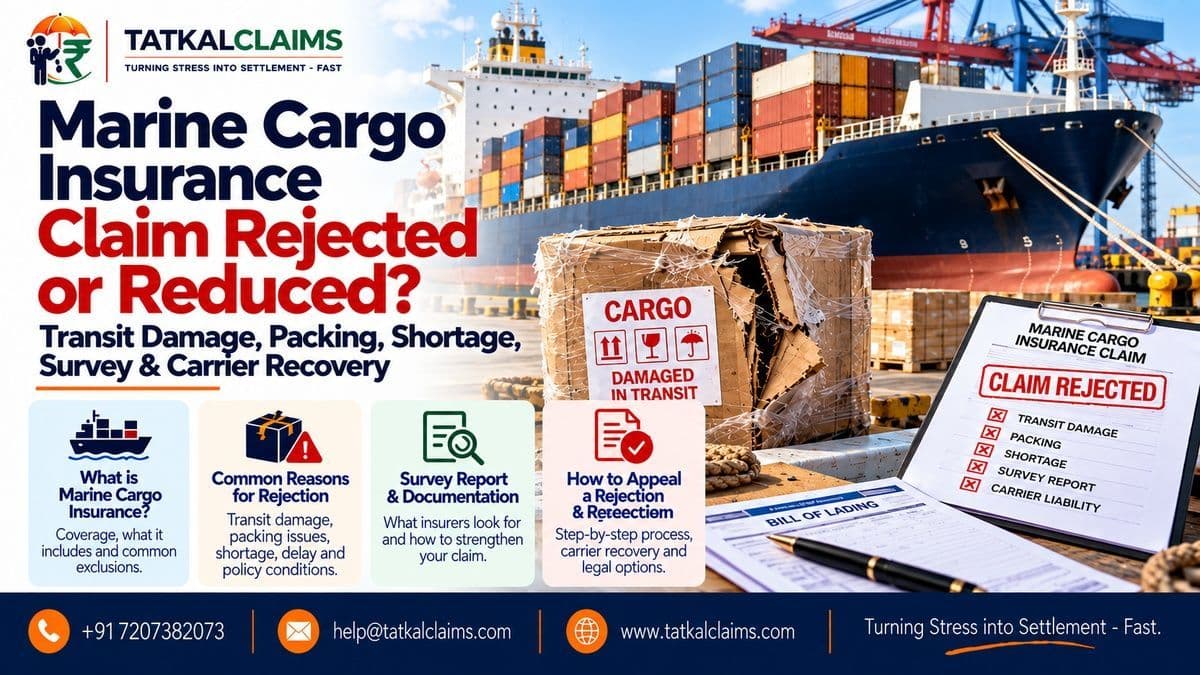
The truck reaches the warehouse and the cartons are wet. A machine arrives with dents. Part of the consignment is short. A container seal looks intact, but stock is missing. You inform the insurer—and the claim later comes back with words like “insufficient packing”, “inherent vice”, “delay”, “undeclared shipment”, “no recovery rights” or “not covered under the selected transit clause”.
Marine cargo claims are document-heavy, but the dispute is usually not solved by sending more papers at random. The practical question is narrower: what exactly was insured, when did the transit cover attach, what physical event caused the loss, and which clause or exclusion actually fits that evidence?
A strong appeal reconstructs the shipment from policy schedule to final delivery: policy/certificate, declaration, invoice and packing list, LR/GR/Bill of Lading/Air Waybill, survey evidence, damage or shortage certificate, carrier notice, photographs, salvage and claim calculation.
Written by: Tatkal Claims, Claims Review Team
Reviewed by: Ankit L Kanoi, Founder
What This Guide Covers — and What It Keeps Separate
This guide covers marine cargo and goods-in-transit claim disputes for Indian policyholders: inland road/rail/air transit, import/export cargo, specific-voyage policies, open policies and similar cargo arrangements.
| Issue | This Marine Cargo guide | Separate intent |
| Goods damaged during insured transit | Yes | — |
| Wet damage / impact / overturning / shortage | Yes | — |
| Packing or inherent-vice rejection | Yes | — |
| Carrier recovery / subrogation problem | Yes | — |
| Surveyor assessed transit loss too low | Covered here; deeper valuation issues can use surveyor guide | Property surveyor assessment |
| Warehouse burglary unrelated to insured transit | No | Burglary guide |
| Pure business loss because project was delayed | Usually not standard cargo damage cover | ALOP / DSU wording |
If the main dispute is the surveyor’s low valuation of repair, stock, depreciation or salvage rather than transit coverage, also use our surveyor low-assessment guide.
If goods were stolen from premises outside the insured transit and the issue is forcible entry, stock proof or security conditions, use the separate burglary claim guide.
Start With the Schedule, Certificate and Shipment Declaration
Before debating the cause of damage, confirm that this exact shipment was within the insurance contract.
- Policy type: specific voyage, open policy/open cover, annual turnover/sales turnover or another arrangement.
- Policy/certificate number and UIN.
- Interest insured: the goods or commodity actually shipped.
- Mode and route: road, rail, air, sea, courier or multimodal.
- From/to locations and any agreed intermediate storage.
- Basis of valuation: invoice value, invoice plus an agreed percentage, depreciated value, duty or another basis.
- Per-sending/per-location limit, deductible or franchise.
- Transit clause selected: Institute Cargo Clauses A/B/C or Inland Transit A/B and any add-ons.
- Special warranties: closed vehicle, tarpaulin, approved carrier, packing standard, temperature control, security or route.
- For open policies/covers: declaration timing, premium balance and whether the shipment was actually declared.
IRDAI’s current non-life guidance expressly says marine cargo cover may be “Basic Cover” or “All Risks”, with the wider form offering broader protection, and that responsibility for arranging insurance can depend on sale terms such as FOB, C&F or CIF. The issued contract still controls the claim.
Specific Voyage vs Open Policy: Why the Difference Matters
New India’s current product pages illustrate the basic structural difference. A specific-voyage policy covers a specified single transit and ends when that cargo reaches the destination under the applicable wording. An open policy is an annual cargo contract designed to cover multiple dispatches against an overall sum insured, with shipments handled through declarations.
That means an open-policy rejection can turn on something a one-off claimant may never face: whether the shipment was declared within the agreed period, whether the available premium/sum insured was adequate, or whether the sending exceeded a per-shipment limit.
Do not answer an “undeclared shipment” rejection only with the invoice. Produce the declaration ledger, certificate, broker/insurer email, premium statement, monthly declaration and any system-generated shipment record.
“All Risks” Is Broad Cover — Not a Promise to Pay Every Cause
HDFC ERGO’s current Marine Cargo Customer Information Sheet says overseas transit may be written under Institute Cargo Clauses A, B or C, while domestic transit may use Inland Transit Clauses A, B or C, depending on the schedule. It describes the product as indemnity for physical loss or damage according to the selected wording.
Institute Cargo Clauses (A), as reproduced in current marine-cargo wordings, start broadly by covering risks of loss of or damage to the insured subject matter except the stated exclusions. That opening is important—but the exclusions are equally important.
| Insurer position | Claimant-side question |
| “All risks does not cover this” | Which exact exclusion is being invoked? |
| “Damage is due to packing” | What packing defect, who packed, and what evidence proves causation? |
| “Inherent vice” | Was the damage inevitable from the goods themselves, or caused by an external transit event? |
| “Delay” | Is the claimed loss merely economic delay, or is there separate insured physical damage from a covered peril? |
| “Shortage” | Is there open-delivery/tally/weighment evidence, or only an unexplained book shortage? |
| “Transit had ended” | What event and clause terminated cover? |
Packing Rejection: The Insurer Still Needs a Causal Case
Marine wordings commonly exclude loss caused by insufficiency or unsuitability of packing or preparation where the relevant packing was done by the insured or its employees, or before cover attached, depending on the clause.
That does not make every crushed carton a packing claim. The key questions are what the packaging specification was, whether it was customary for that cargo and route, what condition it was in at dispatch, and whether an external transit event actually caused the damage.
| Evidence | What it can establish |
| Pre-dispatch photos/video | Condition of cargo and outer packing |
| Packing SOP / vendor specification | Expected packing standard |
| Purchase order / export packing requirement | Contractual packaging requirement |
| Packing list and weights | Number, description and weight of packages |
| Independent packing contractor invoice | Who performed packing |
| Transporter damage/open-delivery certificate | Condition on arrival |
| Surveyor photographs | Impact, water ingress, crushing or handling marks |
| Container/truck condition | External cause rather than internal defect |
If the insurer simply writes “improper packing”, ask for the survey finding, photograph, packaging requirement and causal reasoning. A label is not the same as proof that packing caused the insured loss.
Wet Damage, Rust, Corrosion and Moisture: Find the External Event
Rainwater, seawater, condensation and humidity do not create the same coverage analysis.
A torn tarpaulin, overturned truck, container water ingress, flooding or sea-water entry may point to an external transit event. Gradual rust, ordinary atmospheric moisture, inherent moisture content or poor protective packing may point toward an exclusion or commodity-specific limitation.
For rust/corrosion disputes, preserve evidence showing when the condition first appeared, the packaging and moisture barrier used, weather or accident records, container condition, survey observations and whether the damage pattern is consistent with a sudden external event.
Do not let the insurer collapse “rust” into “inherent vice” without explaining the physical mechanism.
Inherent Vice vs External Transit Damage
Inherent vice means the nature or internal condition of the cargo itself causes the deterioration, rather than an external insured event.
This can matter for perishables, hygroscopic commodities, machinery susceptible to corrosion, temperature-sensitive goods and cargo that naturally loses weight or volume.
| Question | Evidence to examine |
| Was cargo sound at dispatch? | Inspection/QC certificate, photos, supplier records |
| Was there an accident or abnormal transit event? | Police/transport report, carrier certificate, GPS, weather record |
| Was packaging appropriate? | SOP/specification, packing contractor evidence |
| Was there abnormal moisture/temperature ingress? | Data logger, container survey, seal record |
| Did similar cargo in same shipment remain sound? | Lot-level/tally evidence |
| What exactly did the surveyor say caused damage? | Survey report and lab/testing basis |
If the survey report offers two possible causes—one covered and one excluded—ask the insurer to identify the factual basis on which it selected the excluded cause.
Delay Is a Major Exclusion — and Often Misunderstood
Standard cargo wordings commonly exclude loss, damage or expense proximately caused by delay, even where the delay itself follows an insured transit event.
That is different from physical cargo damage happening during a delayed journey. If a truck accident physically damages machinery and also delays the project, the machinery damage and the project-delay financial loss are different heads.
New India’s current ALOP/DSU product page describes delay-in-start-up cover as protection for financial consequences of project delay caused by material damage to critical equipment during shipment. That is a different form of cover from ordinary marine cargo damage.
Shortage Claims: Physical Evidence Matters More Than Stock Arithmetic
Shortage claims are difficult when outer packing is sound, a container seal is intact or there is no open-delivery/tally evidence. Some policies expressly exclude shortage from outwardly sound packing or an intact seal.
If packages are visibly torn, tampered with or short-delivered, obtain a carrier’s shortage/damage certificate, weighment, tally record, open-delivery record, seal report and photographs before the goods are moved or unpacked further.
If the shortage is discovered only during later warehouse reconciliation, reconstruct the evidence chain from dispatch quantity to carrier receipt to unloading tally. The insurer will usually ask where in that chain the physical loss can be located.
| Document | Purpose |
| Invoice + packing list | Expected quantity/value |
| LR/GR/Bill of Lading/AWB | Carrier custody and shipment details |
| Weighbridge slips | Dispatch/arrival weight comparison |
| Seal number / seal condition | Container integrity |
| Open delivery / shortage certificate | Carrier acknowledgement |
| Port/terminal tally | Loading or discharge discrepancy |
| Non-delivery certificate | Supports missing consignment/packages |
| CCTV/GPS where available | Transit/unloading evidence |
Was the Loss Actually During the Insured Transit?
Marine cargo coverage attaches and terminates according to the transit clause and any extensions. Storage chosen for ordinary distribution may terminate one form of transit cover; agreed intermediate storage or an additional-transit clause may work differently.
For an “outside transit” rejection, build a timestamped chain: dispatch, gate-out, carrier receipt, transshipment, port/airport arrival, customs clearance, inland movement, destination arrival and unloading.
If the cargo sat at a warehouse for days, identify why. Was it still in the ordinary course of transit, awaiting customs/carrier movement, or deliberately stored for allocation/distribution? The answer can change coverage.
Insurable Interest: Who Actually Suffered the Cargo Loss?
Current marine-cargo documents expressly require the claimant to have insurable interest in the goods at the time of loss. In a buyer/seller dispute, title and risk can move at different points depending on the contract and sale term.
For imports/exports, preserve the purchase contract, Incoterm/sale term, invoice, Bill of Lading, insurance certificate, bank/LC documents and any assignment or endorsement.
If the insurer says “you were not at risk when the cargo was damaged”, the appeal must answer the sale-contract and insurance-interest question—not only prove that damage occurred.
Survey: Preserve the Scene Before the Claim Becomes an Argument
IRDAI describes a licensed surveyor and loss assessor as an intermediary who investigates, manages, quantifies and validates losses and reports on them with professional competence and objectivity.
Current insurer claim guidance repeatedly tells cargo claimants to give immediate notice, minimize further loss, preserve damaged goods, photograph the condition and allow survey/inspection before disposal or non-urgent repair.
HDFC ERGO’s current Marine Cargo Customer Information Sheet states, for that product, surveyor appointment within 24 hours of claim intimation, survey report within 15 days of allotment and claim decision within 7 days of the survey report. Treat those as that insurer’s current stated service timelines, not a substitute for checking the applicable regulatory/policy rules in your own claim.
If the surveyor accepts coverage but the assessed quantum is too low, compare quantities, repair rates, depreciation, salvage and stock valuation using our low surveyor assessment guide.
Carrier Recovery Rights Can Make or Break a Good Cargo Claim
Marine cargo policies commonly require the insured to preserve rights against carriers, bailees and other third parties. That means notifying the transporter/shipping line/airline/railway/port and lodging the appropriate monetary claim within the applicable time.
Universal Sompo’s current marine claims page, for example, publishes mode-specific notification and carrier-claim time limits and tells insureds to obtain open-delivery, damage, non-delivery or landing certificates as applicable. Those published windows are useful operational guidance, but the legal time limit for your shipment should be checked against the actual mode, carriage document and governing law.
Do not sign a “full and final” carrier settlement or waive recovery rights without understanding the insurance consequence. The insurer may later rely on subrogation/prejudice provisions.
If the insurer reduces or rejects the claim for lost recovery rights, ask it to identify: the carrier right that was lost, the deadline allegedly missed, the amount recoverable from the carrier, and the policy clause permitting the reduction.
Documents That Usually Decide a Marine Cargo Claim
| Document | Why it matters |
| Policy schedule / certificate / UIN | Exact cover, limits, clauses, insured interest |
| Declaration / open-policy record | Proves shipment was included |
| Commercial invoice | Value and ownership |
| Packing list / weight list | Quantity, packaging and weight |
| LR/GR / Railway Receipt / AWB / Bill of Lading | Transit contract and custody |
| Bill of Entry / customs papers where relevant | Import value/duty and timing |
| Survey report / survey photographs | Cause and quantum |
| Carrier damage/open-delivery/non-delivery certificate | Independent transit evidence |
| Carrier notice and monetary claim | Preserves recovery rights |
| Repair/replacement estimate and invoices | Quantum |
| Salvage details | Net-loss calculation |
| Bank/payment records | Proof of financial loss where required |
If the insurer keeps issuing piecemeal queries, build a dated document index and respond using our claim query and deficiency-letter guide.
How to Audit a Reduced Marine Cargo Settlement
A coverage dispute and a quantum dispute are different. Even after accepting the claim, the insurer may apply deductible/excess, underinsurance, depreciation, betterment, salvage, policy limits or another scheduled adjustment.
HDFC ERGO’s current CIS expressly lists betterment, depreciation, salvage value, underinsurance/average, policy excess/deductible/franchise and reinstatement premium as possible assessment deductions, depending on the claim.
| Layer | Check |
| Gross physical loss | Quantity × accepted value / repair cost |
| Basis of valuation | Invoice, invoice + agreed %, depreciated value etc. |
| Underinsurance / limit | Per-sending and policy limit |
| Depreciation / betterment | Clause and calculation |
| Salvage | Quantity, rate and disposal basis |
| Carrier recovery | Actual recovery or policy-permitted adjustment |
| Deductible / franchise | Exact schedule amount |
| Net payable | Arithmetic after all permitted deductions |
Do not accept a one-line settlement figure. Ask for the surveyor’s assessed loss and the insurer’s separate policy adjustments.
Stronger Grounds for Challenging a Rejection
- The insurer cites “poor packing” without identifying the packing defect or showing how it caused the damage.
- The survey evidence shows an external accident, impact, water ingress or other transit event but the insurer labels the loss “inherent vice” without technical support.
- The shipment was declared and within policy limits, but the insurer relies on an “undeclared shipment” rejection contradicted by declaration records.
- The insurer applies a narrow named-peril analysis even though the schedule shows the wider transit clause.
- The carrier issued an open-delivery/damage/shortage certificate, but the insurer ignores it without explanation.
- The insurer says transit had ended but cannot identify the termination event under the applicable clause.
- Carrier recovery rights were preserved, yet the insurer assumes prejudice or applies a deduction without quantifying it.
- The surveyor’s cause or quantum findings are internally inconsistent with the photographs, tally records, repair evidence or independent technical report.
Grounds That Are Usually Harder to Challenge
- The shipment was outside the declared route/interest or exceeded an unambiguous per-sending limit.
- An open-policy shipment was never declared where declaration was a clear condition and no evidence supports inclusion.
- The loss is ordinary leakage, normal weight loss, wear and tear or deterioration inherent in the cargo.
- The only claimed loss is commercial delay/lost profit under a standard cargo policy with a clear delay exclusion.
- The cargo was badly packed by the insured before transit and the survey evidence directly links the damage to that defect.
- The shortage is discovered only through later stock reconciliation with sound outer packing, intact seal and no carrier/tally discrepancy.
- The insured disposed of damaged cargo before survey without urgent necessity and cannot reconstruct cause or salvage.
A difficult claim can still be reviewed for causation, wording and proportionality. But an appeal should not pretend that “all risks” overrides a clear exclusion.
How to Appeal a Rejected or Reduced Marine Cargo Claim
- Get the full policy schedule/certificate, UIN, applicable cargo/transit clauses, endorsements and warranties.
- Prove this shipment was insured: declaration, certificate, invoice, route, carrier document and premium/open-policy record.
- Create a one-page transit chronology from dispatch to discovery of damage/shortage and survey.
- Identify the physical cause of loss and attach survey photographs, carrier certificate, weather/accident evidence, packing evidence and technical reports.
- Preserve and evidence recovery rights against the carrier/bailee and disclose any recovery already received.
- Respond to the exact exclusion or warranty cited by the insurer; do not rely on a generic “all risk” argument.
- If the dispute is quantum, demand the gross assessment, salvage, depreciation, average/underinsurance, deductible and net calculation separately.
- Escalate a clause-specific grievance if the rejection or reduction remains unsupported.
If the insurer maintains the decision after grievance, compare escalation options in our Bima Bharosa vs Insurance Ombudsman guide and check current eligibility and monetary/jurisdictional rules.
Questions to Put to the Insurer in Writing
| 1 | Which exact cargo/transit clause and exclusion or warranty did you apply? |
| 2 | Do you accept that this shipment was declared and within the insured route/limit? If not, why? |
| 3 | What physical cause of loss did the surveyor determine? |
| 4 | If packing is alleged, what precise packing defect caused the loss? |
| 5 | If inherent vice is alleged, what technical evidence rules out an external transit event? |
| 6 | If shortage is disputed, what part of the tally/open-delivery/seal evidence is not accepted? |
| 7 | If carrier recovery rights are said to be prejudiced, which right was lost and what financial prejudice resulted? |
| 8 | If transit is said to have ended, what clause and timestamp/event terminated cover? |
| 9 | Please provide the survey-assessed gross loss and every deduction separately. |
| 10 | Please issue the final reasoned claim decision with the policy clause and calculation relied upon. |
How Tatkal Claims Can Help
Tatkal Claims can review the marine cargo schedule/certificate, declarations, invoice and packing list, LR/GR/Bill of Lading/AWB, survey report, carrier correspondence, photographs, salvage and settlement calculation to identify whether the insurer’s rejection follows the actual transit clause and evidence.
Where the evidence supports a challenge, assistance can include reconstructing the transit chronology, testing a packing/inherent-vice/delay rejection, organizing carrier-recovery proof, responding to deficiency queries and preparing a clause-specific grievance. We cannot promise payment: an undeclared shipment, clear packing failure, inherent deterioration, excluded delay loss or loss outside the insured transit can make the insurer’s position sustainable.
Frequently Asked Questions
Frequently asked questions
Does “all risks” marine cargo insurance cover every type of loss?
No. “All risks” is broad physical-loss/damage cover but remains subject to exclusions, warranties, deductibles, the insured transit and the schedule. Common exclusions can include ordinary leakage/wear, insufficient packing in specified circumstances, inherent vice and delay.
Can a marine cargo claim be rejected for improper packing?
Yes, where the applicable wording excludes loss caused by insufficient or unsuitable packing and the facts fit that clause. The insurer should still identify the defect and show that it caused the loss.
What is inherent vice in a cargo claim?
It is deterioration arising from the nature or internal condition of the goods rather than an external insured event. The causation evidence matters; insurers should not use the label without explaining the physical mechanism.
Is rust or wet damage automatically excluded?
No. Coverage depends on cause and wording. Sudden external water ingress, flooding or an accident may present a different case from gradual corrosion, humidity, inherent moisture or inadequate protective packing.
What if my shipment was under an open policy but the insurer says it was not declared?
Produce the declaration ledger, certificate, monthly declaration, broker/insurer email, premium record and shipment entry. Open-policy declaration compliance can be central to admissibility.
Why does the insurer ask me to claim against the transporter as well?
Marine cargo policies commonly require the insured to preserve recovery rights against carriers and other responsible parties. The carrier claim and insurance claim are separate, but losing recovery rights can prejudice the insurer depending on the policy and law.
Can I throw away damaged cargo after taking photographs?
Usually not without insurer/surveyor consent unless urgent safety or loss-minimisation needs require action. Current insurer guidance tells claimants to preserve damaged property for inspection and document any necessary disposal.
Can I claim lost profit because damaged cargo delayed my project?
Not automatically under standard marine cargo cover. Standard cargo wordings commonly exclude loss caused by delay. Consequential project-delay loss may require specific ALOP/DSU or similar cover.
Is the surveyor’s assessment final?
The survey report is important evidence, but the insurer makes the coverage and settlement decision under the policy. If the report’s cause or quantum is unsupported, challenge it with technical, documentary and valuation evidence.
What is the strongest format for a marine cargo appeal?
Use a clause-and-evidence file: schedule and UIN, shipment declaration, transit chronology, invoice/packing/carriage documents, survey and carrier evidence, cause analysis, carrier recovery proof and a calculation answering each rejection reason.
Sources & Methodology
Primary-source review checked on 29 September 2026. Product examples are used to show how marine cargo wording and claim handling can differ; they are not treated as universal market rules. For a live claim, apply the issued schedule/certificate, UIN, declarations, endorsements, cargo/transit clauses, carriage contract and facts of the shipment.
Disclaimer: This guide explains marine cargo insurance claim disputes for Indian policyholders in general terms. Coverage, transit attachment/termination, Institute Cargo/Inland Transit clauses, packing exclusions, inherent vice, delay, shortage, declarations, warranties, carrier-recovery duties, deductibles, valuation, salvage and survey requirements vary by product and shipment. Product examples do not guarantee the outcome of any claim. Always apply the schedule/certificate, UIN, endorsements, declarations, policy wording, carriage contract and applicable law for the specific transit. This is not legal or financial advice for a particular case.