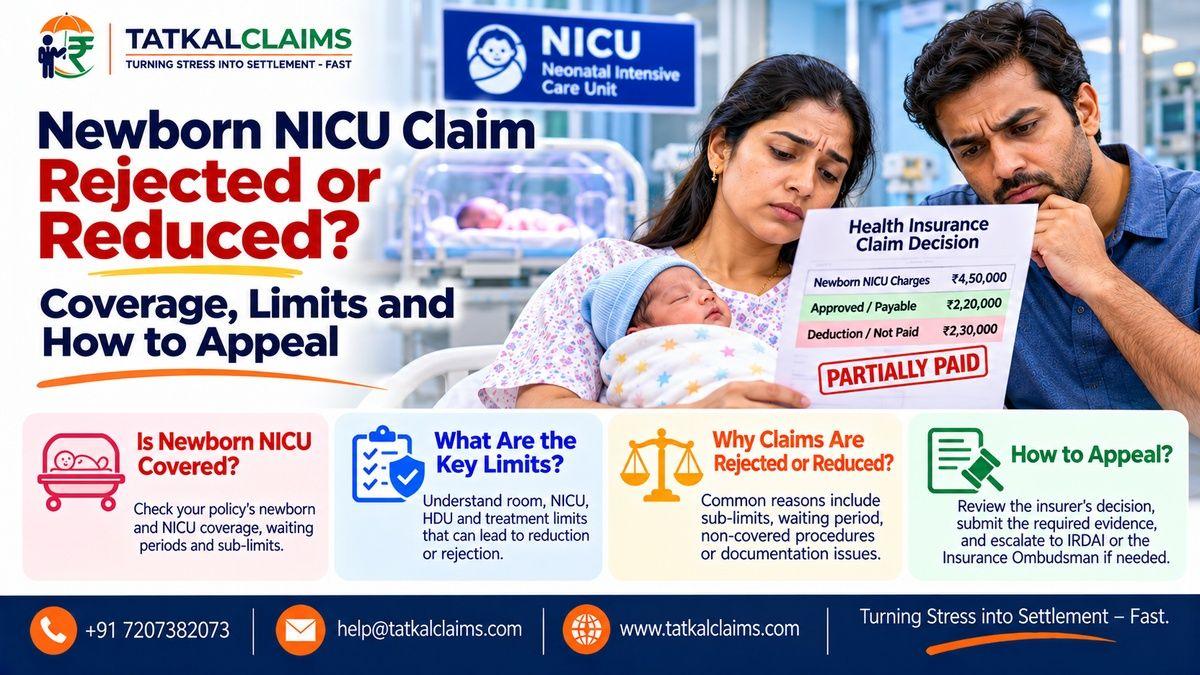
A baby may need emergency care in a neonatal intensive care unit (NICU) hours after birth. When the insurer declines cashless approval or pays only part of the bill, families are often given a short reason: “newborn not covered”, “prematurity excluded”, “maternity limit exhausted” or “baby not added to the policy”. Those are not interchangeable reasons.
The useful first step is to identify exactly whose expense was billed, which newborn benefit (if any) was in force on the baby's date of birth, and the insurer's written clause-by-clause calculation. A NICU admission does not guarantee payment under every parent policy, but a generic rejection may still deserve a careful challenge.
Is NICU Treatment Covered Under a Parent's Health Insurance?
It depends on the issued policy, not the words “family floater” alone. Some individual or family products include newborn treatment from birth; others require an optional maternity/newborn benefit; group policies may follow different eligibility and enrolment rules. The newborn benefit may have a separate amount, draw from the family sum insured, or be linked to an admissible maternity claim.
Check the policy schedule and Customer Information Sheet (CIS), product wording with the exact Unique Identification Number (UIN), applicable endorsements, and the plan version valid on the baby's date of birth. Distinguish three questions: whether the baby was eligible, whether the NICU treatment was an insured event, and how much is payable under that benefit.
First Separate the Mother's Bill From the Baby's Bill
| Expense or issue | Usually relates to | Document to check |
|---|---|---|
| Delivery, caesarean section, obstetric services | Mother's maternity or pregnancy-related benefit | Mother's itemised hospital invoice; maternity clause |
| Baby's NICU bed, monitoring, respiratory support and neonatal medicines | Newborn's treatment benefit or applicable child cover | Baby's separate invoice; neonatal admission and discharge records |
| Day-one cover, child inclusion, endorsement or premium | Whether the baby was covered at the date of treatment | Schedule, endorsement, enrolment/notification record |
| Reduction described as a “maternity cap” | Which cap applies to which line of the two bills | Actual policy clause and settlement line-item calculation |
Do not automatically charge a baby's treatment against the mother's delivery cap. Equally, do not assume it must be paid from a separate full sum insured. The applicable benefit wording and policy schedule decide what amount the insurer has contracted to pay, subject to current law.
For the mother's delivery expenses, waiting periods and caesarean limits, use our maternity claim rejection and deduction guide; this article focuses on the separate newborn/NICU dispute.
Six Common Reasons an NICU Claim Gets Rejected or Reduced
1. “The Baby Is Not an Insured Member”
Ask whether the insurer is denying a day-one newborn benefit, alleging the baby was not added to the plan, or applying an age-of-entry rule. These are separate decisions. Request the newborn clause, the policy schedule, the member list at birth, any endorsement and the insurer's record of when notification was received. A baby absent from a renewal schedule is not necessarily the same issue as an admission on the birth date under a specific day-one newborn benefit.
2. “The Initial Waiting Period Applies”
A first-month waiting-period objection should identify the exact clause and why it applies to this child under the selected newborn benefit. A product marketed as “day-one cover” is not by itself proof that every waiting period is waived. Compare the benefit wording and any special newborn provisions rather than relying on a brochure. If a congenital-condition exclusion or waiting period is cited, review the regulatory position separately below.
3. “Prematurity or Routine Post-Natal Care Is Excluded”
Prematurity, routine healthy-newborn care and treatment of a diagnosed illness are not the same medical facts. Ask the neonatologist to document the admission diagnosis, gestational age, the reason NICU-level care was necessary, respiratory or feeding support, investigations, clinical progress and the dates of active treatment. A bare label such as “premature baby” should not substitute for applying the actual coverage and exclusion wording to those records.
4. “Congenital Defect or Internal Anomaly Is Excluded”
Check whether the diagnosis actually describes an internal congenital condition, an external congenital anomaly, prematurity-related complications or an unrelated neonatal illness. Ask for the exact diagnosis as documented by the treating specialist; do not alter or backdate medical records to obtain cover.
IRDAI addressed internal congenital birth defects in circulars dated 12 October and 8 December 2022. Importantly, both circulars appear in Annexure 6 of the 29 May 2024 Health Insurance Master Circular among the circulars it superseded. Consequently, do not cite either 2022 document alone as a currently operative blanket rule. For a live dispute, seek the insurer's current regulatory basis, applicable product wording and any amendments, and check how an internal congenital condition is treated in that contract.
5. “Only a Maternity or Newborn Sub-Limit Is Payable”
Ask for the precise source of the cap and a breakdown of the claimed expenses it covers. Some products include a newborn benefit only when the mother's maternity benefit is admissible; others have a distinct day-one baby cover. For example, United India Insurance's Family Medicare Policy prospectus (UIN UIIHLIP25037V062425) describes an optional maternity/newborn benefit, day-one newborn inpatient cover up to 90 days, and a stated newborn amount limit. This illustrates product-specific design, not a universal NICU cap.
A treatment sub-limit is different from an initial waiting period, a room/ICU daily limit or a co-payment. If multiple reductions were applied, demand a separate calculation and policy clause for each one. For checking additional line-item deductions, see our health insurance short-settlement guide.
6. “The Birth Was Reported Late or the Baby Was Not Added in Time”
Many plans state a time limit to notify a birth, endorse a child or arrange continued cover beyond an initial newborn period. But '90 days' is not a universal grace period or an automatic coverage guarantee: some plans use different conditions, and a day-one benefit may be distinct from adding the child for later renewals. Keep emails, HR/TPA notifications, insurer acknowledgement, birth certificate, premium receipts and the dates each request was submitted.
What the IRDAI Rules Say—and What They Do Not Automatically Promise
The two 2022 IRDAI circulars expressly addressed insurance cover for newborns and internal congenital anomalies, including newborn/unborn-cover products. Their historical instructions matter when assessing an older claim or understanding product changes. However, the 2024 Health Insurance Master Circular expressly lists them among superseded circulars (Annexure 6, entries 10 and 12). A complaint filed today needs analysis under the regulatory framework applicable to the claim and the issued product, not an isolated quotation from a superseded circular.
The 2024 circular also emphasizes clear Customer Information Sheets, defined policy terms and a reasoned claims process. If the insurer says that a waiting period, exclusion or sub-limit controls the NICU claim, request the actual clause and current regulatory explanation. This article does not claim that every baby has automatic unlimited NICU insurance from birth.
A Relevant Bombay High Court Decision on Premature Twins
In Rita Kirit Joshi v New India Assurance Co. (Bombay High Court, 1 March 2023), the mother challenged repudiation of treatment expenses for premature twins admitted to a NICU. The court rejected the insurer's attempt, on the policy and facts before it, to treat premature newborns as outside the day-one newborn cover merely because the care arose from prematurity. It ordered the insurer to honour the claim and awarded interest and costs.
The decision is useful when an insurer relies on an overly broad reading of “prematurity” in a comparable clause. It is not proof that every current product covers all NICU bills, regardless of its coverage, limits or the timing of a claim. The court examined a particular policy and set of facts, before the 2024 Master Circular.
Worked Example: Check Each Deduction Separately
Illustration only: the baby's NICU bill totals ₹3,20,000, and the mother's delivery expenses are ₹40,000. The settlement allows ₹1,00,000 for the baby's treatment and denies ₹2,20,000. That arithmetic shows the unpaid baby-treatment amount; it does not, by itself, prove the settlement lawful or unlawful.
| Question to ask | What must match |
|---|---|
| Was a ₹1,00,000 newborn limit genuinely applicable? | Exact policy version, selected optional cover, UIN and limit wording |
| Is the mother's ₹40,000 delivery cap separate? | Maternity clause and separate mother/baby invoices |
| Were ventilator, investigations or medicines deducted again? | Original NICU tariff, itemised bill, insurer's settlement calculation |
| Were all the NICU days admitted as medically necessary? | Dated neonatal progress charts and written review reasons |
If the insurer claims that ₹1,00,000 is the only newborn benefit payable, ask whether that amount is a per-baby, per-delivery, per-policy-period or aggregate limit, and what wording supports the interpretation. Do not multiply or combine limits across twins, policies or renewals without examining the contract.
Documents That Make an NICU Appeal Stronger
From the insurer, collect the issued policy schedule, CIS, applicable policy wording/UIN, endorsements, newborn/benefit selections, premium and enrolment records, cashless requests, final authorization, itemised settlement, and the final rejection or short-settlement letter. Preserve screenshots or email records of online intimation and the claim-reference number.
From the hospital, request separate mother and baby itemised bills, neonatal admission note, dated daily NICU charts, treatment summary, discharge summary, consultant's explanation of medical necessity, investigations, ventilator or oxygen logs where relevant, bed/tariff records and any transfer chronology. Keep originals intact; seek a dated clarification if records conflict.
Make a reconciliation with four columns: amount billed, amount allowed, amount deducted and the exact reason/policy clause. If the letter simply says “newborn excluded” or “maternity cap”, ask the insurer to specify which baby, which dates, which expenses and which version of the policy it assessed.
How to Challenge a Rejected or Reduced NICU Claim
First, submit a focused written reconsideration to the insurer's claims or grievance team. Ask for the policy schedule and clause relied on, the specific waiting period or cap, the calculation for each denied bill item, and the evidence behind any assertion that care was routine or unnecessary. Attach the neonatal timeline and the enrolment evidence.
Second, request that the insurer separately reassess (a) the baby's eligibility at birth, (b) the payable treatment under newborn/NICU cover, (c) any congenital-condition objection and (d) the amount of each deduction. If you contest the medical assessment, seek the treating neonatologist's dated explanation rather than an unsupported statement that all charges must be paid.
Third, retain the insurer's written reply and grievance acknowledgement. If the dispute remains unresolved, consider IRDAI's Bima Bharosa grievance route and, where eligible, the Insurance Ombudsman. Check the applicable eligibility criteria, deadlines and monetary jurisdiction before filing; do not assume every case qualifies for each forum.
A Short Written Request You Can Send
Subject: Request for itemised reconsideration of newborn NICU claim — Policy [number], Claim [number]
My newborn received NICU treatment from [date] to [date]. The claim was rejected/reduced by ₹[amount], with the stated reason [quote the insurer]. Please supply the policy wording and newborn-benefit clause applicable on the date of birth, the child's coverage/enrolment determination, the itemised calculation for each deduction, and the medical or other evidence relied upon.
Please also explain whether the decision applies a maternity limit, separate newborn limit, waiting period, congenital-condition exclusion or other condition, identify the current policy and regulatory basis, and issue a reasoned written decision after reviewing the attached birth, notification, clinical and billing records.
How Tatkal Claims Can Help
Tatkal Claims can compare the baby's eligibility and benefit wording against the NICU medical timeline and settlement sheet, identify missing evidence, and prepare a focused reconsideration or grievance. No outcome or full NICU reimbursement is guaranteed.
To request a review, contact Tatkal Claims at help@tatkalclaims.com or +91 7207382073. Share the claim number, settlement communication and relevant policy documents through a suitable private channel; avoid publicly posting the child's identifying medical information.
Frequently asked questions
Does my family floater automatically cover a newborn's NICU admission?
Not necessarily. Confirm whether the issued product covers the newborn from birth, whether an optional newborn benefit was selected, and the conditions and amount that apply.
Can an insurer reject an NICU claim solely because the baby was premature?
Prematurity alone is not a complete coverage analysis. The 2023 Bombay High Court Rita Kirit Joshi decision rejected that interpretation for a specific day-one newborn clause, but each current claim needs the contract and clinical records examined.
Are the 2022 IRDAI newborn circulars still in force?
Both cited 2022 circulars appear in Annexure 6 of IRDAI's May 2024 Health Insurance Master Circular as superseded. Do not rely on them alone as a current blanket rule; check the current framework, the issued policy and the insurer's stated regulatory basis.
Is there a compulsory 90-day window to add every baby?
No universal 90-day rule should be assumed. Notification, endorsement and continuation deadlines depend on the product, group membership and selected benefit. Check the exact issued policy.
Does the mother's maternity limit also cap the baby's NICU bill?
Sometimes the newborn benefit is linked to maternity cover or has its own limit. Ask for the clause and separate mother/baby calculations rather than accepting an unexplained combined cap.
What if the insurer says NICU stay was not medically necessary?
Request the disputed dates and medical-review reasons. Submit contemporaneous neonatal charts and a dated explanation from the treating neonatologist, without modifying original records.
Can I appeal after cashless approval was denied?
Yes, a cashless decision and the final assessment are not necessarily the same. Ask for the written denial, assess reimbursement eligibility under the contract and preserve claim deadlines and hospital records.
What evidence should I send first?
Start with the policy schedule and benefit selection, baby's birth and NICU admission dates, neonatal summary, separate hospital invoice, insurer's final settlement letter, and proof of any newborn notification.