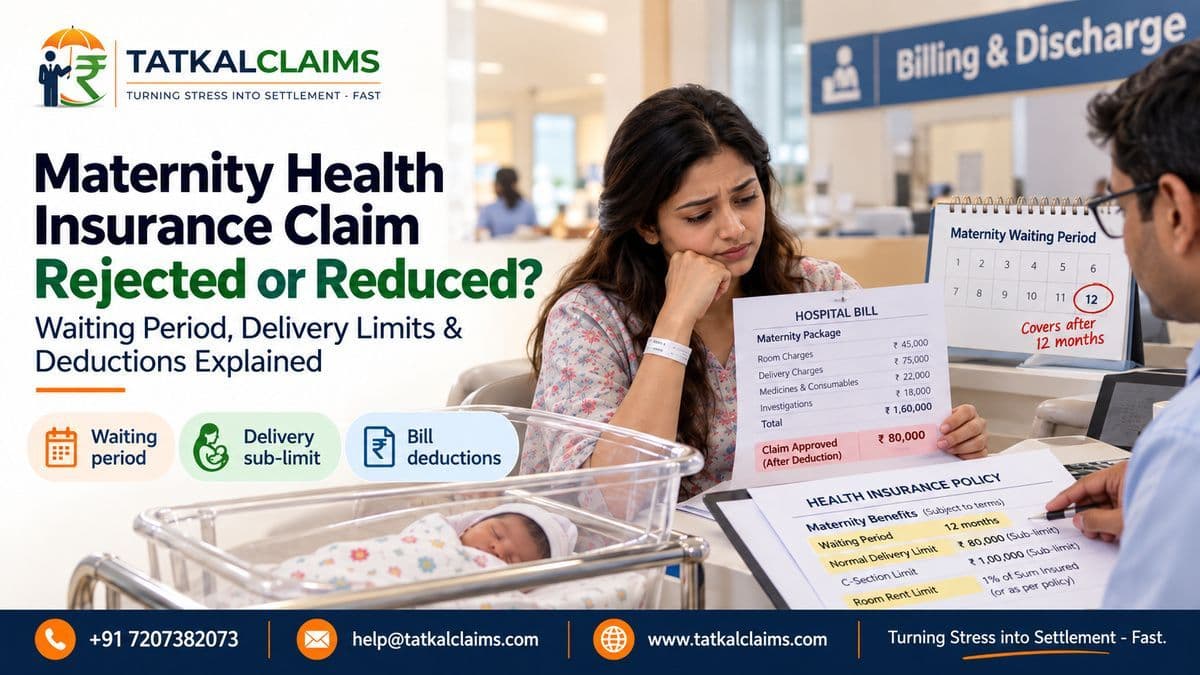
Your maternity claim has been rejected, or the insurer has approved only a fraction of the hospital bill. Before assuming that “maternity is covered” means the entire delivery bill must be paid, identify exactly what maternity benefit your policy, rider, employer plan or group certificate actually provides.
Maternity cover is often structured differently from ordinary hospitalisation cover. A policy may impose its own waiting period, a separate maternity sub-limit, different limits for normal delivery and Caesarean section, lifetime or policy-period delivery limits, separate rules for pre-natal and post-natal expenses, and distinct newborn benefits.
That means two very different disputes can arise: a total rejection because the insurer says the maternity benefit was not available or the waiting period was not completed, and a short settlement because the claim is accepted but capped or reduced under the policy. The appeal strategy depends on which problem you actually have.
First Separate a Maternity Claim From an Illness During Pregnancy
This article deals with claims for actual maternity benefits: delivery, Caesarean section, pregnancy-related hospitalisation where the maternity section applies, eligible pre-natal/post-natal expenses and newborn benefits linked to the maternity cover.
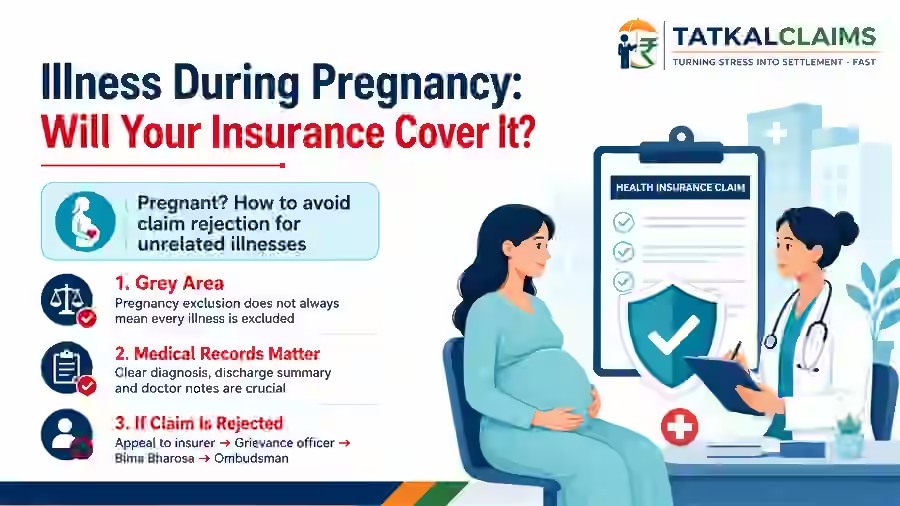
A different issue arises when a pregnant policyholder is hospitalised for an illness that may be medically unrelated to pregnancy, such as dengue, gastroenteritis, pneumonia or an injury. In that situation, the dispute is usually whether a pregnancy exclusion is being wrongly applied to an otherwise covered illness.
If your hospitalisation was for an illness that happened during pregnancy rather than for maternity treatment itself, read our separate guide: Pregnant and Hospitalised for an Unrelated Illness? Will Health Insurance Cover It?.
Does Your Policy Actually Include Maternity Cover?
Start with the issued contract. Many ordinary health policies exclude maternity expenses unless a maternity benefit, optional cover, rider or group extension has been selected. The fact that the base policy covers hospitalisation does not automatically create maternity cover.
Current market examples show why this matters. New India Assurance currently offers maternity through an optional rider on specified base health policies, while Star Women Care provides specific maternity and newborn benefits. Employer/group health policies can be more configurable: current HDFC ERGO group wording treats maternity, pre/post-natal expenses and baby cover as distinct selectable benefits whose limits and conditions depend on the Policy Schedule or Certificate of Insurance.
| Document | What to verify |
| Policy schedule / certificate | Is maternity shown as included, excluded, optional or subject to a separate limit? |
| Full policy wording | Definition of maternity expenses, waiting period, exclusions and claim conditions |
| Endorsement / rider | Was maternity added or modified after the base policy was issued? |
| Employer/group benefit sheet | What cover did the employer actually purchase for that policy year? |
| Certificate of insurance | Individual member's cover dates, sum insured and selected benefits |
| Renewal history | Continuity of the maternity benefit and whether any break/reset issue exists |
Maternity Waiting Period: Check the Exact Trigger and Continuity
Maternity waiting periods vary materially by product. Current IRDAI policyholder guidance states that the maximum waiting period under a health insurance policy should not exceed 36 months. Within that ceiling, current maternity products still use different periods and benefit structures, while group arrangements can depend on the issued schedule or certificate.
For example, Star Women Care currently shows a 12- or 24-month maternity waiting period depending on the sum-insured band. Care's current CARE product lists a 24-month maternity wait. New India Assurance's current Maternity Rider lists 36 months for sum insured up to ₹15 lakh and 12 months for ₹25 lakh and above. These are product examples only; your own issued schedule and wording control.
Group policies require special care because the maternity benefit may be selected or modified at group level. Current HDFC ERGO group wording states that the maternity limit and applicable conditions are tied to the Policy Schedule or Certificate of Insurance. Do not assume your employer plan uses the same waiting period or benefit design as a retail policy—or as another employer's plan.
| Question | Evidence to collect |
| When did maternity cover first become effective for this insured person? | Policy schedule, certificate, joining date and endorsement |
| Was the cover continuous? | Prior policies, renewals, migration/portability records where applicable |
| Did the maternity benefit itself start later than the base health cover? | Benefit endorsement and renewal schedule |
| What event completes the waiting period under the wording? | Exact waiting-period clause and delivery/admission dates |
| Did an employer/group change insurer or benefit design? | Old and new group certificates and HR benefit communication |
| Is the insurer using the correct policy year/version? | UIN, schedule, certificate and effective dates |
Why an Accepted Maternity Claim Can Still Be Short-Settled
The most common source of surprise is the maternity sub-limit. The insurer may accept the claim but restrict payment to the amount selected for maternity, even though the total health-policy sum insured is much higher.
Current product wordings show several structures. Star Women Care uses delivery limits tied to sum insured, while New India Assurance's current Maternity Rider sets benefit limits according to the underlying sum-insured band. Group plans can also specify maternity limits in the employer's selected benefit schedule, and some group proposal structures distinguish normal-delivery and Caesarean limits.
Medical necessity can support why a Caesarean section was required, but it does not automatically expand a contractual maternity cap. A dispute arises when the insurer applies the wrong cap, wrong benefit option, wrong delivery category, an unstated deduction or a restriction that is not actually in the applicable policy.
| Deduction / cap | What to verify |
| Maternity sub-limit | Exact rupee/percentage limit in the schedule or group certificate |
| Normal-delivery limit | Whether a separate cap applies |
| Caesarean-section limit | Whether the policy provides a different C-section cap |
| Per-delivery / per-policy / lifetime limit | How many deliveries or claims the benefit permits |
| Co-payment / deductible | Whether it applies to the maternity section |
| Room eligibility | Whether room-category restrictions apply to the delivery admission |
| Non-payable items | Whether the item is excluded by policy or merely labelled non-medical |
| Pre/post-natal limit | Whether these expenses are inside the maternity cap or separately covered |
| Newborn limit | Whether baby's expenses are under a separate sub-limit |
If the insurer has accepted the maternity claim but deducted multiple amounts, use our health-insurance short-settlement guide to audit the settlement line by line.
Normal Delivery vs Caesarean Section: Classification Can Change the Payable Limit
Some policies use different financial limits for normal delivery and Caesarean section. That makes the hospital's operative record and the policy schedule important.
If the insurer has applied a normal-delivery limit to a Caesarean claim, or a lower benefit option than the one selected, ask it to identify the exact schedule entry and calculation. Conversely, if the policy clearly caps Caesarean delivery at a stated amount, the fact that the actual hospital bill was much higher does not by itself invalidate the cap.
Where the insurer questions whether the Caesarean section was medically necessary, obtain the obstetrician's contemporaneous notes, indication for surgery, labour records and operative note. Do not ask the doctor to rewrite history; the purpose is to clarify the medical record accurately.
Can Room Rent or Proportionate Deduction Affect a Maternity Claim?
Potentially, but only if the applicable policy wording makes room eligibility or related proportionate deductions relevant to the maternity claim. A maternity sub-limit and a room restriction are separate contractual mechanisms and can sometimes operate together.
Do not accept a percentage deduction merely because the insurer says the room category was higher. Ask for the room-entitlement clause, the permitted room category, the hospital room actually used, the list of proportionately reduced charges and the exact calculation. Some policies may structure maternity as a fixed cap where other deductions have limited practical effect; others may apply additional restrictions.
For the detailed calculation method and how to challenge an incorrect room-linked deduction, see our room-rent capping and proportionate deduction guide.
Pre-Natal and Post-Natal Expenses Are Not Automatically Unlimited
A maternity benefit may include some pre-natal and post-natal expenses, exclude them, or cover them only when connected with an admissible delivery claim and within a stated limit. The phrase “maternity covered” does not automatically mean every consultation, scan, medicine and test throughout pregnancy is reimbursable.
Star Women Care, for example, states that delivery expenses can include pre-natal and post-natal expenses subject to its maternity limits, while its product also has separate ante-natal care features. Care's group wording shows how comprehensive maternity cover can include pre-natal and post-natal medical expenses tied to an admissible maternity claim. These examples demonstrate product variation, not a universal entitlement.
| Expense | Question to ask |
| Routine obstetric consultations | Is OPD/ante-natal care specifically covered? |
| Ultrasound/scans | Are they within a separate ante-natal benefit or only linked to admissible hospitalisation? |
| Medicines/supplements | Does the maternity/OPD section cover them and are they otherwise excluded? |
| Pre-delivery investigations | Are they within the defined pre-natal period and benefit limit? |
| Post-delivery consultations | Does post-natal cover exist and for how long? |
| Post-delivery complications | Are they maternity expenses, ordinary hospitalisation, or a separate complication benefit under the wording? |
Newborn Expenses and NICU Bills Need Their Own Coverage Check
Do not assume that the mother's maternity cover automatically pays every expense incurred for the newborn. Newborn cover can have its own eligibility trigger, date of commencement, sub-limit, premium/addition requirement and covered-expense definition.
IRDAI's 2022 newborn circulars are important but should not be overstated. The regulator clarified protections relating to internal congenital anomalies and the intent of day-one protection where a health product covers newborns. This does not mean every policy is required to pay every newborn or NICU expense from birth. You must first establish that the product provides newborn cover and then apply the newborn benefit terms.
Current Star Women Care material, for example, provides day-one newborn hospitalisation subject to product conditions and limits, including conditions linked to an admissible delivery claim or specified pregnancy-scan requirements. HDFC ERGO group material shows “Baby Cover from Day 1” as a benefit that can be selected by the group. These examples show why the mother's maternity section and the baby's cover should be audited separately.
| Issue | Evidence |
| Was newborn cover included? | Policy schedule, group certificate and newborn-benefit clause |
| When did cover begin? | Birth date, inclusion rules and day-one wording |
| Was an admissible delivery claim a condition? | Maternity and newborn clauses |
| Was prior notification/addition required? | Policy servicing terms and insurer communication |
| Does a newborn sub-limit apply? | Benefit table/schedule |
| Are congenital conditions involved? | Diagnosis and the applicable regulatory/policy wording |
| Who was billed? | Separate mother and baby itemised hospital bills |
| Was NICU treatment medically necessary? | Neonatologist notes, NICU admission/discharge records |
Pregnancy Complications, Ectopic Pregnancy and Other Admissions Need Correct Classification
Not every admission involving pregnancy is necessarily payable under the same maternity bucket. Some policies expressly exclude maternity generally but carve out certain conditions such as ectopic pregnancy; other products may cover specified pregnancy complications under the maternity benefit or another section.
The diagnosis, cause of admission and exact policy wording decide which section applies. If the insurer simply writes “maternity excluded,” ask it to identify the precise clause and explain how the diagnosis falls within it.
Likewise, do not force an unrelated medical admission into a maternity benefit merely because the patient was pregnant. That can create the same classification error in the opposite direction.
Infertility, IVF and Assisted Reproduction Are Separate Benefits
Maternity cover does not automatically include infertility treatment, IVF, assisted reproductive technology or related procedures. These may be excluded, separately insured, or offered under an optional benefit with its own waiting period and limits.
If the disputed bill includes both fertility treatment and later maternity/delivery expenses, separate the two. The insurer may have a valid exclusion for one category while still needing to assess the other under the maternity section.
The same caution applies to surrogacy and oocyte-donor related cover. Current law and IRDAI product requirements interact with specialised product terms, so these should be analysed from the specific policy rather than folded into a generic maternity assumption.
Employer and Group Maternity Cover Can Differ Sharply From Retail Policies
Many maternity disputes arise under employer-sponsored group health insurance. In these policies, the employer or group administrator may choose a benefit design that differs from the insurer's retail products.
A group certificate may specify zero waiting period, a fixed normal-delivery limit, a different Caesarean limit, pre/post-natal cover, newborn cover, co-payment or other customised terms. The relevant evidence is the group policy schedule/certificate for the year of delivery—not what a colleague received under another employer or what the insurer's retail website says.
If HR or the TPA told you maternity was covered but the insurer now relies on a different schedule, obtain the master policy benefit sheet, your certificate of insurance, employer communication and the insurer/TPA pre-authorisation record. A servicing or misrepresentation issue may be separate from the underlying claim calculation.
Cashless Maternity Rejected? Reimbursement May Still Need Separate Assessment
A cashless denial does not always mean the underlying maternity claim has been finally repudiated. Cashless authorisation can fail because of network, documentation, eligibility or benefit-verification issues, while the policyholder may still have a reimbursement route subject to policy terms.
IRDAI's current health-insurance guidance states that cashless pre-authorisation should be decided immediately and not later than one hour, final discharge authorisation within three hours, and non-cashless claims within 15 days. These timelines do not make an otherwise excluded maternity expense payable, but they matter where an admissible claim is being delayed.
If cashless maternity was denied and you paid the hospital yourself, see our cashless rejection and reimbursement guide.
Demand an Itemised Settlement Sheet for a Reduced Claim
A maternity short settlement cannot be properly audited from a single line saying “payable as per policy.” Ask for the assessed claim amount, each disallowed item, each cap or percentage applied, and the clause supporting it.
| Insurer line item | What you should be able to identify |
| Total hospital bill | Mother's bill and baby's bill separately where relevant |
| Admissible maternity amount | How the insurer arrived at the starting admissible figure |
| Maternity cap | Exact schedule/benefit limit used |
| Room/proportionate deduction | Clause, ratio and affected line items |
| Non-medical deduction | Specific item and exclusion/coverage basis |
| Pre/post-natal deduction | Whether outside benefit, outside time window or beyond sub-limit |
| Newborn/NICU deduction | Newborn clause, commencement date and sub-limit |
| Co-pay/deductible | Percentage/amount and policy basis |
| Final payable amount | Arithmetic reconciliation to the above deductions |
If the insurer relies on an internal medical opinion, audit note or other claim-file material you have not received, use our claim-file evidence guide.
Ask the Insurer These Questions Before You Appeal
| Question | Why it matters |
| Which exact maternity clause and policy version did you assess? | Confirms the insurer used the correct contract. |
| What maternity limit applies to this insured person? | Separates overall sum insured from maternity cap. |
| How did you calculate the waiting period? | Tests start date, continuity and benefit-effective date. |
| Was the claim classified as normal delivery, C-section or another pregnancy-related admission? | Checks the correct sub-limit/category. |
| Which deductions were made in addition to the maternity cap? | Exposes room, co-pay, non-medical or other reductions. |
| How were pre-natal/post-natal expenses treated? | Tests benefit scope and time window. |
| How were newborn/NICU expenses treated separately from the mother's bill? | Prevents mixing two benefit calculations. |
| If cashless was denied, is reimbursement still open? | Distinguishes cashless decision from final admissibility. |
| If this is group insurance, which employer-selected benefit schedule applies? | Identifies the actual customised cover. |
How to Build a Maternity Claim Appeal
A strong appeal should be a calculation-and-clause document, not only an emotional request for reconsideration. Start with the policy number, member ID, claim number, delivery/admission date and rejection or settlement date.
| Step | What to attach or explain |
| 1. Prove cover | Policy schedule, group certificate, endorsement and maternity benefit |
| 2. Prove waiting-period completion | Cover start date, renewal history and delivery/admission date |
| 3. Identify applicable limit | Normal/C-section/maternity sub-limit from the correct schedule |
| 4. Reconcile hospital bill | Itemised mother/baby bills and payment receipts |
| 5. Challenge wrong deductions | Settlement sheet plus clause-by-clause response |
| 6. Clarify medical classification | Obstetrician/operative/discharge records where classification is disputed |
| 7. Address newborn separately | Baby-benefit clause, birth record and NICU/newborn documents |
| 8. State remedy | Exact additional amount or reconsideration requested and why |
If the insurer's cap is clearly written and correctly applied, an appeal cannot create broader cover than the contract provides. The strongest disputes are usually wrong waiting-period calculations, wrong benefit schedules, incorrect delivery classification, unsupported deductions, ignored newborn terms or failure to assess a reimbursement claim after cashless denial.
Escalation: Insurer/GRO, Bima Bharosa and Insurance Ombudsman
First submit a written grievance to the insurer or its Grievance Redressal Officer with the policy clause, calculation, settlement sheet and the exact remedy sought. Preserve the acknowledgement and response.
Bima Bharosa's current FAQ states that an insurer should resolve a complaint within 15 days of receipt. If the matter remains unresolved or the response is unsatisfactory, Bima Bharosa can be used to register and track the grievance with IRDAI.
The Insurance Ombudsman can consider eligible health-insurance complaints involving total or partial repudiation and policy-term disputes. The current CIO procedure requires an insurer-first complaint; a complainant can approach the Ombudsman after an unsatisfactory response or no response within 30 days, subject to the ₹50 lakh ceiling, one-year filing framework and the rule against parallel proceedings on the same subject.
Compare these routes in our Bima Bharosa vs Insurance Ombudsman guide.
For the filing process and documents, see our Insurance Ombudsman complaint guide.
A Practical 7-Day Action Plan
| Day | Action |
| Day 1 | Collect policy wording, schedule/certificate, maternity endorsement and insurer decision. |
| Day 2 | Confirm maternity cover, waiting period and the relevant normal/C-section limit. |
| Day 3 | Obtain the full itemised mother and newborn hospital bills plus settlement sheet. |
| Day 4 | Separate maternity, room, non-medical, pre/post-natal and newborn deductions. |
| Day 5 | Collect obstetrician, operative, discharge and newborn/NICU records for any disputed classification. |
| Day 6 | Prepare a clause-by-clause reconsideration request with your calculation of the amount payable. |
| Day 7 | Escalate to GRO/Bima Bharosa and prepare the Ombudsman record if the dispute remains unresolved and eligible. |
How Tatkal Claims Can Help
Tatkal Claims can review the policy or group certificate, maternity benefit, waiting-period history, hospital bills, settlement sheet, obstetric records, newborn/NICU records and insurer correspondence to identify whether the dispute is about coverage, timing, a maternity cap, delivery classification, room restriction, non-payable items or newborn cover.
Where a challenge is supportable, assistance can include reconstructing the benefit calculation, identifying unsupported deductions, preparing the insurer/GRO grievance, requesting missing claim-file material and organising the Bima Bharosa or Ombudsman record where eligible. If the insurer has correctly applied a clear contractual maternity cap, the review should identify that limitation rather than promise a higher settlement.
Frequently Asked Questions
Frequently asked questions
Does a ₹10 lakh health policy mean the insurer will pay up to ₹10 lakh for delivery?
No. Maternity may have a separate sub-limit or may be excluded entirely. Check the maternity benefit in the schedule or group certificate rather than relying on the overall sum insured.
Is the maternity waiting period always 24 months?
No. Current products use different waiting periods, and group policies can be configured differently. Use the exact waiting-period clause and benefit start date in your policy.
Can a maternity claim be paid if the delivery happens before the waiting period ends?
Usually not if the applicable maternity clause makes completion of the waiting period a condition, but the exact trigger and continuity history must be checked. Employer/group arrangements may have different terms.
Can an insurer pay different amounts for normal delivery and C-section?
Yes, if the policy schedule or benefit design specifies separate limits. The insurer should apply the limit corresponding to the actual delivery and the correct policy version.
If a C-section was medically necessary, must the insurer pay the full hospital bill?
Not necessarily. Medical necessity can establish the nature of treatment, but a clear maternity sub-limit may still cap payment. Challenge the claim if the wrong limit or unsupported deductions were applied.
Are pre-natal scans and doctor visits automatically covered when maternity is covered?
No. Some products include defined pre-natal/post-natal or ante-natal benefits, while others exclude or cap them. Check whether OPD expenses are included and whether they must relate to an admissible delivery claim.
Does maternity cover automatically include the newborn and NICU?
No. Newborn cover may be separate and subject to its own commencement rules, conditions and limits. IRDAI protections for newborn congenital conditions do not turn every health policy into unlimited day-one newborn cover.
What if my cashless maternity request was rejected?
Ask whether the rejection is only of cashless authorisation or a final claim repudiation. Reimbursement may still be available subject to the policy terms and claim documents.
Can room-rent capping reduce a maternity claim?
Potentially, if the applicable maternity/policy wording makes room eligibility or proportionate deduction relevant. Ask for the exact clause and calculation rather than accepting a blanket percentage deduction.
Can I approach the Insurance Ombudsman for a maternity short-settlement?
Potentially, if the dispute is within the Ombudsman's jurisdiction and the insurer-first, monetary, limitation and parallel-proceeding conditions are met. Preserve the insurer grievance, settlement letter and policy documents.
Sources and Methodology
Disclaimer: This guide explains current regulatory guidance and selected current insurer/product examples in general terms. Maternity coverage varies materially by policy, rider, employer/group design, waiting period, delivery sub-limit, room eligibility, pre/post-natal terms, newborn cover, exclusions and claim evidence. It is not medical advice and is not a substitute for case-specific legal advice.