
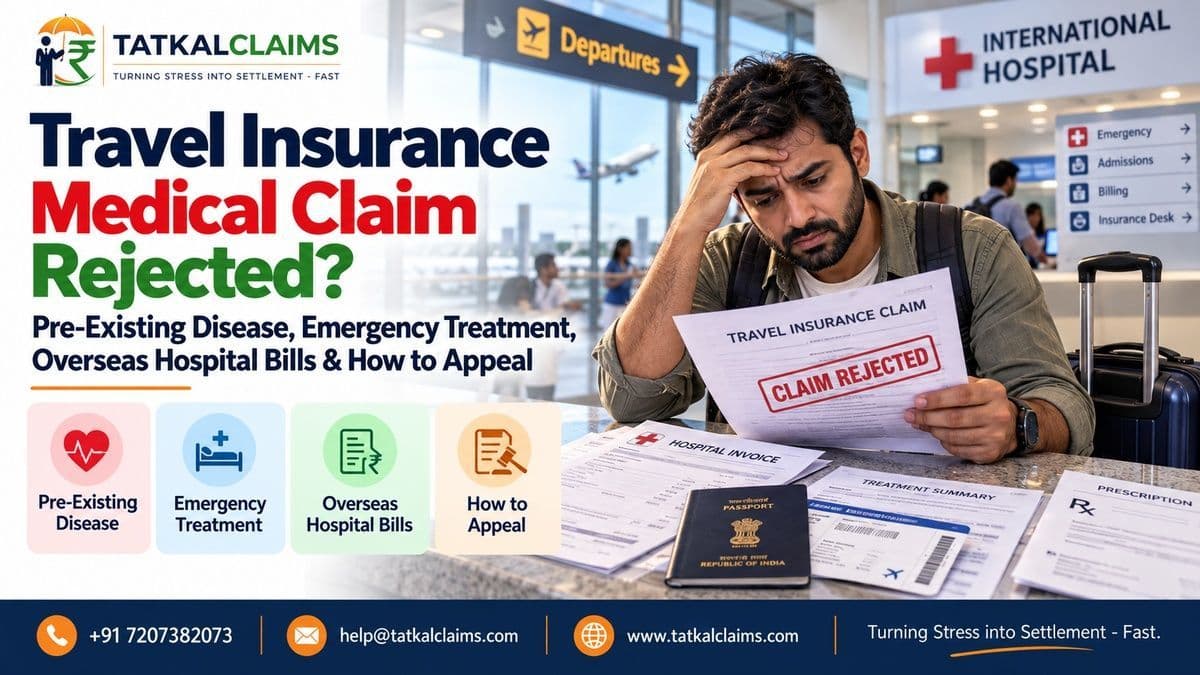
You are abroad, the treatment could not wait, and the hospital bill is already large. Then the travel insurer—or the assistance desk handling the case—says the illness is “pre-existing” and the medical claim is not payable.
That rejection can mean very different things. The policy may completely exclude the condition, allow only emergency treatment linked to a pre-existing disease, require a specific PED extension, cap that extension at a separate limit, or pay only until the traveller becomes medically stable. A one-line “PED” rejection does not tell you which of those rules was actually applied.
The practical way to review a travel medical denial is to rebuild the claim from the policy schedule, the exact travel wording, the medical timeline abroad and the assistance-company correspondence. The question is not simply whether you had a medical history. It is whether this treatment, on these travel dates, falls within the wording you actually bought.
Written by: Tatkal Claims, Claims Review Team
Reviewed by: Ankit L Kanoi, Founder
First: Keep This Separate From a Domestic Health-Insurance PED Rejection
TatkalClaims already has a separate guide on domestic health-insurance PED disputes, including waiting periods, disclosure and the health-policy moratorium. A short-duration overseas travel policy can be structured very differently: the operative wording may instead focus on an emergency, a life-threatening condition, a specifically purchased PED extension, a separate dollar limit or treatment only until stabilisation.
If your dispute is under a regular Indian health insurance policy rather than a travel policy, use our Pre-Existing Disease Health Claim guide.
| Issue | This travel-medical guide | Domestic PED guide |
| Policy type | International / overseas travel insurance | Indian health insurance |
| Main trigger | Illness or injury during insured travel | Hospitalisation / treatment under health policy |
| PED question | Exclusion, emergency carve-out or travel-specific extension | Waiting period, disclosure, moratorium and health-policy terms |
| Operational issue | Assistance company, overseas cashless, foreign hospital evidence | TPA/network hospital and domestic claim process |
| Time focus | Trip dates and travel policy period | Health policy continuity and policy years |
Start With the Schedule, Not the Rejection Email
Before arguing about the diagnosis, identify the contract the insurer is applying. Travel insurers can have several products, variants and revised wordings at the same time. The product name and UIN on the schedule are the safest way to match the claim to the correct wording.
| Item | What to verify |
| Product name + UIN | Exact wording and version applicable to the trip |
| Policy period | Start and end date/time and any automatic extension |
| Geographical scope | Countries/regions actually covered |
| Medical sum insured | Overall medical limit for illness/injury |
| PED wording | Exclusion, emergency carve-out or optional extension |
| Deductible / excess | Amount the traveller must bear |
| Sub-limits / co-pay | Any separate cap for PED, age, treatment or benefit |
| Assistance details | ASP/TPA/claims administrator and notification or approval process |
If the rejection letter does not identify the clause, ask the insurer to provide the exact section, schedule entry and endorsement relied on. A label such as “pre-existing disease” is not a substitute for the contractual basis of the decision.
What Current Travel Wording Shows: Three Different PED Structures
Current policy documents illustrate why this subject cannot be reduced to one market-wide rule.
HDFC ERGO Explorer: PED cover can depend on a scheduled extension
HDFC ERGO’s Explorer prospectus states that its PED extension applies when the benefit is shown in the policy schedule and the pre-existing disease was declared and accepted beforehand. The extension can apply to emergency medical expenses and certain related benefits, while routine follow-up and treatment that can safely wait until return to India are excluded under that extension.
The same prospectus shows that the PED extension can carry its own limit in the schedule. That makes the schedule critical: a claimant cannot infer the available PED amount only from the overall medical sum insured.
ICICI Lombard TripSecure+: emergency/life-threatening wording and planned-treatment exclusions
ICICI Lombard’s current TripSecure+ wording excludes planned treatment and trips undertaken to seek medical attention for a pre-existing condition. It also contains PED-specific wording under which emergency measures in a life-threatening condition may be payable only until the insured becomes medically stable or acute pain is relieved, subject to the policy schedule and any opted extension.
Bajaj General Travel Ace: a separate emergency PED limit and timing trigger
Bajaj General’s Travel Ace wording is different again. It states a maximum USD 3,000 per policy period for emergency medical care of pre-existing diseases, linked to an accident or sudden beginning or worsening of a severe illness presenting an immediate threat to health. The wording also says treatment must start within 24 hours of the emergency event and limits the emergency measure until the insured becomes medically stable or the emergency life-threatening condition is relieved.
Acute Flare-Up vs Planned Treatment: Why the Timeline Matters
A traveller can have a chronic condition and still suffer a genuinely sudden medical emergency abroad. But “sudden” does not automatically mean “covered.” The policy may ask a second question: was the emergency caused by a pre-existing condition, and if so, does this product cover that situation?
The strongest medical timeline distinguishes the purpose of travel, the traveller’s condition before departure, the sudden event abroad, the first consultation, the treatment actually required and the point at which the patient became stable.
| Fact pattern | What to test against the policy |
| Stable hypertension; sudden chest pain abroad | Was the event an emergency? Is PED-related emergency treatment covered, capped or excluded? |
| Known cancer; trip booked specifically for overseas therapy | Planned-treatment / medical-tourism exclusion is likely central. |
| Diabetes; routine medicine refill abroad | Routine/ongoing treatment may be excluded even if the PED extension exists. |
| Asthma; severe unexpected attack requiring ER care | Check emergency/PED wording, severity evidence and any PED sub-limit. |
| Recent surgery; doctor advised against travel | Travel-against-medical-advice exclusion may become material. |
| Minor symptoms before departure; major diagnosis abroad | Medical records and the PED definition become critical; avoid assumptions from the later diagnosis alone. |
When the Insurer Says the Illness Was Pre-Existing
Do not start by arguing that you “felt fine” before travel. Start with the definition of pre-existing disease or condition in the applicable wording. Different products may use different look-back periods, symptom tests, diagnosis tests, treatment/advice tests or broader related-condition language.
Then build the evidence chain. Ask what prior record the insurer is relying on, what condition it says existed before the trip, and how that condition connects to the treatment claimed. Where the wording uses phrases such as “arising out of,” “related to” or “complication of,” the medical connection matters.
If the insurer relied on a medical opinion, investigator material or documents you have not seen, use our Claim File, Medical Opinion & Evidence guide to request the material relied on.
If non-disclosure is alleged, compare the insurer’s allegation with the actual proposal questions and the answers given. A travel-medical claim should not be converted into a vague accusation of “medical history not disclosed” without identifying what was asked, what was answered and why the alleged omission is material under the policy.
Insurer vs Assistance Company: Who Is Actually Handling the Claim?
Travel policies often use an overseas assistance company, Assistance Service Provider (ASP), TPA or claims administrator. The label matters because the policy may assign specific tasks—cashless coordination, hospital contact, medical evacuation approval or document collection—to that entity.
IRDAI’s non-life consumer guidance describes a TPA as providing claims services on behalf of the insurer and notes that prior approval is required in many travel-insurance situations, subject to policy terms and emergency exceptions. The practical point is that the assistance desk is part of the administration chain; the policyholder should still preserve the insurer’s claim number, policy documents and grievance route.
If an assistance company says “not covered,” ask for the reason in writing and confirm whether that is only a cashless/pre-authorisation decision or the insurer’s final claim decision. Do not assume the two are the same.
| Message received | What to clarify |
| “Guarantee of payment denied” | Is cashless denied, or is the underlying claim repudiated? |
| “Contact insurer after return” | What documents and claim reference should be preserved now? |
| “Prior approval not taken” | Which benefit required approval, and was emergency care already underway? |
| “PED not covered” | Which PED clause/extension and schedule limit were applied? |
| “Hospital not in network” | Does the policy permit reimbursement after self-payment? |
| “Evacuation not authorised” | Was evacuation approval mandatory and who had authority to approve it? |
Cashless vs Reimbursement for Overseas Treatment
Cashless is a payment arrangement; it is not always the same thing as coverage. HDFC ERGO Explorer’s current claim procedure, for example, says treatment at a network provider is subject to pre-authorisation and that if cashless access is denied, the insured may take treatment on the treating doctor’s advice and submit documents for reimbursement.
The general distinction is similar to the one explained in our domestic Cashless Claim Rejected / Reimbursement guide, but the foreign-hospital documentation and travel-policy terms remain separate.
| Cashless issue | Reimbursement issue |
| Can the overseas hospital accept insurer/ASP payment guarantee? | Can the insured prove a covered expense after paying? |
| Usually depends on provider/assistance arrangements and pre-authorisation | Usually depends on claim documents, policy terms and proof of payment |
| Can fail for missing information even before final coverage analysis | Can still be considered if the wording allows reimbursement |
| May require immediate contact during treatment | May have a stated notification/submission period |
| Denial does not automatically prove the expense is excluded | Final admissibility still depends on the policy |
Prior Approval: When It Matters and When an Emergency Complicates It
Travel wordings commonly impose approval requirements for benefits such as medical evacuation, repatriation or cashless treatment. Some also require the assistance provider to determine the appropriate facility or transport.
An emergency can make advance contact difficult. That does not mean every late-notified claim is payable, and it does not mean every approval condition disappears. Document why treatment began before contact: ambulance records, emergency-room triage time, admission notes, the patient’s condition and the first practical time the family contacted the insurer or assistance desk.
If the insurer relies on lack of prior approval, ask it to identify the exact benefit requiring approval and explain whether the clause distinguishes an emergency from a planned service. For evacuation, approval wording is often much stricter than for initial emergency treatment.
Medical Necessity Abroad: Prove Why the Treatment Could Not Wait
A travel-medical dispute is often won or lost on medical records that were created before anyone thought about an insurance appeal. The strongest records explain the presenting symptoms, objective findings, diagnosis, severity, immediate risk and why the treatment or admission was necessary at that time.
Where the dispute is “this could have waited until return to India,” ask the foreign treating doctor for a concise factual note if appropriate: what happened, why treatment was urgent, what risk existed if it was deferred and when the patient became stable enough to travel.
Do not ask a doctor to write insurance conclusions. A medical record is more useful when it explains the clinical facts and timing; the policy analysis can then be done separately.
Deductible, Excess, Co-Pay and Sub-Limits Can Reduce an Otherwise Covered Bill
Even when the emergency is covered, the payable amount may be lower than the hospital invoice. Travel policies can apply a deductible/excess for each claim and separate limits for PED treatment, dental treatment, evacuation, age bands or specific benefits.
HDFC ERGO Explorer’s current wording, for example, states that the policy excess/deductible shown in the schedule is self-paid and can apply to each claim. Bajaj Travel Ace separately illustrates how a PED emergency benefit can have a much smaller limit than the overall medical cover.
| Layer | Question |
| 1. Gross hospital bill | What did the hospital charge? |
| 2. Covered medical expense | Which items fall within the medical benefit? |
| 3. Exclusions | Which items are excluded by wording? |
| 4. PED limit / benefit sub-limit | Is a separate cap applicable? |
| 5. Deductible / excess | What amount must the insured bear? |
| 6. Co-pay, if any | What percentage remains with the insured? |
| 7. Currency conversion | What method/date does the wording use? |
| 8. Final payable amount | Does the insurer’s calculation match the schedule? |
Currency conversion is also policy-specific. Some wordings set a particular currency-conversion method for reimbursement. Ask for the insurer’s calculation rather than assuming the exchange rate used on your credit-card statement must control.
Policy Period and Travel Dates: Small Date Errors Can Decide the Claim
Travel medical cover is tied to an insured trip and policy period. Keep the itinerary, boarding passes, passport pages or immigration records, policy certificate and any extension confirmation together.
The important date is not always only the hospital discharge date. Depending on the wording, the insurer may look at when the illness or injury arose, when treatment first started, whether the insured was already abroad when the policy began, and whether continuing treatment after expiry is covered.
Some wordings provide a limited continuation for an existing hospitalisation after policy expiry; others structure extensions differently. Never assume that being admitted before expiry automatically creates unlimited post-expiry cover.
Foreign Hospital Documents: Build a Claim File That Can Travel Across Borders
A foreign hospital may not issue documents in the format an Indian claims team expects. That makes organisation more important, not less. Ask for documents while you are still near the hospital where possible.
| Document | Why it matters |
| Emergency-room / triage record | Shows onset, severity and timing |
| Admission note and discharge summary | Shows diagnosis, treatment and hospital dates |
| Doctor’s consultation notes | Explains clinical reasoning and medical necessity |
| Diagnostic / laboratory reports | Supports the condition actually treated |
| Itemised hospital bill | Separates covered treatment from unrelated charges |
| Receipts / card slips / bank proof | Shows what was actually paid |
| Prescriptions + pharmacy invoices | Links medicine cost to treatment |
| Ambulance / evacuation records | Shows urgency, route and medical need |
| Passport, visa, tickets / itinerary | Proves travel and insured dates |
| Assistance-company correspondence | Shows notification, approvals, refusals and instructions |
| Previous medical records relevant to PED | Helps test the insurer’s pre-existing-condition allegation |
| Translation, where reasonably required | Makes non-English clinical or billing records understandable |
Preserve scans of originals before handing anything over. If the insurer asks for translation, ask whether it requires a certified translation and which documents need it; do not pay to translate an entire file unless necessary.
If documents are being requested repeatedly or in fragments, use our Claim Query & Deficiency Letter guide to maintain a dated submission index.
If PED Is Alleged, Build a One-Page Medical Timeline
A good appeal lets the reviewer see the medical story without reconstructing it from fifty pages. Keep the timeline factual and attach a document reference for each important entry.
| Date | Event | Evidence | Why it matters |
| Before travel | Known hypertension, stable on medication | Prior prescription / doctor note | Disclosed medical history |
| Trip day 3 | Sudden chest pain and breathlessness | Hotel/companion note if available | Unexpected onset abroad |
| Same day | Emergency-room evaluation | Triage + ECG + labs | Severity and timing |
| Same day | Hospital admission | Admission note | Medical necessity |
| Next day | Assistance desk contacted | Email / call reference | Notification chronology |
| Day 4 | Clinically stable for discharge | Discharge summary | End of acute phase |
| After return | Insurer alleges PED exclusion | Rejection letter | Clause to be tested |
The timeline does not prove coverage by itself. Its purpose is to make the policy question precise: was this planned treatment, routine management, or an emergency event that falls within the purchased cover?
Stronger Grounds for Challenging a Travel Medical Rejection
- The schedule shows a PED emergency extension or benefit, but the rejection applies a blanket PED exclusion without addressing that extension.
- The insurer relies on a PED allegation but does not identify the condition, prior record or policy definition used.
- The trip was not undertaken for treatment, and contemporaneous hospital records show a sudden emergency abroad.
- The policy covers PED emergencies or life-threatening conditions, and the treating records support the required severity and timing.
- The insurer treats denial of cashless/pre-authorisation as if it automatically extinguished an otherwise available reimbursement route.
- The deductible, PED sub-limit, co-pay or currency conversion has been applied differently from the schedule or wording.
- The insurer ignores documents already supplied or gives a rejection that does not address the material evidence.
- The claim is rejected for lack of prior contact even though records show an immediate emergency and the policy wording provides a materially different requirement from the one stated in the rejection.
Grounds That Are Usually Harder to Challenge
- The trip was undertaken primarily to obtain the treatment that is now being claimed and the policy excludes planned treatment or medical tourism.
- The claimed expense is routine follow-up, a medicine refill or ongoing management that the PED extension expressly excludes.
- The applicable wording requires the PED to have been declared and accepted, but the proposal/schedule shows that this did not occur.
- The emergency benefit is capped and the insurer has already paid up to the correct sub-limit.
- The treatment continued after the patient was medically stable where the PED emergency wording only pays through stabilisation.
- The illness/treatment falls outside the insured trip or policy period and no applicable extension exists.
- The claimant cannot produce reliable medical records, itemised invoices or payment evidence and the missing material is necessary to establish the claim.
A “weak” ground does not mean the insurer is automatically correct. It means the appeal should first solve the factual or contractual problem rather than relying on a general complaint of unfairness.
How to Appeal a Rejected Travel Medical Claim
- Obtain the policy schedule, certificate, product name, UIN, full wording and every endorsement.
- Mark the exact clauses for medical expenses, PED, planned treatment, deductible/excess, sub-limits, notification, prior approval, cashless/reimbursement and policy period.
- Create a one-page travel and medical chronology from departure to treatment, assistance contact, stabilisation, discharge and return.
- Ask the insurer to identify the exact rejection ground and evidence relied on. If PED is alleged, ask which condition and prior medical record triggers the clause.
- Build an itemised claim calculation: foreign bill, inadmissible items, applicable sub-limit, deductible/excess, co-pay and currency conversion.
- Address approval separately. Explain when the emergency occurred, when contact was first possible and which benefit allegedly required pre-authorisation.
- Submit a clause-by-clause representation to the insurer/GRO with a document index. Avoid sending a long emotional narrative without the policy calculation.
- If the insurer maintains the denial or the grievance is not satisfactorily resolved, use the current grievance escalation route and check Ombudsman eligibility for your case.
For escalation routes, see our Bima Bharosa vs Insurance Ombudsman guide.
IRDAI’s current Bima Bharosa FAQ says the insurer should resolve a grievance within 15 days of receipt; if it is not resolved within the prescribed period or the response is unsatisfactory, the policyholder can escalate through the IRDAI grievance mechanism. Always check the current portal and applicable Ombudsman rules before filing.
Questions to Put to the Insurer in Writing
| 1 | Please identify the exact policy clause and schedule entry relied on for rejection. |
| 2 | What pre-existing condition do you allege, and what medical record establishes it before the trip? |
| 3 | Does my schedule contain a PED extension, emergency PED benefit or separate PED limit? |
| 4 | Why does the claimed treatment fall outside that extension/benefit, if present? |
| 5 | Do you allege that the trip was undertaken for planned treatment? If yes, what evidence supports that conclusion? |
| 6 | Was the assistance-company decision only a cashless/pre-authorisation decision or the insurer’s final coverage decision? |
| 7 | Which treatment or benefit required prior approval, and where is that requirement stated? |
| 8 | Please provide the complete admissibility calculation, including deductible, sub-limit, co-pay and exchange-rate method. |
| 9 | If the treatment is said to be non-emergency, what medical evidence was relied on to reach that conclusion? |
| 10 | Please confirm all documents treated as necessary for the claim and identify any document still outstanding. |
How Tatkal Claims Can Help
Tatkal Claims can review the travel policy schedule and wording, PED disclosure history, foreign hospital records, assistance-company correspondence, bills, rejection letter and claim calculation to identify the exact point of dispute.
Where the record supports a challenge, assistance can include a medical timeline, clause-by-clause representation, bill reconciliation, response to document queries and grievance escalation. We cannot promise claim payment: a clear planned-treatment exclusion, an unpurchased PED extension, an exhausted sub-limit or treatment outside the insured period may make the insurer’s position contractually sustainable.
Frequently Asked Questions
Frequently asked questions
Does travel insurance cover a pre-existing disease?
Sometimes, but not under one universal rule. A travel policy may exclude PED entirely, provide only emergency or life-threatening cover, offer an optional PED extension, or apply a separate limit. Check the schedule, UIN, wording and endorsements issued for the trip.
Is a sudden flare-up of an old illness automatically covered?
No. Sudden onset helps establish an emergency, but the policy may still treat the event as related to a pre-existing condition. Coverage then depends on the PED wording, emergency trigger, extension and applicable limits.
Can a travel insurer reject a claim because cashless approval was not obtained?
Prior approval can be important, especially for cashless treatment, evacuation or other arranged services. But a cashless denial is not always the same as a final rejection of reimbursement. Check the exact claim procedure in your policy and document why advance contact was or was not possible.
What if I was taken to the nearest hospital before anyone could call the assistance company?
Preserve the emergency-room timing, ambulance record, severity notes and the first later contact with the assistance provider. Whether delayed contact is excused depends on the policy wording and the facts; do not assume the approval requirement disappears.
Who is responsible—the insurer or the overseas assistance company?
The assistance company/ASP/TPA may administer cashless, hospital coordination or claims functions under the policy. Keep its communications, but address a disputed coverage decision through the insurer’s claim and grievance process as well.
Can I claim reimbursement if the foreign hospital refused cashless treatment?
Potentially, if the policy permits reimbursement and the treatment is otherwise covered. Keep itemised bills, receipts, discharge records, prescriptions, diagnostics and proof of payment. The exact submission period and documents are policy-specific.
Are overseas hospital bills enough to prove the claim?
Usually not by themselves. The file should also establish diagnosis, medical necessity, dates, treatment, payment, travel dates and—where PED is alleged—the medical history and emergency chronology.
Does the domestic health-insurance 36-month PED waiting period decide a travel claim?
Do not assume so. This travel guide focuses on the travel policy’s own PED exclusion or extension, emergency trigger, trip period and limits. Use the separate domestic PED guide for waiting-period and moratorium issues under Indian health insurance.
Can the insurer stop paying once I am medically stable?
Some PED emergency wordings expressly limit payment to emergency measures until medical stability or relief from the acute condition. Other products differ. The exact wording and medical record of stabilisation are decisive.
What is the strongest format for a travel medical appeal?
A concise file: policy clause and schedule, one-page medical/travel timeline, hospital evidence, assistance-company chronology, itemised claim calculation and a point-by-point response to the stated rejection reason.
Sources & Methodology
Primary-source review checked on 29 September 2026. Insurer examples are used to show how travel medical and PED wording can differ; they are not treated as market-wide rules. For any live claim, match the product name and UIN on the policy schedule to the wording applicable to that trip. No court decision is used here to create a universal PED rule because the central issues are policy wording, medical facts and claim administration.
Disclaimer: This guide explains travel-insurance medical claim disputes for Indian policyholders in general terms. PED definitions, emergency triggers, disclosure requirements, medical necessity, prior approval, assistance-company roles, deductibles, co-pay, sub-limits, currency conversion, claim-document requirements, geographical scope and policy periods vary by product and version. The insurer examples are wording-specific and do not guarantee the outcome of any claim. Always apply the schedule, UIN, endorsements and policy wording issued for the specific trip. This is not legal, medical or financial advice for a particular case.


