Why Health Insurance Claims Go Wrong Even When You Have Coverage
A health insurance policy does not pay simply because the sum insured is large enough. In a disputed claim, the outcome usually turns on a much narrower set of documents: what was disclosed in the proposal, what the policy and Customer Information Sheet actually cover, the medical chronology, the hospital record, the insurer’s queries and the calculation used to arrive at the final amount.
That is why two policyholders with similar treatments can receive very different claim decisions. One file may be stuck on a missing document, another on a waiting-period interpretation, another on medical necessity, and another on a deduction that is purely arithmetic. Treating all of them as a generic “claim rejection” makes the appeal weaker.
Where Health Insurance Claims Usually Break Down
Before challenging the insurer, identify what actually happened: Was cashless authorisation denied? Was a reimbursement claim repudiated? Was the claim admitted but reduced? Is the insurer still asking for documents? Or has the claim simply crossed the applicable turnaround time? Each requires a different response.
1. Rejection or Repudiation
A rejection should be tested against the exact policy clause and the evidence relied on. Common disputes involve alleged non-disclosure, a waiting period, an exclusion, medical necessity, eligibility of the treatment or hospital, or a procedural issue. A denied cashless request should not automatically be treated as a final rejection of the underlying claim; depending on the policy and facts, reimbursement may still be available.
Company-level or industry-level rejection statistics can describe a trend, but they do not answer whether one particular claim is payable. For an individual file, the useful question is much more specific: what fact or clause did the insurer rely on, and does the contemporaneous record actually support that conclusion?
Typical issues we would isolate in the file include:
- Alleged non-disclosure or misrepresentation in the proposal form
- A pre-existing-disease or specific waiting period that the insurer says has not expired
- A policy sub-limit, co-payment, deductible or room-category restriction
- A document or evidence gap that has not yet been answered
- An exclusion or coverage condition cited in the rejection letter
- A proportionate or other deduction whose calculation needs to be reconstructed
- A procedural issue such as delayed intimation, an incomplete claim form or a dispute about hospital eligibility
2. Delay and Repeated Queries
In practice, delay is often a chronology problem. The insurer may say one document is still outstanding, the hospital may say it already sent it, or a new query may arrive after earlier documents were acknowledged. Preserve the date of every upload, email, deficiency letter, hospital submission and acknowledgement. Without that record, it is difficult to establish when the claim became complete and which turnaround time should be measured.
IRDAI’s current health-insurance guidance lists a decision on cashless pre-authorisation within 1 hour, final discharge authorisation within 3 hours, and settlement of claims other than cashless within 15 days. Those are the current regulatory turnaround times; older 30-day references should not be used as the present reimbursement-claim standard.
Interest or other consequences for delay can depend on the provision governing the particular claim and the point from which the delay is measured. The safer approach is to first establish the complete-document date and the applicable rule rather than applying one interest formula to every delayed health claim.
3. Deductions and Unclear Reasoning
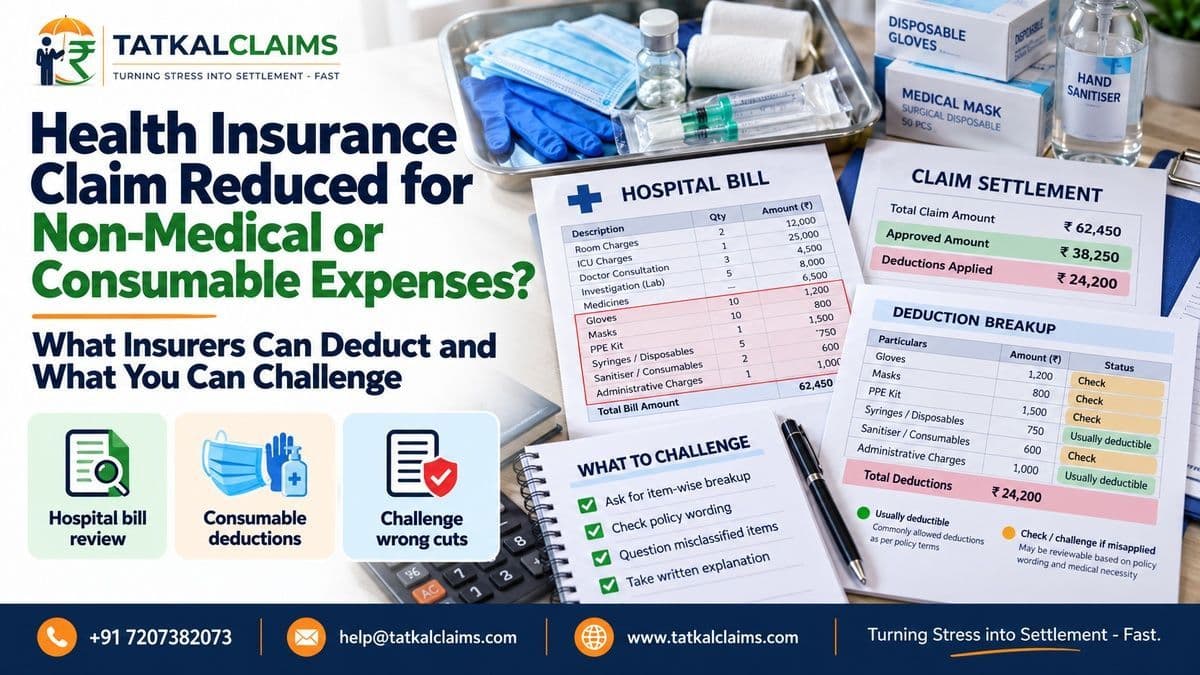
Many disputes are not full rejections at all. The insurer admits the claim but reduces it for a room-category restriction, co-payment, deductible, non-payable item, disease-specific limit or another policy condition. The settlement sheet should be read together with the policy schedule and Customer Information Sheet, not in isolation.
Do not assume that a room-rent cap, ICU cap, cataract limit or treatment sub-limit applies merely because such limits exist in some products. The restriction must exist in the policy that was actually issued, and the deduction still has to follow the wording and the facts of the hospital bill.
4. Documentation and Deficiency Letters
A query or deficiency letter is not the same thing as a rejection. It is a request to complete or clarify the insurer’s record. The safest response is point-by-point: quote each requirement, attach the matching document or explanation, and keep proof of submission. For a practical response structure, see our guide to insurer query and deficiency letters.
For reimbursement claims, build a simple document index covering the claim form, discharge summary, final bill and receipts, pharmacy and investigation records, prescriptions, treating-doctor papers, bank details and any accident-related documents where relevant. The exact checklist varies by policy and claim, so the insurer’s written requirement should be matched against what has already been submitted.
Cashless vs Reimbursement Claims: Two Paths, Two Sets of Challenges
Health claims usually reach the insurer through either a cashless route or a reimbursement route, but the evidence problem is different in each.
For cashless treatment, the key record is the hospital-to-insurer authorisation trail: when pre-authorisation was sent, what query was raised, what was answered, and when final discharge authorisation was requested. Normal cashless access depends on the insurer’s network or other eligible cashless arrangement; the industry’s Cashless Everywhere initiative can also facilitate cashless treatment at non-network hospitals subject to its conditions and insurer operating requirements.
For reimbursement, the policyholder pays first and submits the claim afterwards. Check any policy-level filing requirement, but once the insurer has the claim for settlement, current IRDAI health guidance lists a 15-day turnaround time for claims other than cashless.
A cashless denial and a reimbursement rejection are therefore not interchangeable. A cashless request may fail because the hospital or proposed treatment does not satisfy the cashless process, while the underlying expenses may still need to be examined under the reimbursement provisions of the policy.
Challenges Specific to Family Health Insurance
With a family floater, the claim dispute may also depend on how much of the shared sum insured is still available and whether any restoration or refill benefit has been triggered.
A shared sum insured means one member’s claim can reduce the pool available for the rest of the family. When reviewing a second claim in the same policy year, check the opening sum insured, earlier payments, bonuses, restoration wording and the amount the insurer says remains available.
Age can materially affect pricing and underwriting, but it should not be used as a shortcut explanation for a disputed claim. The claim itself still has to be tested against the issued policy, the insured member’s disclosures and the evidence relating to the treatment.
Where two family members are treated close together, maintain separate claim files and a running statement of the floater balance. That avoids mixing one member’s documents, deductions or available sum insured with the other member’s claim.
The Policy Document Is Only Part of the Claim File
Policyholders often focus only on the policy wording after a dispute starts. In many cases the proposal form, policy schedule, Customer Information Sheet, endorsements and renewal history matter just as much. A verbal assurance at the time of sale can be relevant evidence, but it should be separated from what was actually recorded in the proposal and issued contract.
Before appealing, pull these points from the issued policy rather than relying on assumptions:
- Waiting periods: the exact period depends on the product; under the current IRDAI framework, waiting periods including pre-existing-disease and specific waiting periods cannot exceed 36 months
- Sub-limits and cost sharing: check the actual room-category limit, disease-specific limit, deductible or co-payment in your schedule and wording
- Exclusions and eligibility conditions: these vary by product and treatment; do not assume that a category of treatment is universally excluded across health policies
- Co-payment: identify the percentage, when it applies and whether the insurer has applied it to the correct part of the claim
- Proportionate or related deductions: identify the policy clause first, then reconstruct how the insurer moved from the hospital bill to the admitted amount
This document comparison is often more useful than a long complaint. It turns the dispute into a small number of testable questions: what was promised, what was disclosed, what happened medically, what was submitted and how the insurer calculated its decision.
What Current IRDAI Timelines Actually Say
For current health-claim timelines, IRDAI’s health-policyholder guidance is the better reference point than older circulars or legacy policy articles. It lists specific turnaround times for cashless requests, non-cashless claims and complaints, along with current waiting-period and moratorium standards.
Key current timings and protections include:
- Claims other than cashless: settlement turnaround time of 15 days
- Cashless: decision on pre-authorisation within 1 hour and final discharge authorisation within 3 hours
- Complaints: IRDAI’s health guidance lists 14 days for action and intimation of the decision; Bima Bharosa’s FAQ states that the insurer should resolve a complaint within 15 days
- Moratorium: 60 continuous months of health-insurance coverage, with portability and migration credits counted as applicable; the enhanced portion of sum insured can have its own 60-month clock
- Product availability: insurers are required to make products, add-ons or riders available to cater to all ages and a wide range of medical conditions and treatment situations; this does not mean every single product must accept every risk on identical terms
- Cashless Everywhere: an industry initiative intended to facilitate cashless treatment at non-network hospitals subject to advance or emergency intimation, policy admissibility and insurer operating conditions; it is not an unconditional cashless guarantee at every hospital
- Senior-citizen premium revisions: IRDAI's 30 January 2025 circular directs general and health insurers offering indemnity-based individual health products to senior citizens not to revise premiums by more than 10% per annum; a proposed increase above 10% requires prior consultation with IRDAI.
These rules are most useful when tied to the actual claim chronology. A policyholder should be able to show when the request was made, what documents were submitted, what the insurer asked for and when the decision became due.
What to Do When a Health Claim Is Rejected, Delayed or Reduced
Start with the claim file, not with a long grievance. Build the chronology and isolate the exact decision you want the insurer to reconsider.
First, obtain the rejection, deduction or delay explanation in writing. For a rejection, identify the policy clause and factual reason cited. For a short settlement, obtain the settlement sheet or calculation. For delay, identify the last acknowledged document and the current claim status.
Second, classify the dispute: disclosure, waiting period, exclusion, medical necessity, document deficiency, cashless process, room or other sub-limit, co-payment, proportionate deduction, or unexplained delay. Do not argue every possible issue if the insurer has relied on only one or two.
Third, compare the insurer’s reason with the policy schedule, wording, Customer Information Sheet, proposal form, endorsements and relevant medical record. The strongest challenge usually points to the exact document that contradicts or qualifies the insurer’s conclusion.
Fourth, use the insurer’s grievance mechanism with a short chronology and indexed supporting documents. IRDAI’s current health guidance lists 14 days for action on a complaint and intimation of the decision, while Bima Bharosa’s FAQ describes a 15-day insurer resolution timeline.
Fifth, if the insurer does not resolve the grievance or the response remains unsatisfactory, Bima Bharosa can be used to register and track the grievance with IRDAI’s grievance system. Our Bima Bharosa vs Insurance Ombudsman guide explains where the two routes differ.
Sixth, an eligible dispute may be taken to the Insurance Ombudsman after first approaching the insurer, subject to the Ombudsman’s monetary limit, filing timeline and other eligibility conditions. The process is intended to be accessible without requiring a lawyer. Before filing, use our Insurance Ombudsman complaint process guide to check the current filing framework.
Consumer Commission proceedings are a separate remedy that may be appropriate in some disputes. The correct forum and strategy depend on the claim amount, relief sought, limitation position, evidence and what has already happened in the insurer and Ombudsman process.
What Tatkal Claims Would Check First in This File
We would begin with a one-page chronology: policy inception and renewals, relevant proposal disclosures, admission and discharge dates, cashless or reimbursement route, insurer queries, document-submission dates, rejection or settlement date and every grievance already filed.
Then we would classify the dispute before writing anything. A medical-necessity rejection needs different evidence from an alleged non-disclosure case. A short settlement needs the deduction reconstructed line by line. A delay case needs the complete-document date established. A cashless denial needs the pre-authorisation trail separated from the reimbursement entitlement.
The objective is not to produce the longest complaint. It is to identify the one or two findings that actually control the claim, match them against the policy and contemporaneous evidence, and carry the same organised file through the insurer grievance route and any later escalation.