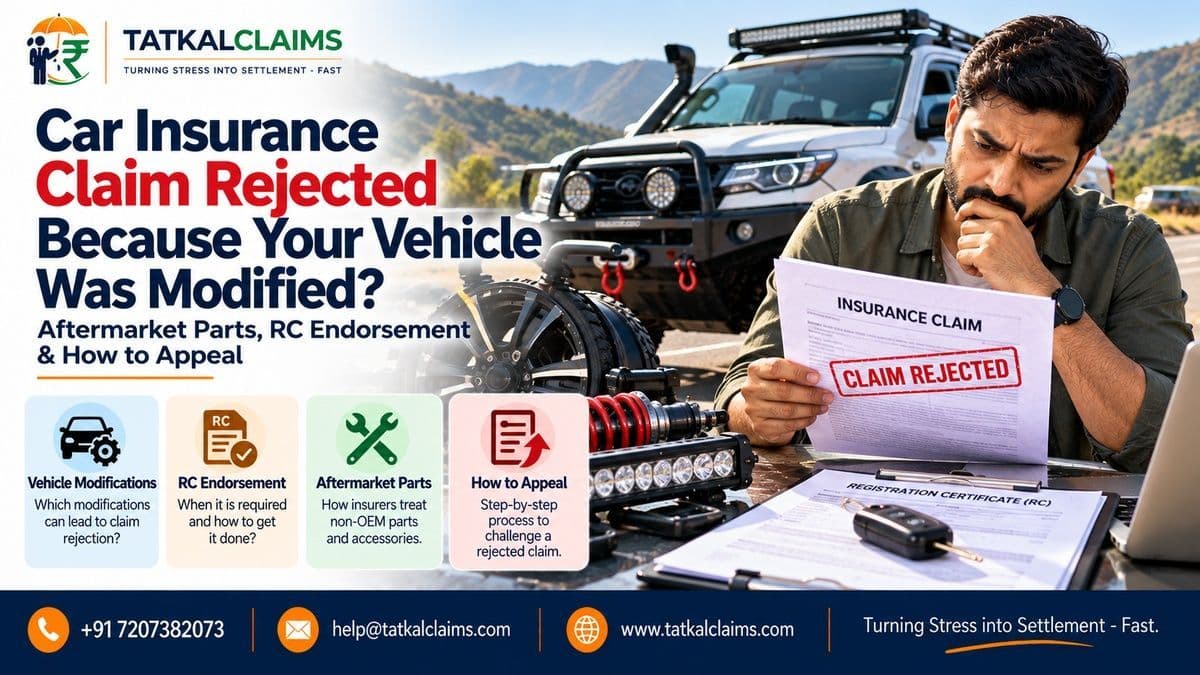
Your car is involved in an accident, theft, fire or other insured loss. During inspection, the surveyor notices larger wheels, an aftermarket suspension, a modified exhaust, extra lights, non-OEM wiring, a body kit, an ECU remap or another change from stock specification. The insurer then says the vehicle was “modified” and rejects or reduces the claim.
That does not create one automatic answer. A modified-vehicle dispute has at least three separate questions: whether the alteration was legally permissible and properly recorded, whether the insurer was informed and the policy endorsed where required, and whether the modification caused or materially contributed to the loss being claimed.
Those questions should not be collapsed into a slogan such as “any modification voids insurance” or “an unrelated modification can never affect a claim.” The actual policy wording, proposal declarations, RC particulars, technical evidence, survey findings and the nature of the loss all matter.
What Section 52 of the Motor Vehicles Act Currently Says
Section 52 of the Motor Vehicles Act regulates alteration of motor vehicles. The current text restricts alterations that put registration particulars at variance with what was originally specified by the manufacturer, while also allowing the Central Government to prescribe specifications, approval conditions and retrofitment standards for permitted alterations.
The law changed after the Supreme Court’s January 2019 decision in Regional Transport Officer v. K. Jayachandra. That judgment interpreted the Section 52 framework then before the Court and strongly emphasised road safety, manufacturer specifications and the prohibition on impermissible structural alterations. But the Motor Vehicles (Amendment) Act, 2019 and the 2021 Central Motor Vehicles Rules subsequently created a more detailed route for compliant alterations and retrofitment.
So it is inaccurate to reduce the current position to “the Supreme Court banned every modification.” The correct question is whether the specific alteration is permitted under the current Act, rules, notified standards and registration process.
How the 2021 Alteration and RC-Endorsement Process Works
Rule 47A of the Central Motor Vehicles Rules provides a prior-approval route for alterations or retrofitments covered by Rule 112. The owner applies in Form 22C. The registering authority is required to decide the request within the prescribed period, and the rule also provides for deemed approval if it does not approve or reject within seven days.
Rule 47B provides for endorsement of the alteration or retrofitment in the registration certificate. For alterations under the relevant Rule 112 route, the owner applies in Form 22D after the compliance process. The rule contains a fourteen-day timing requirement linked to the compliance certificate, with an additional proviso dealing with cases where prior approval was not obtained.
Rule 112 says specified alterations or retrofitments—including changes in fuel, propulsion system, engine, chassis or body structure—must comply with notified conditions, standards and specifications. The work must be carried out through the permitted categories of OEM/dealer/state-authorised workshop or service station, and compliance must be tested, validated or self-certified as the rule permits, with a compliance certificate.
A procedural filing route does not mean every desired modification is automatically legal. The proposed change still has to fall within the standards and conditions allowed by law.
| Question | Why it matters |
| Did the modification change a basic feature or RC/manufacturer specification? | It may fall within Section 52 alteration rules. |
| Was prior approval required and obtained? | Rule 47A may apply to the alteration/retrofitment route. |
| Was the work done by an authorised category of workshop/dealer/OEM? | Rule 112 identifies who may perform regulated alterations. |
| Was compliance certified? | Form 22F or other applicable compliance evidence can be important. |
| Was the RC updated/endorsed? | Rule 47B provides the endorsement process for relevant alterations. |
| Was the insurer informed separately? | RC compliance does not automatically update the insurance contract. |
RC Approval and Insurance Endorsement Are Two Different Things
Even where a modification is lawful and properly endorsed in the RC, the motor insurance policy may still need to be updated. IRDAI’s motor-insurance policyholder guidance says changes such as modifications to the vehicle or its use are recorded in the policy by endorsement, based on a request and supporting proof. Some endorsements can require additional premium.
Conversely, telling the insurer does not by itself legalise a vehicle alteration that violates the Motor Vehicles Act or CMVR. Regulatory compliance and policy disclosure should both be checked.
Current insurer material also commonly tells policyholders to report upgrades and modifications and states that non-factory accessories may require separate declaration or cover. This is especially important where the claim includes the value of the aftermarket part itself.
Not All Modifications Create the Same Insurance Risk
| Modification | Main questions to check |
| Aftermarket wheels / tyre size | OEM-approved size, handling/load implications, whether specifications materially changed, insurer disclosure. |
| Suspension / ride-height change | Safety/handling effect, legality under current standards, causal link to accident. |
| ECU remap / performance tune | Power/emissions change, legality, insurer disclosure, causation in engine or accident claim. |
| Aftermarket exhaust | Noise/emission compliance, policy disclosure, relation to claimed damage. |
| High-wattage lights / extra horns / rewiring | Electrical load, workmanship, insurer disclosure, forensic cause in fire claim. |
| Body kit / structural body alteration | Whether body structure/basic feature changed, approval/compliance evidence, accident causation. |
| Bull bar / crash guard | Specific road-safety restrictions and whether the fitment is authorised/permitted. |
| Wrap / colour change | Whether recorded vehicle particulars need updating and whether insurer records remain accurate. |
| Audio / infotainment / accessories | Whether the accessory value is insured and whether installation affected wiring or caused loss. |
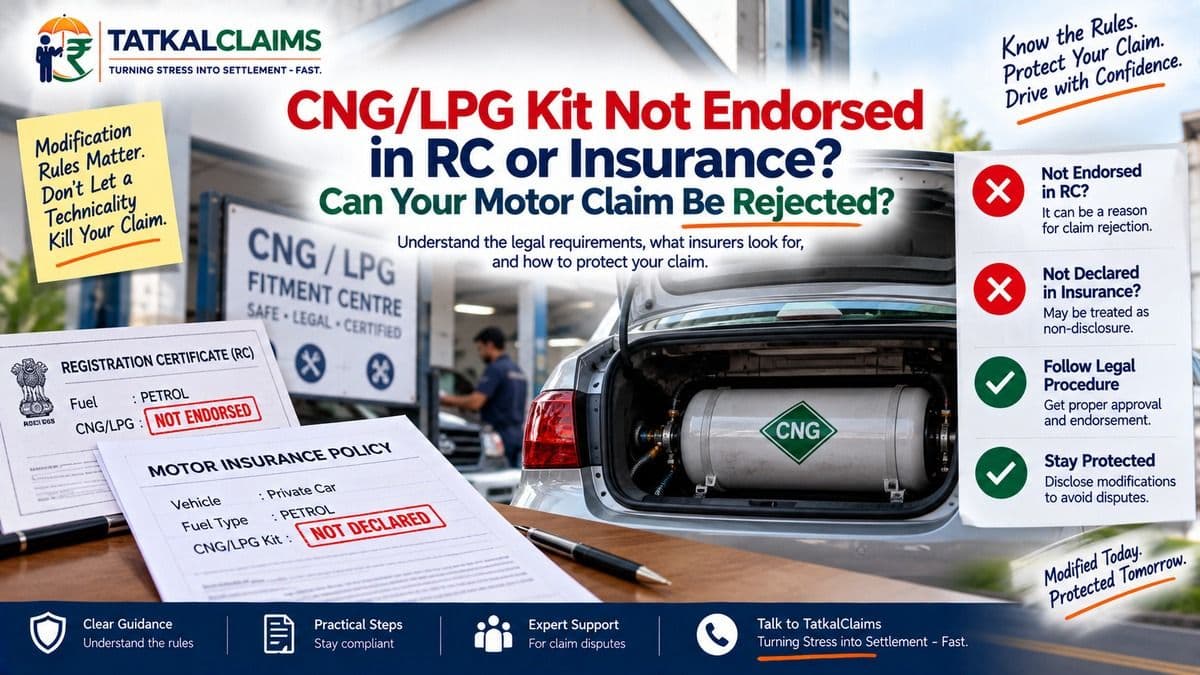
| Fuel conversion | Separate Section 52/RC/insurance issues; use the dedicated CNG/LPG analysis. |
The degree of risk is not determined merely by whether a part is “aftermarket.” A floor mat and a relocated battery are not equivalent. A cosmetic accessory and a structural suspension or chassis change should not be analysed the same way.
Likewise, a modification that is unrelated to a theft claim raises a different factual question from electrical rewiring that an investigator says caused a fire. The insurer should identify the specific breach and the evidentiary basis for its decision.
Fuel-conversion disputes have their own RC and policy rules. See our CNG/LPG kit endorsement and motor-claim guide.
What About Bull Bars and Crash Guards?
MoRTH issued a 2017 direction asking States and Union Territories to act against unauthorised crash guards and bull bars, citing Section 52 and road-safety concerns. That circular is useful evidence that these fittings have been treated as a safety and alteration issue by the transport ministry.
Because the alteration framework has since been amended, do not assume that every accessory carrying a similar marketing label is automatically lawful or unlawful. Check the current approved specification, vehicle type, fitment and applicable transport-authority position.
For insurance, also ask whether the disputed accessory contributed to the collision damage or injury, whether its value was separately insured, and whether the policy/proposal required it to be declared.
Are Bigger Wheels or Different Tyres Automatically a Claim Rejection?
No simple rule should be applied to every tyre change. Replacement within an OEM-approved specification is different from moving to a materially different size, load rating, offset or wheel setup that changes vehicle characteristics.
The 2019 Supreme Court judgment referred to the legislative concern with tyre changes and manufacturer specifications under the then Section 52 framework. Current law must still be read with the post-2021 alteration rules and the vehicle manufacturer’s permitted specifications.
If the insurer says a wheel or tyre modification caused the accident, ask for the technical basis: tyre size, wheel dimensions, load/speed rating, alignment or suspension effect, photographs, survey findings and any expert conclusion linking the change to loss.
If the accident was caused by an entirely different external event, the modification issue may still matter under the policy, but causation becomes an important part of the dispute rather than something to assume either way.
Electrical Accessories and Fire Claims Need Forensic Evidence
Fire claims are where modification disputes become particularly technical. Extra lights, high-wattage bulbs, amplifiers, horns, battery relocation, added fuel tanks or non-OEM wiring can create an argument about short circuit, overload, poor insulation or unsafe installation.
In HDFC ERGO General Insurance Co. Ltd. v. Sukhdeep Kaur, decided by the Punjab State Consumer Commission on 16 June 2026, the insurer’s appeal was allowed after the Commission relied on forensic material indicating that the battery and fuel-tank locations had been altered and that the fire originated from the modified battery area. The result turned on the evidence in that case; it is not a rule that every aftermarket electrical item defeats every fire claim.
A contrasting 2026 District Consumer Commission decision in Ayyappan v. General Manager treated alleged non-OEM electrical accessories differently where the Commission found the modification and causal link were not established through adequate technical evidence. That is a lower-forum, fact-specific decision, not a nationwide rule.
Does the Insurer Have to Prove the Modification Caused the Loss?
There is no safe universal answer that causation is always legally required before any modification-related repudiation can stand. Some proposal forms and policy declarations impose broad duties to disclose additions or alterations, and the wording can be strict. At the same time, consumer and court decisions often scrutinise whether the insurer proved the alleged breach, identified the relevant policy clause and established the factual basis for linking the change to the loss.
That means an appeal should not rely only on “the modification was unrelated.” First read the exact repudiation letter and policy. Then test whether the insurer has proved the modification, proved the applicable clause, and explained why that breach defeats the specific claim.
Where the insurer’s own proposal, pre-policy inspection, photographs or renewal records show the modification was visible and known before cover was issued, preserve that evidence. It can materially affect the factual dispute about disclosure, although it does not automatically cure an illegal alteration or rewrite the policy.
| Question | Evidence to collect |
| What exact modification is alleged? | Survey photos, workshop report, OEM specification, RC, invoices. |
| What law or policy clause is invoked? | Repudiation letter, policy wording, proposal/declaration, endorsements. |
| Was the insurer informed or did it inspect the vehicle? | Emails, endorsement request, inspection photos, renewal records. |
| Did the modification cause or aggravate the loss? | Surveyor report, forensic report, ECU/diagnostic data, accident reconstruction where relevant. |
| Is the claim for the modified part itself or unrelated damage? | Repair estimate split by part and cause. |
If the insurer is relying on a surveyor or investigator, use our guide on how to request the survey report, investigator report and evidence used against your claim.
What If the Claim Is Only for the Aftermarket Accessory?
A comprehensive motor policy does not necessarily mean every added accessory is automatically insured at its full replacement value. Non-factory electrical or electronic accessories may need declaration, valuation and additional premium or endorsement.
If the base vehicle damage is admitted but the insurer excludes the upgraded stereo, lights, alloys or other accessory, ask whether the dispute is about admissibility of the entire claim or only the value of the undeclared accessory.
A line-item settlement analysis can prevent an accessory-coverage dispute from being confused with the whole accident claim.
Own-Damage and Third-Party Claims Must Be Kept Separate
A policyholder’s own-damage claim for repair or total loss is a contractual indemnity question under the policy. Third-party bodily injury or property claims operate under a different statutory framework and should not be assumed to fail merely because the owner’s own-damage claim faces a modification dispute.
Insurer defences, statutory liability and recovery rights in third-party cases can involve different provisions and case law. If there has been a serious road accident, analyse the MACT/third-party issue separately from the damaged-owner vehicle claim.
For injury or death claims arising from a road accident, see our third-party motor accident and MACT guide.
Do Not Mix a Modification Dispute With Other Motor Compliance Disputes
A modified vehicle claim should not absorb unrelated issues such as an expired driving licence, commercial permit, fitness certificate or private-car-for-hire use. Each has its own statutory and policy analysis.
If the rejection is really based on the driver’s licence, use the separate expired driving-licence motor-claim guide.
Documents to Collect Before You Appeal
| Document / evidence | Why it matters |
| Full policy schedule and wording | Shows cover, exclusions, conditions and endorsements. |
| Proposal form / declaration | Shows what was disclosed when the risk was accepted. |
| RC before and after alteration | Shows whether particulars were updated. |
| Form 22C / 22D / 22F or applicable approval papers | Shows regulatory approval and compliance route. |
| Modification invoice and workshop details | Shows what was changed, when and by whom. |
| OEM specification / approved accessory list | Helps compare stock and modified configuration. |
| Insurer endorsement / email / inspection photos | Shows whether the insurer knew and accepted the change. |
| Surveyor report | Shows what the insurer says was observed. |
| Forensic / fire-cause report | Critical where electrical or fuel modifications are blamed. |
| Repair estimate split by component | Separates modified-part dispute from other covered damage. |
| Accident photographs / CCTV / dashcam / police record | Helps test the claimed causal link. |
What to Ask the Insurer in Writing
Ask the insurer to identify the exact modification it relies on, the specific policy clause and proposal declaration allegedly breached, the Section 52/CMVR provision it says applies, and whether rejection is based on non-disclosure, illegality, causation, an excluded accessory, or a combination of grounds.
Also ask for the surveyor’s observations, photographs, technical report, forensic material and the calculation of any deduction. If only one part of the claim is disputed, ask why the undisputed direct damage is not being assessed separately.
Avoid sending a generic emotional appeal. Build a clause-by-clause and evidence-by-evidence response.
How to Structure a Modification-Claim Appeal
| Section | What to state |
| 1. Vehicle and policy | Registration, policy number, cover type, date of loss. |
| 2. Modification facts | Exactly what was changed, when, by whom and why. |
| 3. Regulatory status | Approvals, compliance certificate, RC endorsement, or explanation of disputed applicability. |
| 4. Insurance disclosure | When and how insurer was informed; attach endorsement/inspection proof. |
| 5. Cause of loss | Explain why the insurer’s causation theory is supported or contradicted by evidence. |
| 6. Claim split | Identify modified-part value separately from unrelated vehicle damage. |
| 7. Relief sought | Reconsideration, fresh survey/technical review, or component-wise settlement. |
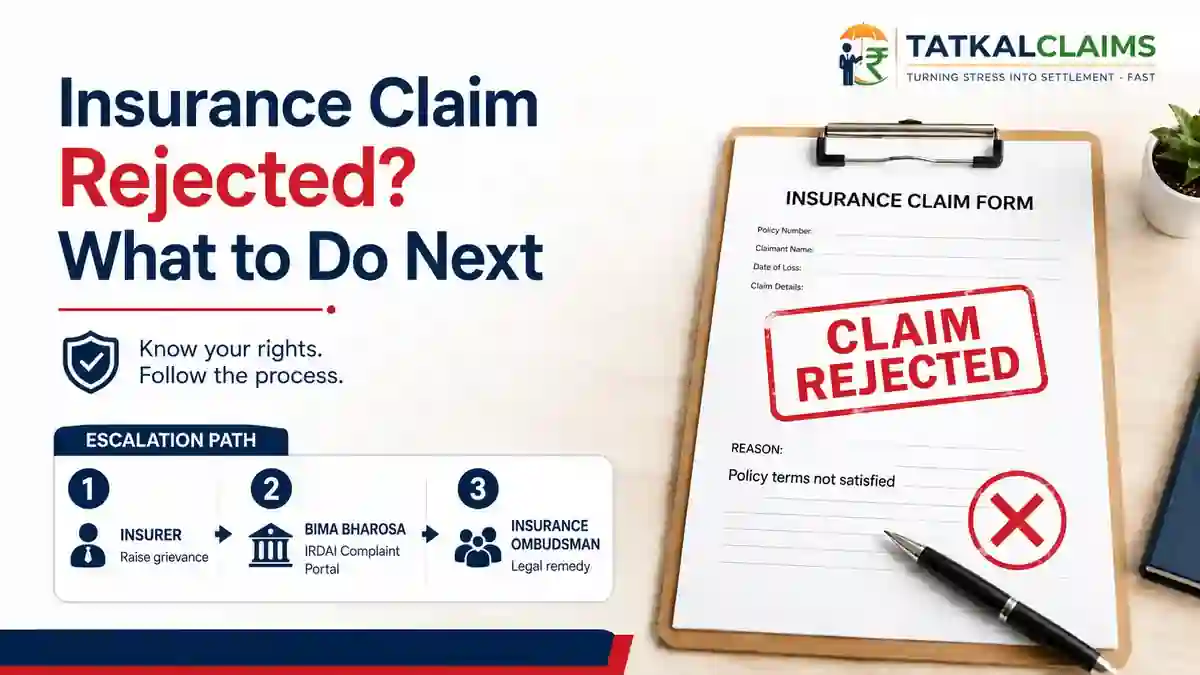
For the broader escalation framework after repudiation, use our insurance claim rejection guide.
Escalation After the Insurer’s Final Response
Start with the insurer’s grievance redressal channel and preserve the complaint number, attachments and written response. If the dispute remains unresolved, Bima Bharosa can be used to lodge or track a grievance with the regulated entity through IRDAI’s grievance framework.
The Insurance Ombudsman may be available if the complaint falls within the applicable subject-matter, procedural and monetary requirements. Consumer or other legal remedies may also be relevant depending on the amount, facts and relief sought.
If you are deciding between escalation routes, see Bima Bharosa vs Insurance Ombudsman.
If There Has Been No Claim Yet: Fix the Records Before a Loss
If you have already modified the vehicle and there is no claim, do not wait for an accident to discover a documentation gap. Check whether the alteration is permissible, whether transport-authority approval or RC endorsement is required, and whether the insurer needs an endorsement or extra premium.
Keep invoices, compliance certificates, OEM/dealer confirmation, photographs and insurer acknowledgements. If the insurer refuses to endorse a modification, obtain that position in writing before relying on the vehicle for continued insured use.
Where the alteration is safety-critical or may not be legally permissible, get competent transport-law and technical advice rather than assuming an insurance endorsement alone solves the issue.
A Practical 7-Day Action Plan After a Modification-Based Rejection
| Day | Action |
| Day 1 | Secure the vehicle and preserve photographs of the modified and damaged parts before repair. |
| Day 2 | Collect policy, proposal, RC, endorsement, modification invoice and workshop/OEM records. |
| Day 3 | Request surveyor, investigator and forensic material relied on by the insurer. |
| Day 4 | Map the alleged modification against Section 52, Rules 47A/47B/112 and applicable standards. |
| Day 5 | Build a causation timeline and separate modified-part damage from unrelated damage. |
| Day 6 | Submit a clause-specific grievance with documentary annexures. |
| Day 7 | Escalate through the appropriate grievance route if the insurer’s response remains unsupported. |
How Tatkal Claims Can Help
Tatkal Claims can review the repudiation letter, motor policy, proposal form, RC, modification/fitment documents, insurer endorsement history, survey report, photographs, workshop diagnosis and forensic evidence to identify whether the real dispute is regulatory compliance, non-disclosure, accessory cover, causation or a combination of these.
Where a rejection appears unsupported, assistance can include preparing a clause-specific reconsideration request, demanding the evidence relied on, separating admissible damage from disputed modification-related damage, and preparing insurer grievance, Bima Bharosa or Ombudsman escalation where appropriate.
A review should not promise that every modified-vehicle claim is payable. A prohibited alteration, missing required approval, material non-disclosure, uninsured accessory or technically proven causal link can materially weaken a claim.
Frequently Asked Questions
Frequently asked questions
Does any car modification automatically void my insurance?
Not automatically in every case. The outcome depends on the modification, current vehicle law, whether approval or RC endorsement was required, what the policy/proposal says, whether the insurer was informed, and the evidence connecting the modification to the loss.
Do I need to tell my insurer about aftermarket modifications?
IRDAI’s motor-insurance guidance says vehicle modifications or changes in use should be recorded through policy endorsement. Insurer requirements and additional premium can vary, so notify the insurer in writing and obtain the endorsement where required.
If the RTO endorsed the modification, is my insurance automatically updated?
No. RC endorsement and insurance endorsement are separate records. You should also inform the insurer and confirm how the change affects cover and premium.
If the insurer endorsed the modification, does that mean the alteration is legal under the Motor Vehicles Act?
Not necessarily. Insurance acceptance does not replace transport-law compliance. Check Section 52, the CMVR alteration process and applicable standards separately.
Can bigger alloy wheels or tyres cause a claim rejection?
They can create a dispute if the setup materially departs from approved specifications, breaches applicable requirements or is alleged to have contributed to the accident. Ask the insurer for the exact specification and technical basis rather than assuming every wheel change has the same effect.
Can an ECU remap affect a motor insurance claim?
Yes, potentially. A performance remap can affect power, emissions or risk characteristics and may require disclosure. Claim impact depends on legality, policy wording, disclosure and whether the remap is relevant to the loss.
Are aftermarket lights, horns or music systems covered automatically?
Not always. Non-factory accessories may need declaration and separate premium or endorsement. Electrical installation can also become a causation issue in a fire claim.
If my modified car was stolen, can the insurer reject the theft claim?
A theft claim should still be analysed under the actual policy, disclosure duties and facts. The relevance of a modification to theft may be different from a fire or accident claim, but do not assume the issue is legally irrelevant without reading the policy and repudiation grounds.
Can I rely on the 2019 Supreme Court judgment to say all modifications are banned?
No. The judgment is important, but the statutory and CMVR alteration framework changed afterward. Current Section 52 and the 2021 rules provide a regulated pathway for certain compliant alterations and retrofitments.
What should I do first after a modification-based rejection?
Get the written repudiation reason, policy and proposal, RC and alteration approvals, survey/forensic reports, insurer endorsement history and repair estimate. Then challenge the exact clause and evidence rather than sending a generic appeal.
Sources and Methodology
Disclaimer: This guide explains the current vehicle-alteration framework and common motor-insurance issues in general terms. Modified-vehicle claims are highly fact-, policy- and specification-specific. Legal permissibility, RC endorsement, insurer disclosure, accessory cover and causation can each affect the result. Lower-forum decisions cited here are illustrative, not universal rules. This is not legal, engineering or insurance advice for a specific vehicle.