If IFFCO Tokio has rejected your health or motor insurance claim, denied cashless treatment, reduced the amount payable, delayed a decision or relied on a survey or policy condition you disagree with, the first step is not simply to complain that the decision is unfair. You need to identify the exact reason, compare it with the policy wording and evidence, and challenge that reason systematically.
First: Identify What Happened to Your IFFCO Tokio Claim
| Claim problem | What it usually means | Best first move |
|---|---|---|
| Health claim rejected | Admissibility is disputed because of medical evidence, policy conditions, waiting periods, exclusions, disclosure or documentation | Get the precise medical or policy reason and clause |
| Cashless request denied | Cashless authorisation was refused, but reimbursement may still be separately assessed | Preserve the cashless denial and hospital records |
| Health claim short-settled | The claim is admitted but deductions reduce payment | Demand the complete deduction calculation |
| Motor own-damage claim rejected | Coverage, causation, vehicle documents, survey findings or policy conditions are disputed | Obtain the repudiation letter and survey basis |
| Motor claim short-settled | The survey or assessment allows less than the repair or loss claimed | Identify each excluded repair item and valuation |
| Claim delayed | The claim remains undecided or unpaid | Build a dated chronology and escalate the delay |
| Claim approved but unpaid | Admissibility may no longer be disputed, but payment has not reached you | Ask for the payment reference, approved amount and reason for non-credit |
For the broader framework, use Tatkal Claims' Insurance Claim Rejected? What to Do Next – Complete Guide for India alongside this insurer-specific guide.
IFFCO Tokio's Claim-Settlement Numbers Need Context
Nyvo's July 2026 compilation of published IRDAI data reports a three-year weighted claim-settlement ratio of 85.8% for IFFCO Tokio and 46.8 complaints per 10,000 claims. In Nyvo's table, IFFCO Tokio sits just above Navi General and Cholamandalam MS on the settlement-ratio measure.
Those are aggregate company-level statistics. They do not determine whether your individual IFFCO Tokio claim is payable or whether a particular rejection is correct. Nyvo also notes that general-insurer figures can combine different lines of general insurance business, so they should be treated as context rather than an individual claim probability.
Step 1: Get the Exact Rejection, Deduction or Delay Reason in Writing
Record the policy number, claim number, date of hospitalisation, accident, theft or other loss, amount claimed, amount approved if any, date of rejection or settlement, exact reason given and the policy clause relied upon.
If the decision merely says that the claim is not admissible as per policy terms, ask IFFCO Tokio to identify the relevant clause and explain how it applies to your facts.
For a health claim, preserve the proposal form, policy wording, cashless correspondence, discharge summary, diagnostic records, prescriptions, bills, receipts and every document query. For a motor claim, preserve the policy, RC, driving licence, photographs, repair estimate, workshop records, survey communications, invoices, police papers where relevant, towing records and theft documents where applicable.
For a short settlement, request a line-by-line calculation showing the amount claimed, amount considered, deductions, policy basis and final payable amount.
Step 2: Register the Complaint With IFFCO Tokio
IFFCO Tokio currently lists 1800-103-5499 as its 24×7 toll-free number and support@iffcotokio.co.in as its customer-support email. Its health-claims material also lists dedicated health-claim channels and explains the reimbursement process.
IFFCO Tokio's grievance page says the turnaround time for resolving an initial concern is 4 working days and that the customer receives an automatic notification with a service-request number.
Whenever possible, follow a telephone conversation with a written complaint. State what IFFCO Tokio decided, why you dispute it, which evidence contradicts the decision, which policy provision you rely upon and what remedy you want. Do not send an unstructured bundle of documents without explaining what each one proves.
Step 3: Escalate to IFFCO Tokio's Chief Grievance Officer
If you are dissatisfied with the initial resolution and want the decision re-examined, escalate the matter to IFFCO Tokio's Grievance Redressal Officer / Chief Grievance Officer through the official contact published on its grievance page.
Chief Grievance Officer email: chiefgrievanceofficer@iffcotokio.co.in. Contact number: 0124-2850159.
IFFCO Tokio states that after examining the matter at this level, it will send its final response within 14 days from receipt of the complaint on this email address.
Your Chief Grievance Officer escalation should contain a short chronology: date the claim arose, date the claim was submitted, date and reason for rejection or deduction, first grievance reference number, response received, evidence submitted and the exact point that remains unresolved. Do not simply forward the same email again; explain what the earlier response failed to address.
IFFCO Tokio Health Claim Rejected? Check These Issues
1. Cashless Request Denied
IFFCO Tokio's current health-claims page states that the TPA turnaround time is 1 hour for initial cashless authorisation and 3 hours for final discharge authorisation after receipt of the required documents.
A cashless denial does not automatically mean that the underlying medical claim has finally been rejected. IFFCO Tokio states that where cashless is not approved, the policyholder can settle the hospital bill and apply for reimbursement, subject to the policy terms and claim assessment.
Preserve the cashless request, denial communication, hospital pre-authorisation papers, discharge summary, bills and receipts, prescriptions, investigation reports and payment proof.
Use Tatkal Claims' Cashless Health Insurance Claim Rejected? How to File a Reimbursement Claim guide when preparing the reimbursement file.
2. Reimbursement Claim Rejected or Delayed
IFFCO Tokio's current health-claims page states that the turnaround time for reimbursement claims is 15 days from receipt of all required documents.
If the claim remains pending, create a document-submission chronology. Record when the original claim was submitted, which additional documents were requested, when you supplied them and whether the insurer later repeated a requirement already satisfied. If a repudiation letter is subsequently issued, the dispute changes from a delay problem to a rejection problem.
3. Pre-Existing Disease, Waiting Period or Non-Disclosure
If IFFCO Tokio alleges a pre-existing disease or non-disclosure, reconstruct the information available when the policy was purchased. Compare the proposal-form questions, answers actually provided, pre-policy medical reports, earlier treatment records, prescriptions, first diagnosis date and present hospital records.
Do not assume that the appearance of a disease in a later medical record automatically proves non-disclosure. The dispute may depend on what the policyholder knew, what the proposal form asked, what was disclosed and what connection the alleged condition has with the present claim.
Use Tatkal Claims' Health Insurance Claim Rejected for Pre-Existing Disease? guide for the detailed PED, waiting-period and moratorium framework.
4. Medical Necessity or Hospitalisation Dispute
If the insurer disputes the need for hospitalisation or treatment, obtain a detailed treating-doctor explanation addressing the patient's symptoms, diagnosis, clinical findings, investigations, reason for admission and why the chosen treatment or hospitalisation was medically necessary. A generic doctor's certificate may be insufficient where the insurer has relied upon a detailed medical assessment.
5. Health Claim Short-Settled
If IFFCO Tokio admits the claim but pays less than expected, request the complete settlement sheet. Separate deductions relating to non-payable items, policy limits, deductibles, proportionate deductions, sub-limits, excluded expenses and other policy-based adjustments, then compare each deduction with the policy wording.
Tatkal Claims' Health Insurance Claim Short-Settled? How to Check and Challenge Deductions guide can be used for the deduction audit.
IFFCO Tokio Motor Claim Rejected? Check These Issues
IFFCO Tokio's motor-claim guidance states that the insured should report the loss promptly, submit the completed claim form and loss estimate, and cooperate with the inspection or survey. Where the cause of loss is not established, evidence showing that the loss resulted from an insured peril becomes particularly important.
1. Survey or Repair-Estimate Dispute
Current IFFCO Tokio motor claim material states that the initial survey should occur within 24 hours from claim intimation, the insurer should obtain the survey report within 15 days of allocation, and approval or rejection should follow within 7 days from receipt of the survey report with all relevant claim documents.
If the dispute concerns the amount of damage attributable to the accident, preserve photographs taken immediately after the incident, the repair estimate, workshop diagnosis, invoices and any available survey communication. Ask IFFCO Tokio to identify every repair item it has excluded, and explain why each disputed repair item was caused by the insured incident.
2. Cause-of-Loss Dispute
Build a chronology using accident photographs, dashcam or CCTV where available, police documents, towing records, workshop inspection, witness material, survey records and the physical damage pattern. The closer the evidence is to the time of the accident, the stronger the causation record generally becomes.
3. Total Loss, Constructive Total Loss or IDV
If the dispute concerns whether the vehicle should be repaired or treated as a total or constructive total loss, check the insured declared value, repair estimate, survey assessment, salvage treatment and applicable policy wording.
Use Tatkal Claims' Car Total Loss vs Constructive Total Loss: 75% IDV Rule, Salvage & Claim Settlement guide for the calculation framework.
4. Theft Claim
For a theft claim, preserve the FIR, police acknowledgement, claim intimation, policy, RC, available vehicle keys, financier documents where relevant and the non-traceable or final police report when issued. If IFFCO Tokio alleges delayed intimation, document when the theft was discovered, when police were informed and when the insurer was notified.
Use Tatkal Claims' Car Stolen? Insurance Claim Process, Documents, FIR, Non-Traceable Certificate & Delayed Intimation guide for the detailed theft process.
5. Driving Licence, Vehicle Use or Policy Condition
If the rejection relies on a licence issue, vehicle-use condition, ownership status or another alleged breach, ask IFFCO Tokio to identify the specific policy provision. Then compare that provision with the RC, driving licence, policy schedule, endorsements, transfer documents, date of loss and actual use of the vehicle. Do not assume every technical discrepancy automatically defeats the entire claim.
What If IFFCO Tokio Approved the Claim but Payment Has Not Reached You?
An approved-but-unpaid claim should be treated differently from a repudiation dispute. Ask for the approved settlement amount, settlement date, payment status, UTR or payment reference, bank details used and the reason for any failed transfer. Your grievance should clearly say 'claim approved but payment pending' so that admissibility is not unnecessarily reopened.
Step 4: Use Bima Bharosa for an Unresolved Grievance
If the insurer-level grievance remains unresolved or the response is unsatisfactory, you can register the complaint through IRDAI's Bima Bharosa grievance platform. Keep the policy, claim number, repudiation or settlement letter, IFFCO Tokio grievance, Chief Grievance Officer response, medical, repair, survey or other evidence, chronology and disputed amount ready.
Tatkal Claims' Bima Bharosa vs Insurance Ombudsman guide explains when each route may be appropriate.
Step 5: Check Whether the Insurance Ombudsman Fits Your Case
The Council for Insurance Ombudsmen currently states that the policyholder should first complain to the insurer or insurance broker. If the response is unsatisfactory, or no response is received within 30 days, an eligible complaint can be filed with the Insurance Ombudsman.
Current CIO guidance states that the value of the claim including expenses should not exceed ₹50 lakh, the complaint should generally be filed within one year of the applicable rejection, decision or expiry of the insurer-response period, and the same subject matter should not already be pending before or disposed of by another court, consumer forum or arbitrator.
Use Tatkal Claims' How to File an Insurance Ombudsman Complaint in India guide before filing.
A Practical IFFCO Tokio Appeal Structure
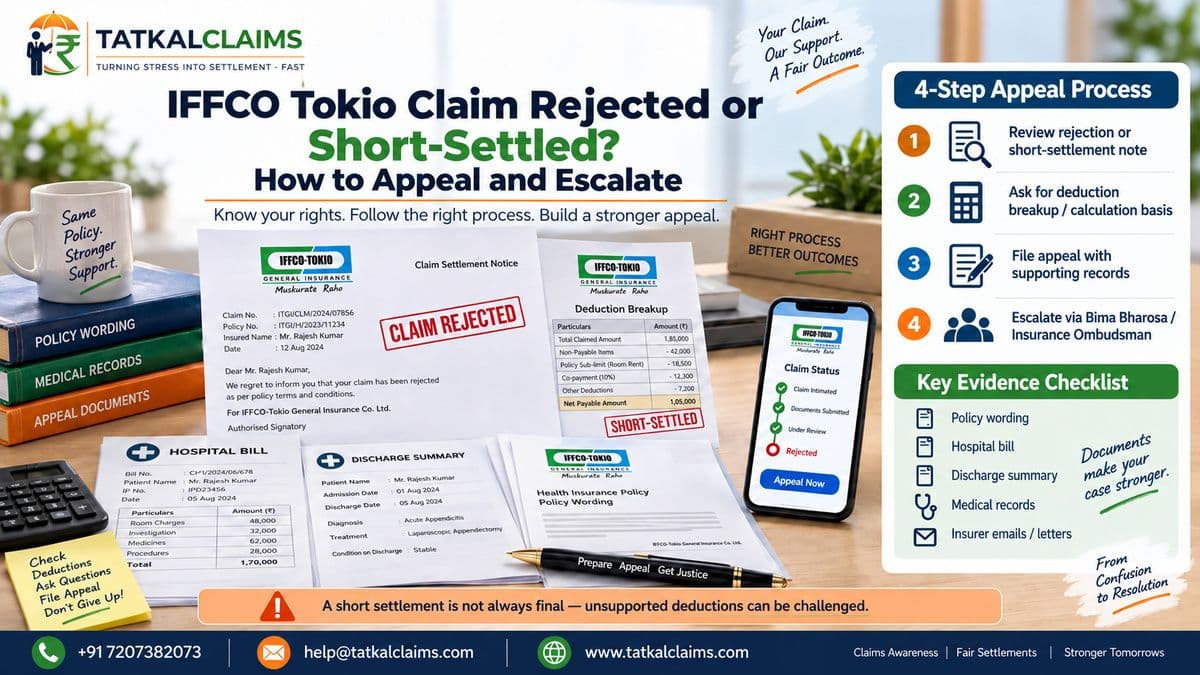
1. Identify the policy, claim number and decision being challenged. 2. Quote IFFCO Tokio's exact rejection reason or deduction. 3. Identify the policy clause, medical issue, survey conclusion or factual point in dispute. 4. Explain why that conclusion is incorrect or incomplete. 5. Attach numbered evidence addressing each point. 6. State the exact remedy requested: reconsideration, recalculation, payment, release of approved funds or a reasoned review. 7. Preserve every customer-support, Chief Grievance Officer, Bima Bharosa and Ombudsman acknowledgement.
Your 7-Day Action Plan After an IFFCO Tokio Claim Rejection
Day 1: Collect the policy, claim decision and settlement sheet. Day 2: Create the treatment, accident, theft or loss chronology. Day 3: Identify the exact disputed policy clause, medical conclusion, survey finding or deduction. Day 4: Obtain missing hospital, doctor, workshop, police, repair or payment evidence. Day 5: Draft the appeal with numbered evidence. Day 6: Submit it through the appropriate IFFCO Tokio grievance channel and preserve the service-request number. Day 7: Calendar the relevant IFFCO Tokio, Bima Bharosa and Ombudsman timelines.
When Tatkal Claims Can Help
Tatkal Claims can help review an IFFCO Tokio claim where the rejection reason is vague, medical reasoning appears inconsistent with the records, a PED or non-disclosure allegation is disputed, cashless has been denied and reimbursement is uncertain, the claim has been substantially short-settled, the survey assessment does not match the accident evidence, repeated documents are being requested, the insurer's reason changes or earlier grievance attempts have not resolved the dispute.
The review can focus on the policy wording, rejection clause, evidence gaps, medical records, survey assessment, deduction calculation and the appropriate escalation route.
No appeal or grievance process can guarantee claim payment. The outcome depends upon the exact policy wording, evidence, applicable regulations, limitation periods and the forum examining the dispute.
Frequently Asked Questions
Frequently asked questions
How do I complain about an IFFCO Tokio claim?
Start through IFFCO Tokio's customer-support channel at 1800-103-5499 or support@iffcotokio.co.in and preserve the service-request number. If the resolution is unsatisfactory, escalate the matter to its Chief Grievance Officer.
How do I contact IFFCO Tokio's Chief Grievance Officer?
IFFCO Tokio currently publishes chiefgrievanceofficer@iffcotokio.co.in for escalation to its Chief Grievance Officer, with contact number 0124-2850159. Check the insurer's current grievance page before submitting because the officer holding the role may change.
How long does IFFCO Tokio take to respond to a grievance?
Its current grievance page says the service TAT for resolving an initial concern is 4 working days. At the Chief Grievance Officer level, it states that a final response will be issued within 14 days from receipt of the complaint on that email address.
What are IFFCO Tokio's health cashless timelines?
IFFCO Tokio currently states 1 hour for initial cashless authorisation and 3 hours for final discharge authorisation, after receipt of the required documents.
How long should an IFFCO Tokio health reimbursement claim take?
IFFCO Tokio's current health-claims material states 15 days from receipt of all required documents for reimbursement claims.
What are IFFCO Tokio's motor survey and claim-decision timelines?
Current motor claim material states an initial survey within 24 hours from claim intimation, survey report within 15 days of allocation, and approval or rejection within 7 days from receipt of the survey report with all relevant claim documents.
Can I file reimbursement if IFFCO Tokio denied cashless treatment?
Potentially, yes. IFFCO Tokio's health-claim procedure says that if cashless is not approved, the patient may settle the hospital bill and apply for reimbursement, subject to the policy terms and claim assessment.
Can I complain through Bima Bharosa?
Yes. If the insurer grievance is unresolved or its response is unsatisfactory, Bima Bharosa provides IRDAI's grievance-registration and tracking mechanism.
Can an IFFCO Tokio claim dispute go to the Insurance Ombudsman?
Potentially, if the eligibility requirements are met. Current CIO guidance includes the prior-insurer complaint requirement, a ₹50 lakh monetary ceiling and the applicable one-year filing framework.
What should I attach to an IFFCO Tokio appeal?
Attach the policy, claim decision, chronology, earlier grievance correspondence and documents that directly answer the disputed reason. Health cases may require hospital and medical records; motor cases may require survey, photographs, repair, RC, licence, police and theft documents.
Sources
Disclaimer: This article is for general informational purposes and does not constitute legal, medical or financial advice. Insurance disputes depend on the exact policy wording, evidence, facts and applicable law.