
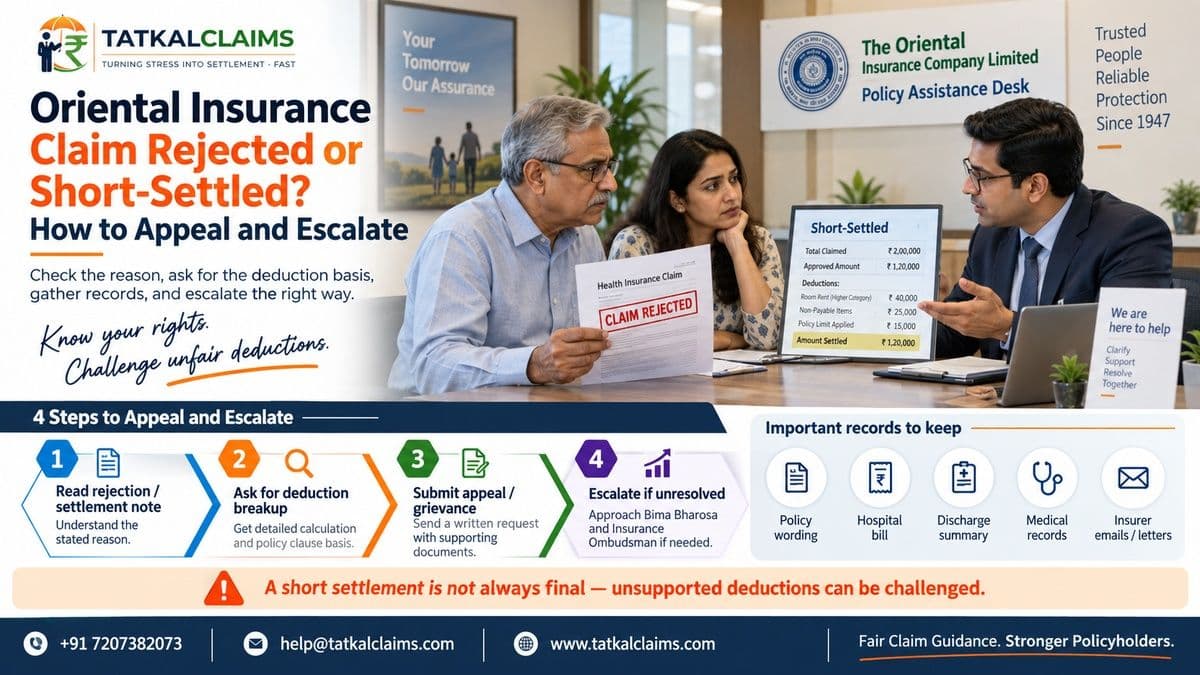
In an Oriental Insurance fire or property dispute, the rejection letter is only one part of the file. The real issue may be repeated document demands, a survey valuation, depreciation, salvage, ownership or co-ownership, underinsurance, or a disagreement over what was actually destroyed. Before escalating, rebuild the loss from the documents created at the time of the event and compare them with the surveyor's assessment and the policy wording.
First: Identify What Happened to Your Oriental Insurance Claim
| Claim problem | What it usually means | Best first move |
|---|---|---|
| Cashless health request denied | Cashless authorisation was refused; reimbursement may still require separate assessment | Get the denial reason and preserve the full hospital file |
| Reimbursement or indemnity claim rejected | A final adverse claim decision has been issued | Challenge the exact clause, medical finding or document deficiency |
| Claim partly paid | The claim was admitted but deductions, depreciation, limits or assessment reduced the payout | Ask for the calculation, survey/TPA basis and clause for each deduction |
| Claim pending | No final approval, repudiation or settlement has been communicated | Build a dated chronology and escalate the delay separately |
If you first need the general framework for challenging a repudiation, use our complete insurance claim rejection guide.
Step 1: Get the Rejection, Deduction or Delay Position in Writing
Record the policy number, claim number, date of loss or hospitalisation, amount claimed, amount approved, date of decision, and the exact rejection or deduction reason. If the claim team, TPA, surveyor or branch has communicated only a verbal explanation, ask for the written basis and the policy clause, medical reasoning or assessment relied upon.
Build a short chronology and a numbered evidence index. Do not simply resend the entire claim file. Link each disputed point to the document that answers it: medical records for a health dispute, repair and survey records for motor, or stock, valuation and loss records for property claims.
Step 2: Use Oriental Insurance’s Internal Grievance Route
Oriental Insurance’s current policy wording directs policyholders with grievances to the Policy Issuing Office or the Company’s grievance cells at Regional Office level. If the grievance remains unaddressed, the matter can be taken to the Customer Care Department at Head Office.
Oriental’s published customer-contact information lists csd@orientalinsurance.co.in for Customer Service and gro@orientalinsurance.co.in for grievance complaints, together with toll-free 1800 11 8485 and 011-33208485. The website also provides online grievance registration and status tracking. Because contact details can change, verify the current grievance page before a high-level escalation.
Carry the same claim number, complaint reference, chronology and requested remedy through every internal level. A single continuous trail is more useful than opening multiple complaints with different wording, because later forums will want to see what was raised with the insurer and how the insurer responded.
Health Claims: Challenge the Exact Medical or Policy Reason
If an Oriental health claim is rejected for pre-existing disease, non-disclosure, waiting period, medically unnecessary hospitalisation, diagnostic admission, missing documents or an exclusion, answer that specific reason. Compare the proposal disclosures and policy wording with the medical record the insurer relies on. Where the dispute is clinical, a treating-doctor clarification should explain the diagnosis, why admission or treatment was necessary, and the timeline supported by contemporaneous records.
If only cashless authorisation was denied, do not automatically treat that as final repudiation of reimbursement. Our cashless-to-reimbursement guide explains what to preserve and how the two stages differ.
Current IRDAI health guidance lists 15 days for settlement of claims other than cashless. For a delayed reimbursement claim, record when the complete claim file and every subsequent document were submitted so the delay can be measured against the applicable timeline.
If a health claim was admitted but short-settled, reconstruct the payout line by line. Separate co-pay, deductible, room-rent or proportionate deductions, sub-limits, non-payables and exclusions. Use our health-insurance short-settlement guide to audit the calculation before escalating.
Motor Claims: Rebuild the Survey and Coverage Analysis
For motor own-damage or theft disputes, identify whether the rejection concerns policy coverage, delayed intimation, driving licence, vehicle use, repair before inspection, theft documentation, depreciation, salvage or the surveyor’s assessment. Ask for the assessment basis where available and compare it with photographs, repair estimates, invoices, RC, driving licence, FIR and non-traceable records as relevant.
For theft claims, the chronology of police reporting, insurer intimation and non-traceable documentation can be critical. See our car-theft insurance claim process guide for the evidence sequence.
Fire, Property and Other General-Insurance Claims: Audit the Loss Assessment
For fire, burglary, shop, property or business-loss disputes, start with the repudiation or settlement letter and identify whether the disagreement concerns cause of loss, policy warranty, underinsurance, average clause, stock records, valuation, salvage, excluded property, delayed intimation or the surveyor’s quantification.
A useful Oriental example is the Oriental fire-claim delay case study. A 30-room ancestral house in Shimla was destroyed by fire while insured for ₹1.25 crore. Oriental kept the claim pending for nearly three years, raised repeated document and co-ownership objections, and its survey assessment reduced the net amount to about ₹80.17 lakh after a flat 50% depreciation and salvage deduction. The Shimla District Consumer Commission found deficiency in service and unfair trade practice and directed payment of the full ₹1.25 crore insured amount with compensation. The lesson is case-specific but practical: preserve proof that requested documents were already supplied, separate ownership issues from the insured interest actually accepted when the policy was issued, and demand the calculation behind depreciation or salvage rather than arguing only with the final figure.
Step 3: Escalate an Unresolved Oriental Insurance Grievance to Bima Bharosa
If Oriental Insurance does not resolve the complaint satisfactorily, the policyholder can use IRDAI’s Bima Bharosa grievance platform. A complaint registered there flows to the insurer’s system as well as the IRDAI repository, creating a trackable regulatory record.
Bima Bharosa should not be described as an automatic claim-payment order. Its role is grievance registration, tracking and regulatory monitoring. The current portal states that a complaint will be attended to within 14 days.
For the practical difference between regulatory grievance tracking and independent redressal, read Bima Bharosa vs Insurance Ombudsman.
Step 4: Check Whether the Insurance Ombudsman Fits Your Case
The Council for Insurance Ombudsmen says you should first complain to the insurer or insurance broker. If you are dissatisfied with the response, or there is no response within 30 days, an eligible complaint can be taken to the Ombudsman. Current CIO guidance states that the value of the claim including expenses should not exceed ₹50 lakh and that the complaint should be filed within one year from rejection, repudiation or partial settlement, subject to the applicable procedure.
The Ombudsman route is not mechanically available for every commercial policy. Current CIO procedure identifies eligible complainants including personal-lines policyholders, group policyholders, sole proprietorships and micro enterprises. It also says the same subject matter should not already have been taken to another forum, court or arbitrator.
If the Ombudsman route fits your case, use our step-by-step Insurance Ombudsman complaint guide for jurisdiction, documents and filing checks.
A Practical Oriental Insurance Appeal Structure
- Identify the policy, insured person or asset, claim number and exact decision you are challenging.
- Quote Oriental Insurance’s rejection reason, survey finding or disputed deduction exactly.
- Explain why the reason is factually, medically, technically or contractually incorrect.
- Attach a numbered evidence index that directly answers each disputed point.
- State the remedy you want: reconsideration, recalculation, reasoned review, release of pending payment or payment of the disputed admissible amount.
- Preserve every branch, Regional Office, Customer Care, Bima Bharosa and Ombudsman reference for the next stage.
Your 7-Day Action Plan After an Oriental Insurance Claim Rejection
Day 1: collect the policy schedule, wording and rejection or settlement letter. Day 2: build a dated claim chronology. Day 3: identify the exact disputed clause, medical conclusion, survey finding or deduction. Day 4: obtain the missing medical, technical, repair, police, stock or valuation evidence. Day 5: prepare a point-by-point representation. Day 6: submit it to the Policy Issuing Office or appropriate Oriental grievance channel and save proof. Day 7: calendar the insurer follow-up, Bima Bharosa and Ombudsman deadlines that may apply.
What Tatkal Claims Would Rebuild First in an Oriental Insurance File
For a fire or property claim, we would start with the event record, survey correspondence, document-request trail, insured value, loss assessment, ownership papers and the calculation used for depreciation, salvage or underinsurance. For motor claims, we would compare the survey with repair and causation evidence. For health claims, we would separate TPA processing from Oriental's final medical and contractual position. The purpose is to identify exactly where the insurer's assessment departs from the contemporaneous evidence or policy wording.
No appeal or claim-resolution service can guarantee payment. The outcome depends on the policy wording, facts, evidence, applicable regulations, limitation periods and the forum that ultimately reviews the dispute.
Frequently asked questions
Where should I first complain about a rejected Oriental Insurance claim?
Oriental Insurance’s current policy wording directs policyholders first to the Policy Issuing Office or the Company’s grievance cells, including Regional Office channels. If unresolved, the matter can be taken to the Customer Care Department at Head Office.
Can I register and track an Oriental Insurance grievance online?
Yes. Oriental Insurance’s customer-contact information provides an online grievance registration and status-tracking route in addition to email, telephone and branch channels.
What email can I use for an Oriental Insurance grievance?
Oriental Insurance publishes csd@orientalinsurance.co.in for Customer Service and lists gro@orientalinsurance.co.in for grievance complaints. Verify the current insurer grievance page before sending a high-level escalation because officer and contact details can change.
Does a denied Oriental cashless health request automatically reject reimbursement?
Not necessarily. Cashless is a settlement facility. Depending on the policy terms and facts, a reimbursement claim may still require separate assessment. Preserve the denial reason, hospital papers, bills and payment receipts.
Sources
Disclaimer: This article is for general informational purposes and does not constitute legal, medical or financial advice. Insurance disputes depend on the exact policy wording, claim type, evidence, facts and applicable law.