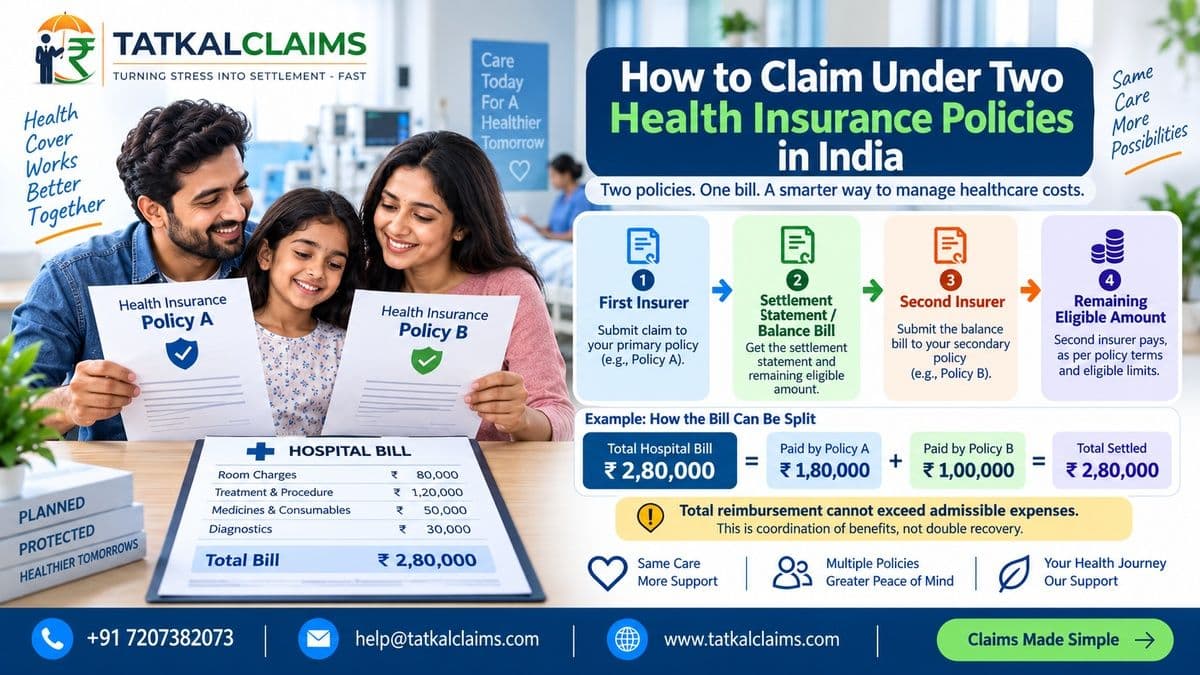

The hospital bill is ₹7.4 lakh. Your super top-up deductible is ₹5 lakh. So the arithmetic looks obvious: ₹2.4 lakh should come from the super top-up.
Then the claim is rejected—or the insurer says the deductible is still not exhausted. That is usually the moment people discover that a super top-up does not simply add up every rupee printed on every hospital invoice.
The trigger is normally built around admissible expenses under the super top-up policy, during its policy year, after applying its own waiting periods, exclusions, sub-limits, room-rent rules, non-medical deductions or other conditions. A ₹7.4 lakh bill can therefore produce a very different deductible calculation.
What a Super Top-Up Actually Does
A super top-up is an indemnity health cover that starts paying only after a specified deductible has been exhausted in the manner stated in the policy. The distinguishing feature is usually that the deductible is tested on an aggregate basis across eligible claims in the policy year, rather than separately against each hospitalisation.
HDFC ERGO’s current my:health Medisure Super Top Up wording defines Aggregate Deductible as a rupee amount of covered expenses that must be crossed before benefits become payable. It expressly says the deductible applies in aggregate to hospitalisation expenses that are admissible under that policy and not excluded, during the policy year.
The same wording says that for an individual policy the aggregation is for the insured person, while for a floater policy it is for the insured family.
Top-Up vs Super Top-Up: Why the Difference Matters in a Claim
| Feature | Regular top-up | Super top-up |
| How deductible is usually tested | Against each claim/event | Against aggregate eligible claims in the policy year |
| ₹3 lakh + ₹3 lakh claims with ₹5 lakh deductible | Neither claim may cross ₹5 lakh | Combined eligible claims may cross ₹5 lakh |
| Best evidence in dispute | Each claim calculation | Year-to-date deductible ledger |
| Main mistake | Assuming smaller claims will accumulate | Insurer or claimant failing to carry forward eligible amounts correctly |
Insurer product information from HDFC ERGO and ICICI Lombard currently describes super top-up deductibles on an aggregate annual basis. But the wording of your actual policy remains controlling.
A marketing label is not enough. If the schedule says “top-up” while the policy wording uses a per-claim deductible, do not assume annual aggregation merely because the brochure used the phrase “super top-up.”
The Most Important Word Is “Admissible”
Suppose the hospital raises a ₹4 lakh bill. If ₹45,000 is non-medical, ₹20,000 is outside a sub-limit, and another ₹15,000 is not payable under the wording, the amount that actually counts toward the super top-up deductible may be materially lower than ₹4 lakh.
This is why people can submit bills totalling more than the deductible and still be told that the deductible is not exhausted.
| Item | Hospital bill | Amount admissible under super top-up |
| Hospitalisation 1 | ₹3,00,000 | ₹2,60,000 |
| Hospitalisation 2 | ₹3,50,000 | ₹3,20,000 |
| Total | ₹6,50,000 | ₹5,80,000 |
| Annual deductible | ₹5,00,000 | |
| Amount above deductible before other limits | ₹80,000 |
In that example, the deductible is crossed by ₹80,000, not by ₹1.5 lakh. The precise payable amount can still change because of remaining sum insured, co-pay, benefit limits, waiting periods or other policy conditions.
If a large part of the gap comes from non-medical or consumable deductions, audit those separately using our Consumables and Non-Medical Deductions guide.
Multiple Hospitalisations: How the Annual Aggregate Should Be Tracked
A super top-up becomes most useful when no single admission is catastrophic but several eligible hospitalisations occur in the same policy year.
| Claim | Eligible amount | Cumulative eligible amount | Deductible left | Illustrative super top-up position |
| Claim 1 | ₹2.0 lakh | ₹2.0 lakh | ₹3.0 lakh | No payment |
| Claim 2 | ₹1.5 lakh | ₹3.5 lakh | ₹1.5 lakh | No payment |
| Claim 3 | ₹4.0 lakh | ₹7.5 lakh | ₹0 | ₹2.5 lakh potentially above deductible |
| Claim 4 | ₹3.0 lakh | ₹10.5 lakh | ₹0 | ₹3.0 lakh potentially payable, subject to policy |
A common operational problem is that the third claim is processed as though Claims 1 and 2 never happened. Keep settlement letters and admissibility workings for every earlier claim, even if the super top-up paid nothing at that time.
The deductible ledger should show: claim date, gross bill, admissible amount under the super top-up, cumulative admissible amount, deductible balance and super-top-up amount paid.
The Deductible Usually Resets With the Super Top-Up Policy Year
Aggregate deductible is normally tied to the super top-up policy year. It is not a lifetime threshold.
This becomes important when the base policy and super top-up have different renewal dates. A hospitalisation counted in the base policy’s year may fall into a different super-top-up policy year.
Do not prepare the deductible ledger from the base policy’s renewal date unless both policies actually align. Use the commencement date and policy-year definition in the super top-up schedule.
Do You Need a Base Health Policy for the Super Top-Up to Work?
Not universally. Current HDFC and ICICI product information states that a super top-up can be purchased without an existing base health policy. In that structure, the policyholder can meet the deductible from personal funds or other eligible insurance.
But some linked or group super-top-up products can expressly say that the cover becomes operational only after a specified basic cover is exhausted. That is a product-specific condition, not a universal definition of super top-up.
Therefore, if an insurer rejects your claim only because “base policy was not exhausted,” ask it to point to the exact clause in your own super top-up schedule/wording.
Can the Deductible Be Met Through Another Insurer or Employer Policy?
In many super top-up structures, the deductible is a threshold and does not have to be paid by one particular base insurer. It may be met by eligible medical expenses borne by another indemnity policy, an employer group cover or the insured personally, subject to the super top-up wording.
IRDAI’s current health-insurance framework also allows a policyholder holding multiple indemnity policies to choose the policy under which to claim, and the chosen primary insurer must coordinate with other insurers for the balance where applicable, subject to each policy’s terms.
For the broader coordination rule between multiple indemnity covers, see our Claim From Two Health Insurance Policies guide.
The Base Insurer Paid Only ₹3 Lakh of a ₹5 Lakh Bill. What Counts?
This is where many deductible disputes become messy.
The super top-up should not automatically treat the base insurer’s payment figure as the deductible contribution. Ask what the super top-up considers admissible under its own wording.
For example, the base insurer may pay less because its sum insured is exhausted, while the super top-up may still regard the underlying treatment expense as admissible. Conversely, the base insurer may pay an item that the super top-up expressly excludes.
IRDAI’s multiple-policy rules also recognise that an amount disallowed under one policy may still be claimed under another, subject to the second policy’s terms. The policies do not have to make identical admissibility decisions.
Family Floater: Does Everyone’s Claim Add Toward One Deductible?
It depends on the policy structure.
HDFC ERGO’s current super top-up wording expressly says the aggregate deductible applies to the insured family in the case of a floater policy, while it applies to the insured person for an individual policy.
That means a family-floater super top-up can, under such wording, combine eligible claims of different covered family members toward the family deductible.
| Member | Eligible claim | Cumulative family amount |
| Parent 1 | ₹2.25 lakh | ₹2.25 lakh |
| Parent 2 | ₹1.75 lakh | ₹4.00 lakh |
| Child | ₹2.00 lakh | ₹6.00 lakh |
| Position | ₹1.00 lakh above deductible before other policy limits |
Do not assume this for every product. Read whether the deductible is individual, per insured person, family floater, or subject to a separate certificate of insurance.
Why Cashless Coordination Can Fail Even When the Deductible Is Crossed
The base insurer and super-top-up insurer may not process the claim at the same time. One may be cashless and the other reimbursement. The super top-up may ask for the base insurer’s settlement letter or the year-to-date deductible ledger before authorising the excess.
This can leave the hospital asking the family to temporarily pay the gap even though the final combined insurance position should cover more.
IRDAI’s current framework says the primary indemnity insurer should coordinate with other insurers where the first policy’s available coverage is insufficient. In practice, keep both insurers informed from the start and ask the base insurer to share the final admissibility sheet promptly.
If cashless is denied while coverage may still exist, preserve the hospital documents and follow the reimbursement path explained in our Cashless Claim Rejected guide.
Crossing the Deductible Does Not Override Waiting Periods or Exclusions
A super top-up is still a health insurance policy. Its waiting periods, pre-existing disease terms, specific-disease waiting periods, exclusions, room eligibility, reasonable-and-customary limits and medical-necessity rules can still apply.
A ₹10 lakh admissible-looking hospital bill does not become payable merely because the deductible is ₹5 lakh if the treatment itself falls within a waiting period or exclusion under that super top-up.
This is also why having a base policy with longer continuity does not automatically transfer that continuity to a newly purchased super top-up. Check migration/portability and continuity credits in the super top-up documents rather than assuming the two policies share history.
Deductible and Sum Insured Are Different Numbers
The deductible is the threshold the insured absorbs before the super top-up pays. The sum insured is the maximum liability available after that trigger, subject to the policy.
A ₹5 lakh deductible with a ₹20 lakh super top-up does not mean total medical cover is ₹20 lakh including the first ₹5 lakh. The first ₹5 lakh must be dealt with separately; the ₹20 lakh super-top-up sum insured sits above the deductible under the policy structure.
HDFC ERGO’s current wording expressly says the aggregate deductible does not reduce the sum insured.
Co-Pay, Deductible and Non-Payables Can Stack
A super top-up may have an aggregate deductible and still contain a co-payment or other deduction. Those are separate cost-sharing mechanisms.
If the insurer applies both, ask for the sequence of calculation. You should be able to see the admissible amount, deductible exhaustion, co-pay, sub-limit and final payable amount as separate steps.
If the super top-up has paid but the amount looks wrong, use our Health Claim Short-Settlement guide to audit each deduction separately.
Common Reasons a Super Top-Up Claim Is Rejected or Underpaid
| Reason stated by insurer | What to verify |
| Deductible not exhausted | Was cumulative admissible amount calculated for the whole policy year? |
| Base policy not exhausted | Does your own wording actually require base exhaustion? |
| Earlier claim not counted | Was it admissible under the super top-up and in the same policy year? |
| Non-medical / excluded expenses | Were only inadmissible items removed, with a clear itemised calculation? |
| Waiting period / PED | Does the super top-up have its own continuity/waiting-period history? |
| Family member claims not aggregated | Is the super top-up a family floater or individual policy? |
| Claim fell in previous policy year | Check the super top-up renewal date, not only base-policy date. |
| Sum insured exhausted | Rebuild prior super-top-up payments and remaining SI. |
| Co-pay/sub-limit applied | Check the exact percentage/limit and calculation sequence. |
When a Super Top-Up Challenge Is Stronger
The insurer treats each hospitalisation separately even though the wording clearly provides an annual aggregate deductible.
An earlier eligible claim in the same super-top-up policy year has been omitted from the deductible ledger.
The policy is a family floater with a family aggregate deductible, but the insurer has treated each family member as having a separate deductible.
The insurer rejects because the base cover was not exhausted but cannot identify a clause requiring base exhaustion in that policy.
The insurer uses the base insurer’s paid amount as the deductible figure without assessing admissibility independently under the super-top-up wording.
The gross bill was reduced for non-payables, but the insurer cannot explain which items were removed or why.
The deductible calculation is being reset from the wrong date or ignores an earlier claim within the same policy year.
When the Claim May Be Difficult to Improve
The bills exceed the deductible only because they include expenses expressly excluded under the super top-up.
Earlier hospitalisations occurred outside the current super-top-up policy year.
The claimant is relying on a base policy’s continuity/waiting-period history that was never migrated or credited to the super top-up.
The policy expressly requires a linked base cover to be exhausted and that condition has not been met.
The policy is individual, but the claimant is adding another family member’s expenses to meet one person’s deductible.
The remaining sum insured under the super top-up is lower than the amount being claimed.
Documents to Collect Before Challenging the Deductible
| Document | Why it matters |
| Super top-up schedule + wording + endorsements | Controls deductible, floater structure, exclusions and policy year. |
| Base policy / employer cover schedule | Shows available underlying cover and renewal dates. |
| All hospital final bills in super-top-up policy year | Starting point for cumulative claim calculation. |
| Claim settlement letters from every insurer | Shows paid/disallowed amounts and reasons. |
| Detailed admissibility/deduction sheets | Separates gross bill from eligible amount. |
| Cashless authorisation/final authorisation | Shows what was accepted at each stage. |
| Non-medical deduction list | Explains amounts that may not consume deductible. |
| Previous super-top-up claim numbers | Helps insurer trace earlier deductible consumption. |
| Policy renewal history | Tests waiting periods/continuity and year boundaries. |
| Your deductible ledger | Shows cumulative eligible amount and remaining threshold. |
Use a Deductible Ledger, Not a Stack of Bills
| Claim date | Gross bill | Super-top-up admissible amount | Cumulative admissible | Deductible balance | Super-top-up paid |
| 10 Apr | ₹2,80,000 | ₹2,45,000 | ₹2,45,000 | ₹2,55,000 | ₹0 |
| 18 Aug | ₹1,90,000 | ₹1,70,000 | ₹4,15,000 | ₹85,000 | ₹0 |
| 03 Dec | ₹3,40,000 | ₹3,10,000 | ₹7,25,000 | ₹0 | ₹2,25,000 before other limits |
This makes the disagreement visible. If the insurer’s cumulative admissible amount differs from yours, the appeal becomes a specific accounting/policy dispute instead of a vague complaint that “my bills crossed ₹5 lakh.”
Questions to Put to the Super Top-Up Insurer
| 1 | What is the exact aggregate deductible shown in my schedule? |
| 2 | Is the deductible individual or family-floater based? |
| 3 | What is the current super-top-up policy year used for aggregation? |
| 4 | Which earlier claims in this policy year have been counted toward the deductible? |
| 5 | What admissible amount was recorded for each earlier claim? |
| 6 | Which expenses were excluded from deductible consumption and under what clause? |
| 7 | Does my policy require a specific base policy or exhaustion of base sum insured? If yes, please cite the clause. |
| 8 | What is the remaining deductible immediately before the present claim? |
| 9 | After the deductible is exhausted, what co-pay, sub-limit or other deduction is applied? |
| 10 | Please provide the complete claim calculation and year-to-date deductible ledger. |
How to Appeal a Super Top-Up Rejection
Start with the super top-up schedule—not the base policy. Identify deductible amount, policy year, individual/floater structure and any clause linking it to a base cover.
Then list every eligible hospitalisation in that super-top-up policy year and reconcile the gross bill to the admissible amount. Attach the earlier settlement letters even where the super top-up paid zero.
If the insurer’s calculation differs, challenge the first line where the two ledgers diverge. Do not simply say the deductible has been crossed.
If documents are being requested repeatedly, maintain a dated submission index.
For that process, use our Claim Query and Deficiency Letter guide so each submission remains traceable.
Ask the grievance team for a reasoned response that cites the exact deductible and admissibility clauses used.
When to Escalate Beyond the Insurer
A super top-up grievance is strongest when the arithmetic is already settled into a one-page ledger and the dispute is narrowed to a specific clause or excluded amount.
IRDAI’s current health-insurance framework requires insurers to communicate specific policy terms when a claim is repudiated or partially disallowed and provides for grievance escalation.
If the insurer maintains the denial after internal grievance, compare the available escalation routes in our Bima Bharosa vs Insurance Ombudsman guide and confirm current eligibility before filing.
How Tatkal Claims Can Help
Tatkal Claims can review the super top-up wording, base/employer policies, policy-year dates, hospital bills, settlement letters, admissibility sheets and prior claims to rebuild the deductible ledger and identify where the insurer’s trigger calculation may have gone wrong.
Where a documented issue exists, assistance can include preparing a claim-wise reconciliation, clause-by-clause representation and grievance escalation. We cannot promise payment: if the deductible has not been exhausted by expenses admissible under the super top-up, or the underlying treatment is excluded, the denial may be contractually sustainable.
Frequently Asked Questions
Frequently asked questions
What is an aggregate deductible in a super top-up policy?
It is the specified amount of eligible medical expenses that must be accumulated in the manner stated in the policy before the super top-up begins paying. It usually applies across admissible claims in the policy year rather than separately to each claim.
Do multiple hospitalisations count toward one super top-up deductible?
Usually yes where the wording provides an annual aggregate deductible. Each claim must still be admissible under the super top-up, and only the eligible amount may count.
Does the full hospital bill count toward the deductible?
Not necessarily. Current policy wording examples define the deductible by reference to covered/admissible expenses. Excluded, non-medical or otherwise non-payable amounts may not consume the deductible.
Is a base health insurance policy compulsory for a super top-up?
Not for every product. Some current standalone super top-ups can be purchased without a base policy, while certain linked or group products may expressly require a base cover or its exhaustion. Your own wording decides.
Can I meet the deductible using my employer health insurance?
Often the underlying eligible expenses can be met through employer cover, another indemnity policy or personal funds, subject to the super top-up wording. Keep the employer insurer’s settlement and deduction sheet as evidence.
In a family floater, do claims of different family members combine?
They can where the super top-up wording defines the aggregate deductible on a family-floater basis. HDFC ERGO’s current wording, for example, distinguishes individual-policy aggregation from insured-family aggregation. Check your schedule.
What happens when the deductible is crossed in the middle of a claim?
The amount of the eligible claim above the remaining deductible can become payable under the super top-up, subject to the remaining sum insured and all other policy terms.
Does the deductible reset every year?
Aggregate deductibles are generally tied to the super top-up policy year. Check the policy-year definition and renewal date; do not assume the base policy has the same year.
Can the insurer insist that my base policy must be fully exhausted first?
Only if that requirement follows from your actual policy structure or wording. Standalone super top-ups may not require a named base policy, while linked products can. Ask the insurer to cite the exact clause.
What is the strongest way to challenge a super top-up rejection?
Prepare a year-to-date ledger showing every claim, gross bill, super-top-up admissible amount, cumulative admissible amount, deductible balance and payment. Then challenge the first line where the insurer’s calculation differs from the policy or evidence.
Sources and Methodology
Disclaimer: This guide explains super top-up health insurance claim disputes in India in general terms. Deductible structure, policy year, individual/floater aggregation, base-policy linkage, waiting periods, admissibility, co-pay, sub-limits and exclusions vary by product. Examples are illustrative and do not guarantee payment. Always apply the wording and schedule issued for the specific claim. This is not legal, medical or financial advice for a particular case.