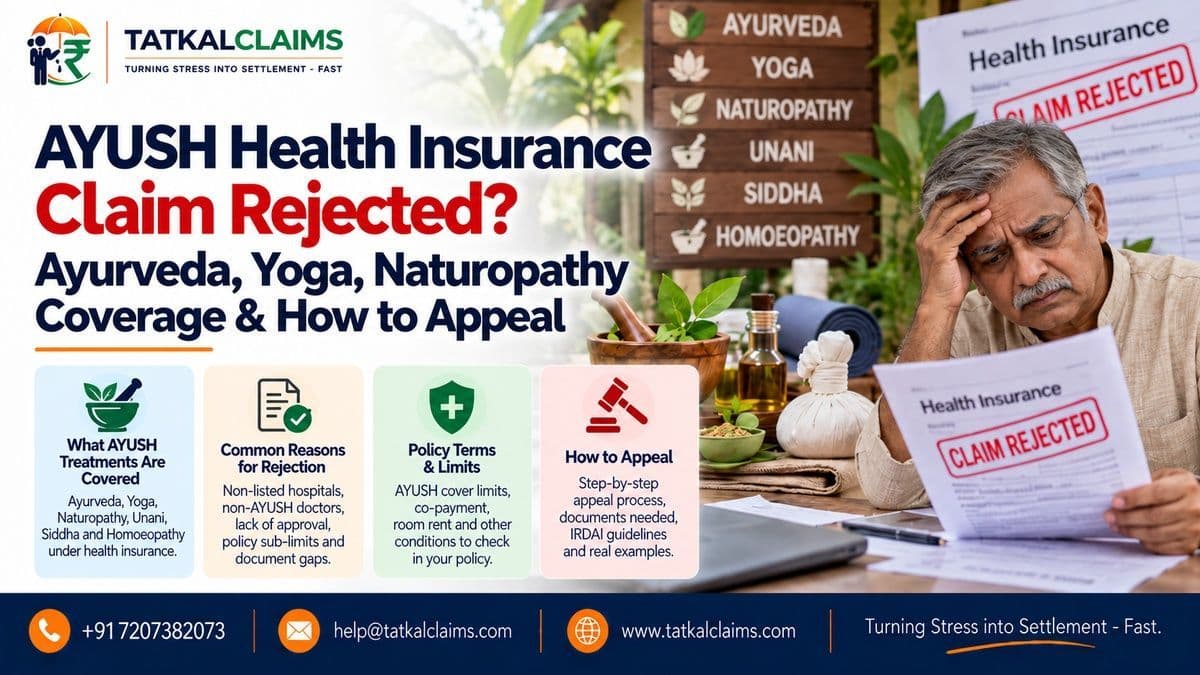
A family can spend days arranging an Ayurveda or other AYUSH admission, follow the doctor’s treatment plan, pay the hospital, and only then discover that the insurer is questioning the claim because the centre was “not an AYUSH Hospital,” the stay looked like wellness therapy, or the treatment was not covered in the way the family assumed.
That rejection can feel especially confusing after IRDAI’s 2024 direction to place AYUSH treatments at par with other treatments. The phrase “at par” is important—but it does not mean every AYUSH expense is automatically payable.
The real questions are more practical: Was the treatment medically necessary? Was it taken at a facility that meets the AYUSH Hospital or AYUSH Day Care definition? Does the policy cover inpatient, day-care or OPD AYUSH treatment? Was the illness subject to a waiting period or exclusion? And does the medical record show treatment rather than a wellness, rejuvenation or lifestyle package?
What Changed for AYUSH Insurance Coverage From 1 April 2024?
IRDAI issued specific AYUSH coverage guidelines on 31 January 2024, effective from 1 April 2024. The regulator said insurers should have a Board-approved policy for AYUSH coverage, including an approach to placing AYUSH treatments at par with other treatments and procedures for enrolling AYUSH hospitals and day-care centres for cashless treatment.
The same direction required insurers to modify existing health products that contained limitations on AYUSH treatment and to put controls and standard operating procedures in place for AYUSH network hospitals, treatment protocols and fraud prevention.
IRDAI’s later health-insurance guidance also says insurers should make available products/add-ons/riders that cater to all systems of medicine, including Allopathy and AYUSH. But the regulator also makes clear that not every single product has to contain every possible benefit.
Be Careful With Old Policy PDFs and Old Rejection Language
One of the most useful checks in an AYUSH rejection is the date of treatment and the version of the policy wording the insurer is relying on.
Some older policy documents contained AYUSH sub-limits or excluded systems such as Yoga and Naturopathy. After the 2024 circular, insurers issued product updates and AYUSH notes to bring affected products into compliance.
HDFC ERGO, for example, published an AYUSH note stating that for affected policies, medically necessary inpatient AYUSH treatment from 1 April 2024 would be covered by default up to the hospitalisation sum insured. Its current group-health wording expressly notes that AYUSH is no longer an optional cover under that product because of the 2024 circular.
What Counts as AYUSH Treatment?
IRDAI’s health-insurance FAQ describes AYUSH treatment as medical and/or hospitalisation treatment under Ayurveda, Yoga and Naturopathy, Unani, Siddha and Homeopathy systems.
That broad definition does not decide whether a specific expense is payable. The policy may distinguish inpatient care, day-care treatment and outpatient consultation. It may also require the treatment to be prescribed by a registered AYUSH medical practitioner and taken at a qualifying facility.
This is where families often get caught: they may hear “AYUSH covered” and assume consultations, medicines bought outside hospital, yoga sessions, massage, wellness stays or residential rejuvenation packages are all covered. They may not be.
The Facility Question: Was This Really an “AYUSH Hospital”?
This is one of the strongest technical rejection points insurers use, and it deserves to be checked carefully rather than dismissed.
Under IRDAI’s standard definition, an AYUSH Hospital can be a Central or State Government AYUSH hospital, a recognised teaching hospital attached to an AYUSH college, or a qualifying standalone/co-located AYUSH hospital.
For the standalone/co-located category, the standard definition includes requirements such as registration with local authorities where applicable, supervision by a qualified registered AYUSH medical practitioner, at least five inpatient beds, a qualified AYUSH practitioner in charge round the clock, dedicated therapy sections or an equipped operation theatre where required, and daily patient records accessible to the insurer.
| Evidence | Why it matters |
| Hospital registration / local licence | Shows the facility’s legal status. |
| AYUSH practitioner registration | Shows treatment was under a registered practitioner. |
| Bed strength | Relevant for the standard inpatient AYUSH Hospital definition. |
| 24-hour medical-in-charge details | Addresses the round-the-clock practitioner requirement. |
| Therapy / OT facilities | Supports the facility-definition requirements. |
| Daily treatment chart and case sheet | Shows real medical treatment and gives the insurer records to verify. |
| NABH/NQAS/other accreditation if applicable | May help with network or empanelment requirements, depending on the policy/insurer. |
What About AYUSH Day Care?
AYUSH day care is not simply “any treatment lasting less than 24 hours.” IRDAI has a separate AYUSH Day Care Centre definition.
A qualifying AYUSH Day Care Centre may include a CHC, PHC, dispensary, clinic, polyclinic or similar registered centre with facilities for treatment or interventions under a registered AYUSH practitioner, dedicated therapy sections or an equipped operating theatre where needed, and proper daily patient records.
Whether the insurer pays a specific AYUSH day-care procedure still depends on the policy. Do not assume that because the facility meets the day-care definition, every short-duration procedure is automatically covered.
If the insurer is rejecting because the stay was under 24 hours, also review our day-care and under-24-hours claim guide.
AYUSH OPD, Consultation and Medicines: Often a Different Question
A common misunderstanding is to treat AYUSH coverage as automatically including outpatient consultations and pharmacy purchases.
IRDAI’s own FAQ says inpatient and outpatient AYUSH coverage depends on the terms of the policy. Some products cover only inpatient AYUSH treatment; some may provide day-care or OPD benefits separately.
If the family paid for a doctor consultation, medicines, yoga sessions or therapies without an admissible inpatient/day-care event, first check whether the policy actually has an AYUSH OPD benefit before appealing the rejection.
Medical Treatment vs Wellness, Rejuvenation or Lifestyle Package
This is where the human story and the insurance file can look very different. A patient may genuinely feel better after Panchakarma, naturopathy or a residential Ayurveda programme—but the insurer will still ask whether the stay was medically necessary treatment for a diagnosed illness or a wellness/rejuvenation programme.
If the hospital bill bundles accommodation, diet, massage, yoga, detox, wellness counselling and treatment into one package, ask the provider to give a clinical breakup. The case sheet should identify the diagnosis, symptoms, treatment prescribed, procedures performed, medicines given and daily progress.
Do not try to relabel a wellness retreat as hospitalisation after the claim is rejected. The appeal should rely on what actually happened medically.
Can the Insurer Say the AYUSH Admission Was Not Medically Necessary?
Yes. AYUSH treatment being covered does not remove the ordinary requirement that hospitalisation or treatment be medically necessary under the policy.
If the insurer says the condition could have been managed as OPD, the strongest answer is not “the patient preferred Ayurveda.” It is the treating practitioner’s explanation of why inpatient or day-care management was required.
The record should connect the diagnosis to the treatment: symptoms, prior failed treatment if relevant, why the chosen therapy was needed, frequency and intensity of procedures, need for monitoring, and why outpatient care was not enough.
For a denial based on “unnecessary hospitalisation” or OPD-level care, use our medical-necessity rejection guide.
Do Waiting Periods and Pre-Existing Disease Rules Still Apply to AYUSH?
Yes. AYUSH treatment does not bypass the ordinary waiting-period structure of the health policy.
If the condition is pre-existing, falls within an initial waiting period, or is a named illness subject to a specific waiting period, the insurer may still apply that clause if it is valid and relevant to the claim.
The appeal should therefore separate two questions: first, is AYUSH treatment covered in principle; second, is this particular disease admissible on this date under the policy’s waiting-period rules?
What About Sub-Limits, Co-Pay, Deductibles and Room Limits?
The 2024 AYUSH direction targeted AYUSH-specific limitations and required insurers to bring their products into compliance. But that does not necessarily erase every ordinary cost-sharing term that applies across the health policy.
A general deductible, co-pay, base sum insured, room entitlement, non-medical deduction rule or policy-wide waiting period may still affect the payable amount if the clause lawfully applies to the claim.
If the insurer applies a special AYUSH-only cap to treatment taken after 1 April 2024, ask it to identify the current policy clause and explain how that clause complies with the 2024 regulatory change. Do not assume the cap is valid merely because it appears in an old brochure.
If the dispute is about deductions rather than total rejection, compare the bill with our non-medical and consumables deduction guide.
Can AYUSH Treatment Be Cashless?
Yes, where the insurer has an eligible AYUSH hospital/day-care centre in its network and the policy conditions are met. The 2024 IRDAI direction specifically required insurers to set quality parameters and procedures for enrolling AYUSH hospitals and day-care centres as network providers for cashless treatment.
But a cashless rejection is not the same as final claim rejection. If the facility is non-network or pre-authorisation fails, reimbursement may still be possible depending on the policy.
If cashless was denied but the treatment has already happened, use our cashless rejection and reimbursement guide.
Six AYUSH Claim Scenarios That Should Not Be Treated the Same
| Scenario | What to check first |
| Ayurveda inpatient claim rejected as “AYUSH not covered” | Policy version, post-April-2024 AYUSH update and current wording. |
| Treatment taken at a small local centre | Whether it meets the AYUSH Hospital or Day Care Centre definition. |
| Panchakarma package rejected as wellness | Diagnosis, medical necessity, daily case sheet and procedure breakup. |
| Yoga/Naturopathy rejected under old exclusion | Treatment date, updated post-2024 wording/endorsement and current product terms. |
| AYUSH stay rejected as OPD-level care | Why inpatient/day-care treatment was medically required. |
| Claim reduced by AYUSH-only sub-limit | Current policy clause, treatment date and compliance with the 2024 AYUSH direction. |
Documents to Collect Before You Appeal
| Document | Why it matters |
| Policy schedule + CIS + full wording | Shows the actual AYUSH benefit and current limits. |
| Any post-2024 endorsement / regulatory note | Critical where old wording differs from current treatment-date rules. |
| Hospital registration and facility credentials | Tests whether the centre qualifies as AYUSH Hospital/Day Care. |
| Treating AYUSH practitioner's registration | Shows treatment was under a qualified practitioner. |
| Admission note and diagnosis | Shows the medical reason for treatment. |
| Daily case sheet / therapy chart | Distinguishes treatment from a wellness stay. |
| Discharge summary | Connects diagnosis, treatment and outcome. |
| Itemised bill + receipts | Separates admissible treatment from package/non-medical items. |
| Investigation reports / prior records | Supports diagnosis and medical necessity. |
| Repudiation / deficiency letter | Shows the exact ground that must be answered. |
What to Ask the Insurer in Writing
Ask the insurer to identify the exact current clause relied on for rejection, not merely write “AYUSH not payable.”
If the facility is disputed, ask which element of the AYUSH Hospital or Day Care definition the insurer says is missing.
If medical necessity is disputed, ask for the medical opinion or claim-review note used to conclude that inpatient/day-care treatment was unnecessary.
If an AYUSH-specific cap is applied, ask for the policy wording effective on the treatment date and the basis for applying that limitation after the 2024 AYUSH coverage direction.
If the insurer relies on an internal medical opinion or undisclosed material, use our guide on obtaining the claim file, medical opinion and evidence relied on.
How to Write the Appeal Without Making It Sound Generic
Open with the exact rejection ground. Then quote the policy clause and the treatment-date wording that applies.
Next, explain the patient’s medical story briefly: diagnosis, why this system of treatment was selected, why inpatient/day-care treatment was required, what was actually done each day, and what records prove it.
Then deal with the technical issue directly. If the insurer says the centre was not an AYUSH Hospital, prove the facility criteria. If it says the stay was wellness, prove diagnosis and treatment. If it applies an old AYUSH cap, produce the current wording or post-2024 endorsement.
Do not fill the appeal with general statements about Ayurveda being recognised in India. Recognition of AYUSH does not answer the insurer’s specific contractual objection.
For the broader grievance structure, see our insurance claim rejection guide.
When to Escalate
If the insurer’s grievance response does not answer the policy version, facility criteria, medical evidence or regulatory update you raised, escalate through the insurer’s grievance process.
Bima Bharosa can be used for regulatory grievance escalation. The Insurance Ombudsman may also be available if the complaint falls within its jurisdiction and eligibility rules.
Before escalating, compare the two routes in our Bima Bharosa vs Insurance Ombudsman guide.
How Tatkal Claims Can Help
An AYUSH rejection often turns on one small piece of the file: an old policy version, a missing facility document, a vague discharge summary, or a treatment package that does not clearly separate medical therapy from wellness services.
Tatkal Claims can review the treatment-date policy wording, AYUSH endorsement, hospital credentials, practitioner registration, daily case records, bills, waiting periods and repudiation letter to identify whether the rejection is genuinely contractual or can be challenged.
The goal is not to argue that every Ayurveda, Yoga, Naturopathy, Unani, Siddha or Homeopathy expense must be paid. It is to show, with the right documents, when a medically necessary AYUSH claim fits the policy and when an insurer may be relying on outdated wording or an unsupported assumption.
Frequently Asked Questions
Frequently asked questions
Is AYUSH treatment covered by health insurance after the 2024 IRDAI circular?
IRDAI directed insurers to adopt a Board-approved approach to AYUSH coverage, place AYUSH at par with other treatments and modify products containing AYUSH limitations, effective 1 April 2024. The individual claim still depends on the issued policy terms and conditions.
Does AYUSH include Ayurveda, Yoga and Naturopathy?
IRDAI's definition includes Ayurveda, Yoga and Naturopathy, Unani, Siddha and Homeopathy. However, the payable treatment setting and expenses still depend on the policy.
Can my claim be rejected because the Ayurveda centre had fewer than five beds?
For a standalone/co-located inpatient AYUSH Hospital, the standard definition includes at least five inpatient beds along with other requirements. A day-care centre has a different definition, so the correct treatment setting must be checked.
Are Panchakarma treatments covered?
They can be payable where the policy covers the treatment, the facility qualifies, and the procedure is medically necessary and properly documented. A wellness or rejuvenation package should not be assumed to be an insurance-covered hospitalisation.
Are AYUSH OPD consultations and medicines covered?
Not automatically. IRDAI's FAQ says inpatient and outpatient AYUSH coverage depends on the policy terms. Many policies focus on inpatient treatment, while OPD may require a separate benefit.
Can an AYUSH claim be rejected as not medically necessary?
Yes. AYUSH coverage does not remove the policy's medical-necessity requirement. The treating practitioner's diagnosis, admission reason, daily treatment record and explanation of why OPD care was insufficient can be important.
Do pre-existing disease waiting periods apply to AYUSH claims?
Yes, unless the policy says otherwise. The system of medicine does not by itself bypass PED, initial or named-disease waiting periods.
Can the insurer still apply an AYUSH sub-limit after 1 April 2024?
If an AYUSH-specific limitation is applied, ask for the policy wording effective on the treatment date and how it aligns with IRDAI's 2024 direction requiring existing products with AYUSH limitations to be modified. The answer is policy- and date-specific.
Can AYUSH treatment be cashless?
Yes where an eligible AYUSH hospital/day-care centre is in the insurer's network and policy conditions are met. The 2024 IRDAI direction specifically addressed enrolment of AYUSH providers for cashless treatment.
What is the most important document in an AYUSH rejection appeal?
There is no single document, but the combination of the current policy wording, hospital/facility credentials and the daily medical case record often decides whether the rejection can be challenged.
Sources and Methodology
Disclaimer: AYUSH coverage is policy- and treatment-specific. IRDAI's 2024 AYUSH direction strengthened the regulatory framework, but it does not make every AYUSH consultation, medicine, wellness programme or non-qualifying facility automatically payable. The issued policy, treatment date, endorsements, AYUSH Hospital/Day Care criteria, diagnosis, medical necessity, waiting periods, bills and medical records control the individual claim. This is not medical, legal or insurance advice for a specific patient.