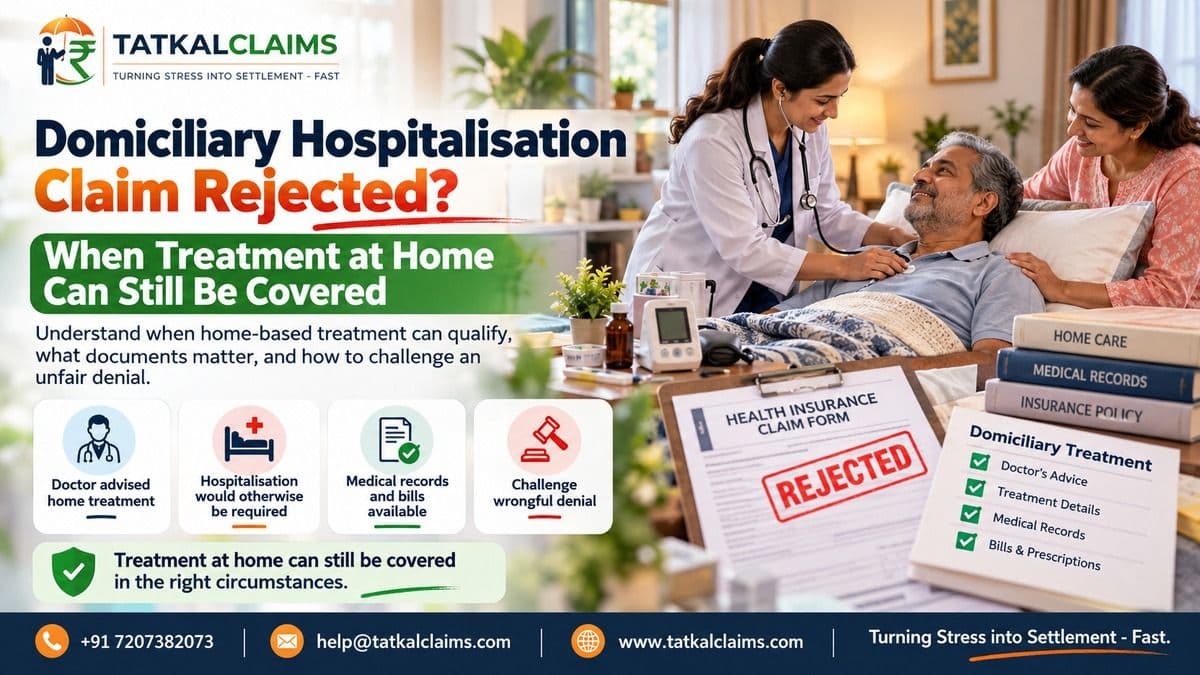
Your insurer has rejected a health claim because treatment was taken at home instead of in a hospital. Before assuming that every home-treatment claim is excluded—or that every medically supervised home treatment must be paid—identify what your policy actually calls the benefit.
Domiciliary hospitalisation is a specific insurance concept. Current health-policy wordings commonly describe it as treatment for an illness, disease or injury that would normally require hospital care but is actually taken at home because the patient cannot be moved to a hospital or because hospital accommodation is unavailable.
That is different from ordinary OPD care, routine home nursing, post-discharge recovery, teleconsultation, physiotherapy at home, or a separate 'home care treatment' benefit. The first task in any rejected claim is therefore classification: what benefit did you claim, what definition applies, and what evidence proves you met it?
What Domiciliary Hospitalisation Usually Means
Current insurer policy wordings continue to use a familiar two-part definition: the illness or injury would normally require care and treatment in a hospital, but the treatment is actually taken while confined at home because either the patient is not in a condition to be moved to hospital or a hospital room is not available.
That definition is important because domiciliary hospitalisation is not created merely by choosing home treatment for convenience. The policyholder normally has to show that hospital-level treatment was needed and that one of the permitted home-confinement circumstances existed.
IRDAI’s current Health Department guidance also makes an important portfolio-level point: insurers are expected to make products, add-ons or riders available across the market for different treatment situations including domiciliary hospitalisation, OPD, day care and home care. But IRDAI expressly notes that this does not mean one policy must contain every benefit. You must check your own product, schedule and endorsements.
| Question | Why it matters |
| Does your policy include domiciliary hospitalisation? | Some products include it, some make it optional, and some allow deletion or different limits. |
| Would the illness normally require hospital care? | Routine OPD-level treatment may not qualify. |
| Why was hospital treatment not feasible? | The policy may require inability to shift the patient or lack of hospital accommodation. |
| Were all benefit conditions met? | Written advice, monitoring records, minimum duration, sub-limit or reimbursement-only conditions may apply. |
Domiciliary Hospitalisation vs Home Care vs Day Care vs OPD
These terms sound similar but can have very different coverage rules.
| Type | Typical insurance meaning |
| Domiciliary hospitalisation | Hospital-level treatment taken at home because the patient cannot be moved or hospital accommodation is unavailable, subject to policy wording. |
| Home care treatment | A separate home-treatment benefit that may cover specified conditions or medically supervised treatment at home under its own rules. |
| Day care treatment | A procedure normally requiring hospitalisation but completed in less than 24 hours because of medical/technological advancement, usually in a hospital or day-care centre. |
| OPD treatment | Consultation, diagnostics, medicines or procedures that ordinarily do not require inpatient admission; payable only if the policy provides OPD cover. |
A policy may cover both domiciliary hospitalisation and home care treatment, but with different limits and documentation. Niva Bupa’s current product material, for example, can list domiciliary hospitalisation separately from home care treatment. Star Health product material also distinguishes the two. This is why a rejection cannot be evaluated from the words 'treated at home' alone.
The reverse is also true: a policy may cover home care for named treatments or conditions but not every form of domiciliary hospitalisation. Always identify the exact section under which the claim was lodged.
If the dispute is really about a procedure completed in under 24 hours rather than home treatment, that belongs under a separate day-care analysis. For broader rejection steps, use our insurance claim rejection guide.
What Policy Conditions Commonly Decide These Claims
The exact conditions vary by product. Current policy examples show why a generic checklist is unsafe.
One current HDFC ERGO Group Health Insurance wording includes domiciliary hospitalisation as a defined benefit but also shows that the cover can be deleted by option under that group product. A current Niva Bupa group policy wording requires medically necessary treatment, written medical advice, reasonable and customary charges, reimbursement treatment under the section and at least three consecutive days before the benefit becomes payable from day one.
Those examples do not mean every policy uses the same limits. They show the opposite: coverage is product-specific.
| Condition | Evidence to collect |
| Benefit exists and is in force | Policy wording, schedule, certificate and endorsements |
| Hospital-level treatment was medically necessary | Doctor’s detailed certificate, diagnosis, treatment plan and clinical notes |
| Patient could not be shifted | Doctor’s contemporaneous opinion explaining the medical risk of transfer |
| Hospital bed/room unavailable | Hospital refusal/non-availability record, emails, calls, portal screenshot or admission desk note |
| Written medical advice for home treatment | Prescription/advice dated before or at commencement of treatment |
| Minimum duration | Daily treatment record proving the required consecutive days, if your policy imposes one |
| Continuous active treatment/monitoring | Daily doctor/nurse chart, vitals, medication and procedure record |
| Reasonable and customary charges | Itemised bills, invoices, receipts and service-provider details |
| Sub-limit/co-pay/deductible | Policy schedule and benefit table |
| Reimbursement-only requirement | Claim form and proof of payment where cashless is not available |
When 'Patient Could Not Be Shifted' May Be the Core Issue
If your policy uses the standard-style circumstance that the patient was not in a condition to be removed to hospital, a vague certificate saying 'bed rest advised' may be too weak. The evidence should explain why transport or admission created a medical risk.
Useful records can include oxygen requirement, haemodynamic instability, severe neurological condition, infection-control concern, immobility, ambulance risk, treating-doctor notes or another clinically specific reason. The issue is not whether home felt more comfortable; it is whether the medical condition made removal to hospital inappropriate under the policy definition.
If the patient could safely travel for consultations, diagnostics and procedures throughout the claimed period, expect the insurer to ask why inpatient-level home confinement was medically necessary. Address that inconsistency directly rather than ignoring it.
When 'No Hospital Bed Was Available' Is the Core Issue
If you rely on non-availability of hospital accommodation, prove it contemporaneously. A later statement that 'beds were full' may be difficult to verify.
Collect admission-denial slips, emergency-desk notes, emails, SMS, WhatsApp messages, hospital portal screenshots, call logs, referral notes or any record showing attempts to secure admission. If multiple hospitals were contacted, preserve that chronology.
Also show that the patient still required hospital-level care. Bed shortage alone does not turn routine outpatient care into domiciliary hospitalisation.
What If You Simply Preferred Treatment at Home?
Preference, convenience, fear of infection, family support, distance from hospital or lower cost may be understandable reasons for choosing home treatment. But they do not automatically satisfy a domiciliary-hospitalisation definition that requires inability to move the patient or non-availability of hospital accommodation.
If your policy has a separate home-care benefit, the same treatment might still fit there. Check that section before abandoning the claim. A home-care clause may have its own list of covered treatments, service-provider rules, monitoring requirements or sub-limit.
Do not rewrite the facts after rejection. If home treatment was chosen voluntarily and no hospital admission was attempted, say so. Your strongest route may be under a different benefit rather than trying to manufacture a domiciliary circumstance.
Is There Always a Three-Day Rule?
No universal rule says every domiciliary claim in India must last more than three days. Some older mediclaim wordings and some current products impose a minimum duration. Other current wordings define domiciliary hospitalisation without placing the duration in the definition itself, while the benefit conditions may differ.
For example, Niva Bupa’s Xpress Health wording requires at least three consecutive days for that specific domiciliary benefit. By contrast, a current HDFC ERGO Group Health wording contains the benefit without the same three-day condition in the benefit clause shown there, while other options and limits can still apply.
The safe rule is simple: never quote 'three days' as an industry-wide IRDAI requirement unless your actual policy says so.
Which Home-Treatment Expenses May Be Payable?
Coverage depends on the benefit wording. Potentially admissible items can include doctor fees, nursing, medicines, diagnostic tests, oxygen, equipment or procedures if they fall within the covered medical expenses and satisfy the policy’s limits and exclusions.
But do not assume every home expense is reimbursable. Attendant charges, food, household expenses, rent for convenience equipment, non-medical consumables, general wellness items, long-term nursing or devices may be excluded or limited.
Ask for a line-item settlement sheet if the insurer accepts the domiciliary claim but deducts part of it. That then becomes a short-settlement dispute rather than a total-admissibility dispute.
If the claim is admitted but deductions are the problem, use our health-insurance short-settlement guide.
Common Reasons Insurers Reject Domiciliary Claims
| Insurer reason | What to check |
| Treatment did not require hospitalisation | Get the treating doctor to explain why inpatient-level care would normally have been required. |
| Patient could have been shifted | Provide contemporaneous medical evidence explaining transport/admission risk. |
| No proof of bed non-availability | Produce hospital refusal or admission-attempt records. |
| Home care chosen for convenience | Check whether a separate home-care benefit fits better. |
| Minimum duration not met | Read the exact policy condition; do not assume a universal minimum. |
| No daily monitoring / active treatment | Submit signed clinical chart, vitals, medications and procedure records. |
| Benefit not opted / deleted | Check schedule, certificate and endorsements. |
| Sub-limit exhausted | Reconcile benefit limit, prior claims and insurer calculation. |
| Expense outside covered heads | Compare each deduction with policy definition/exclusion. |
| Pre-existing disease/waiting-period issue | Treat this separately from the home-treatment eligibility question. |
A Consumer-Case Lesson: Evidence of the Domiciliary Circumstance Matters
In United India Insurance Co. Ltd. v. Rajesh Katiyar, decided by the NCDRC in 2018, the policyholder could not rely on the domiciliary benefit because there was no allegation or evidence that the patient could not be removed to hospital or that hospital accommodation was unavailable. The case involved an older policy and facts, so it should not be treated as a statement of every modern product’s conditions.
Its practical lesson is still useful: where the benefit is triggered by a specific home-confinement circumstance, the claimant must prove that circumstance. Evidence of medical expenditure alone may not be enough.
Build This Evidence File Before Appealing
| Document | Purpose |
| Policy schedule/certificate | Shows the product and benefit in force |
| Complete policy wording | Shows definition, conditions, sub-limit and exclusions |
| Doctor’s home-treatment advice | Shows medical recommendation and start date |
| Detailed medical-necessity certificate | Explains why hospital-level care was required |
| Reason patient could not be shifted | Supports the first domiciliary trigger where applicable |
| Hospital bed non-availability proof | Supports the second trigger where applicable |
| Daily treatment and monitoring chart | Shows active continuous treatment |
| Vitals / nursing notes | Shows clinical supervision |
| Prescriptions and investigation reports | Connect treatment to diagnosis |
| Itemised invoices and receipts | Proves amount claimed |
| Service-provider credentials | Supports legitimacy of nursing/medical services |
| Claim/TPA query history | Shows what was requested and when supplied |
| Repudiation letter | Identifies exact clause and insurer reasoning |
If the insurer relied on a medical opinion or internal assessment you have not seen, use our claim-file evidence guide.
How to Structure the Appeal
Start by quoting the exact domiciliary definition from your policy—not a definition copied from another insurer. Then address each requirement separately.
A strong chronology can be only one page: diagnosis date, doctor’s hospital-level treatment advice, reason hospital admission was not feasible, date home treatment began, daily monitoring period, date treatment ended, amount claimed, date claim submitted and repudiation reason.
Then answer the insurer’s reason directly. If it says the patient could have been shifted, attach the doctor’s contemporaneous explanation. If it says no bed shortage was proven, attach the hospital refusal record. If it says home treatment was only OPD care, show the intensity and continuity of treatment and why inpatient care would normally have been required.
Do not argue only that the treatment was successful at home. Success does not by itself prove that the policy’s domiciliary trigger was satisfied.
Sample Appeal Wording
A concise appeal can say: “My claim was rejected on the ground that treatment was taken at home. Clause ___ of my policy covers domiciliary hospitalisation where treatment that would normally require hospital care is taken at home because ___. The treating doctor’s record dated ___ states that hospital-level treatment was required and that ___ prevented hospital admission/transfer. The attached daily treatment chart, monitoring records, prescriptions and bills show continuous medically necessary treatment from ___ to ___. Please reconsider the claim under the domiciliary-hospitalisation benefit and identify any specific condition you say remains unmet.”
If the issue is bed non-availability, add the hospital admission-attempt evidence. If the issue is a benefit deletion or sub-limit, ask the insurer to point to the schedule or endorsement where that restriction appears.
Cashless or Reimbursement?
Many domiciliary benefits operate on reimbursement, though some modern home-treatment arrangements can support cashless service through designated providers. Do not assume the payment mode from the benefit name.
If you paid the doctor, nurse, pharmacy, diagnostics or home-care provider yourself, keep original bills and payment proof. If a network home-care service was used, preserve the authorisation and service-provider records.
If the file is stuck between the TPA and insurer rather than formally rejected, use our TPA delay/denial guide.
Escalation: Insurer GRO, Bima Bharosa and Ombudsman
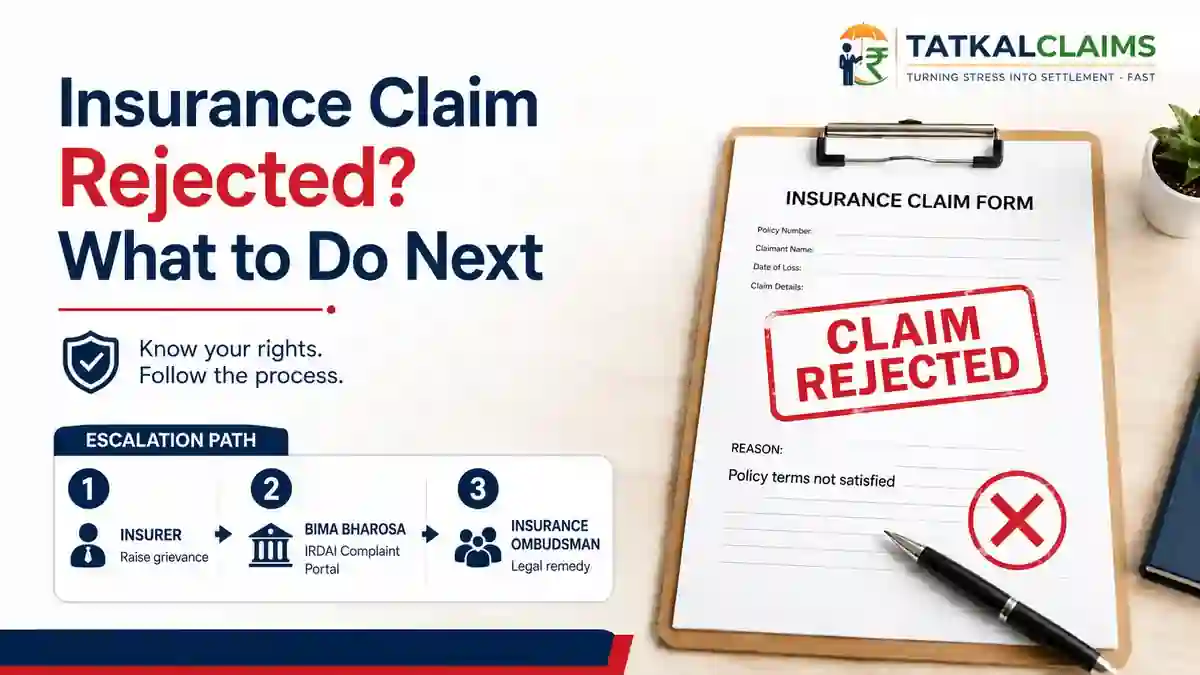
If the claims team does not correct an unsupported repudiation, raise a written grievance with the insurer’s Grievance Redressal Officer. Attach the policy clause, evidence chronology and the exact remedy you seek.
Bima Bharosa’s current FAQ says the insurer should resolve a grievance within 15 days of receipt. If the response is unsatisfactory or the grievance remains unresolved, you can use Bima Bharosa and consider other available redress routes.
The Insurance Ombudsman can hear eligible disputes involving total or partial claim repudiation and policy terms, subject to the current insurer-first, monetary, limitation and parallel-proceeding conditions.
Compare escalation routes in our Bima Bharosa vs Insurance Ombudsman guide.
For the Ombudsman process itself, use our Insurance Ombudsman complaint guide.
A Practical 7-Day Action Plan
| Day | Action |
| Day 1 | Collect the policy schedule, wording, endorsement and repudiation letter. |
| Day 2 | Identify the exact domiciliary definition and benefit conditions. |
| Day 3 | Get a detailed treating-doctor certificate explaining why hospital-level care was required and why admission/transfer was not feasible. |
| Day 4 | Collect bed non-availability evidence if that is the trigger you rely on. |
| Day 5 | Organise daily treatment/monitoring charts, prescriptions, tests and bills. |
| Day 6 | Send a clause-by-clause reconsideration request to insurer/GRO. |
| Day 7 | Prepare the Bima Bharosa/Ombudsman record if the insurer response remains unsatisfactory and the route is eligible. |
How Tatkal Claims Can Help
Tatkal Claims can review the policy wording, benefit schedule, doctor’s advice, home-treatment records, hospital admission attempts, TPA correspondence and repudiation reason to identify whether the claim genuinely fits domiciliary hospitalisation or a different home-treatment benefit.
Where an appeal is supportable, assistance can include building the medical chronology, matching each document to the policy definition, obtaining missing claim-file material, preparing the insurer grievance and organising the Bima Bharosa or Ombudsman record where eligible. If the facts do not meet the policy trigger, the review should identify that weakness rather than promise a result.
Frequently Asked Questions
Frequently asked questions
Is all treatment taken at home covered as domiciliary hospitalisation?
No. Domiciliary hospitalisation is a specific policy benefit. The treatment normally has to be of a kind that would require hospital care, and the policy may require that the patient could not be shifted or that hospital accommodation was unavailable.
Does IRDAI require every health policy to cover domiciliary hospitalisation?
IRDAI’s current health guidance requires insurers to make products, add-ons or riders available across treatment situations including domiciliary hospitalisation, but it also states that one product need not cater to every situation. Check your own policy.
Is domiciliary hospitalisation the same as home care treatment?
Not necessarily. Many products treat them as separate benefits with different definitions, conditions, lists of covered treatments or limits. Read the exact section under which your claim falls.
Do I need proof that no hospital bed was available?
If your claim relies on the policy trigger of non-availability of hospital accommodation, yes, contemporaneous proof can be important. Preserve admission refusal, hospital messages, call logs or other evidence.
What if the patient was too sick to be moved to hospital?
Get a detailed contemporaneous certificate from the treating doctor explaining the medical risk of transfer and why hospital-level treatment was required at home. A generic 'bed rest' note may not be enough.
Is there always a minimum three-day home-treatment requirement?
No universal three-day rule applies to every policy. Some products impose a minimum duration and others structure the benefit differently. Use the condition in your own policy.
Can ordinary home nursing after hospital discharge be claimed as domiciliary hospitalisation?
Not automatically. Post-discharge nursing or recovery may fall under a different benefit or may be excluded. Domiciliary hospitalisation usually requires the home treatment itself to substitute for hospital-level care under the policy definition.
Can I claim domiciliary treatment if I chose home care because it was cheaper?
Cost or convenience alone may not satisfy a domiciliary definition requiring inability to move the patient or lack of hospital accommodation. Check whether your policy has a separate home-care benefit.
What if the insurer accepts the claim but deducts many home-treatment expenses?
Ask for a line-item settlement sheet and compare each deduction with the domiciliary benefit, exclusions, sub-limits and covered medical-expense definition. That may be a short-settlement dispute rather than a total rejection.
Can I approach the Insurance Ombudsman for a domiciliary claim rejection?
Potentially, if the dispute falls within the Ombudsman Rules and the current insurer-first, monetary, limitation and parallel-proceeding conditions are met. First submit a written grievance to the insurer and preserve the response.
Sources and Methodology
Disclaimer: This guide explains current IRDAI policyholder guidance, selected current policy wordings and a past consumer decision in general terms. Domiciliary-hospitalisation coverage varies materially by product and can depend on the policy schedule, endorsements, medical necessity, reason hospital treatment was not feasible, treatment duration, monitoring records, sub-limits, exclusions and claim evidence. This is not a substitute for case-specific legal or medical advice.